

Stop making every agent start from zero. Independent by default. Collaborative when it counts. Trusted because it’s provenanced. Powered by @origin_trail $TRAC.
Joined September 2015
- Tweets10.4K
- Following228
- Followers2K
- Likes39.9K




Pinned Tweet
✅ Data privacy and sovereignty
✅ Fights AI harm with verifiable context and knowledge
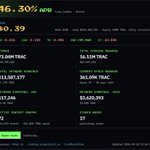
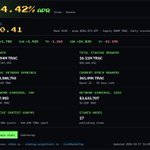
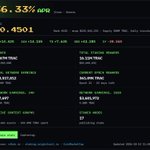
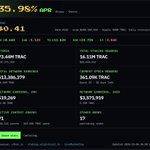
✅ 33% APR from paying customers using the product
✅ Zero inflation since 2018, fully circulating
@origin_trail $TRAC Is finally getting the attention it deserves


My first in a new series of three articles that introduces and educates the masses about the OriginTrail DKG, the native $TRAC token at its center, and a new startup that is using both to actively combat the dark side of AI.
Enjoy.
This is the part most people skip. An AI answer is only as good as where its facts came from.
On the @origin_trail DKG every Knowledge Asset carries who published it, when, and proof it hasn't been changed. So an agent can check before it answers instead of guessing.
And every write is paid in $TRAC.

Before an AI answer reaches you, OriginTrail (@origin_trail) wants receipts: who published each fact, when, and proof it is unchanged.
Publish, cite, check: how answers get checked on the DKG (Decentralized Knowledge Graph).
1. The problem
Generative AI predicts answers. OriginTrail's whitepaper calls a wrong prediction a "hallucination" and says answers based on "known sources that we can check" are the most effective way to manage it: publisher identity, time of publishing, content.
2. Step one: publish the fact
The unit is the Knowledge Asset, "a named contribution that others can use and build on." It climbs three layers: Working Memory, Shared Working Memory, Verifiable Memory (publication: one ERC-721 token minted, publisher paying in TRAC, content committed by a blockchain-anchored Merkle root).
3. Step two: retrieve, then cite
In RAG (retrieval-augmented generation), facts are fetched before the model writes; the whitepaper's dRAG (decentralized RAG) pulls them from the DKG. Each fact is cited by its UAL (Universal Asset Locator), an address stable across updates, with the version or commitment noted when exact content matters.
4. Step three: check it
Each published version is bound to its on-chain commitment, so "later updates cannot silently rewrite its history": agents "verify the content against that commitment instead of trusting a data provider." The docs grade claims on a six-rung trust ladder, draft to consensus-verified, and ask that answers report the checks done.
5. Show the trail
OriginTrail's pattern: publish context as Knowledge Assets, make retrieval auditable, so the agent can "point directly to the knowledge it used," and verify before high-stakes actions. The gut check: "Can I see the trail behind this answer?" By February 2026 the DKG had 2 billion Knowledge Assets published.
The Fine Print
• What gets verified: who published a fact, when, and that its published version is unchanged; only published Knowledge Assets are chain-anchored, drafts sit on the lowest rung, and endorsed and quorum rungs follow each graph's policy. In the docs' words, a commitment "does not establish factual truth"; it lets readers check integrity and attribution.
• dRAG is the whitepaper's name for the retrieval design (v3, pre-publication); the memory layers, UAL citation and trust ladder come from the V10 docs and repository.
In Plain English
• A normal AI answer says: trust the model. A DKG-backed answer points to a record: named publisher, exact version, an on-chain commitment to check, and a note of the checks actually done.
Why This Is Bullish
• Every Knowledge Asset published is paid for in TRAC, and 2 billion are published: the token pays to publish checkable facts.
My Take:
Chatbots have confidence; the DKG has receipts. The answer you'd let near money, compliance or code shows where its facts came from and proves nobody touched them since.
If an AI gave you a number your money depended on, would you ask who published it, and which version, or is a confident answer enough?
$TRAC
You Ask, I Research. Questions welcome.
Follow @BullsCryptolife for free sourced crypto breakdowns.
Sources in the first comment ↓
BRX retweeted

Open DKG PR #3389: if an async share's enqueue and replay replies are lost, a client can lack a job ID though the share ran. A read-only lookup checks stored seal evidence. A match names one successful job; else it's unproven. No outcome authorizes a write.
#OriginTrail #DKG

BRX retweeted
DKG #3375 on testnet-canary: testnet Cores took 7 to 52 min to reach a new graph's owner, so a relay-only member's first write was refused. Now the owner's Edge offers a tie, and a Core accepts it only if the graph-id wallet signed it and it names the sender.
#OriginTrail #DKG

DKG 10.0.25 just landed on testnet-canary and this one is for builders. Local queries now get a hard cap (2s, 8,192 rows), and when a read fails it tells you why: denied, timed out, or too big. Empty now just means no rows.
Sounds boring, but an agent that can tell "no data" from "blocked" stops guessing. That's how agents on @origin_trail get reliable. $TRAC

DKG 10.0.25 changelog is now on testnet-canary. Builder detail: POST /api/query/bounded caps a local SELECT at 2,000 ms and 8,192 rows, and a failed read says why: 403 denied, 503 past deadline, 422 too large. There, empty just means no rows.
#OriginTrail #DKG

BRX retweeted

Practical tip: before your #AI agent touches an exchange API, install #Blackbox and switch on Trader Shield (beta). One command sets up @NousResearch's Hermes Agent, the plugin and a #DKG node.
👉 - curl -fsSL blackbox.umanitek.ai | bash
⭐ Star Agent Blackbox: github.com/umanitek/agent-bl…
🛡️ Install in one line: curl -fsSL blackbox.umanitek.ai | bash
📖 How it works: umanitek.ai/blackbox
This is the risk people skip with AI trading agents. The agent can be smart and still get tricked by one bad package or a poisoned prompt.
Blackbox from @umanitek now plugs into @NousResearch Hermes Agent and checks each action before it runs, against threat data living on the @origin_trail DKG. Trader Shield (beta) also keeps the agent away from wallet key files and seed phrases.
Every one of those checks is a lookup on a shared, verifiable graph. That's real usage for $TRAC, not a whitepaper promise.

Safer AI trading, on TRAC(k)
Blackbox by @umanitek is now a @NousResearch Hermes Agent plugin.
Each action is checked before it runs, against verifiable threat data on Decentralized Knowledge Graph.
Prompt injection, bad packages, drainers: flagged or blocked.
Trust the source.
Good list, and usage is the right question.
For $TRAC the usage is easy to point at. Every time someone publishes a Knowledge Asset on the @origin_trail DKG it gets paid in TRAC, and that flows to the nodes and stakers securing the network.
Agents need memory they can check, not just inference. That's the piece I'm watching.

The crypto AI agent sector sits at around $3.4B.
$HYPE alone is worth nearly 6x at roughly $17B.
AI agents were a big topic at TOKEN2049, but I'm more interested in which projects can turn the attention into actual usage.
Interesting Five I'm watching:
→ $VVV ($1.16B): Private AI inference and API access.
→ $VIRTUAL ($437M): Tools for building and monetizing AI agents.
→ $KITE ($281M): Payments and identity for autonomous agents.
→ $TRAC ($177M): Verifiable data for AI agents.
→ $RLC ($61M): Confidential computing for AI applications.
These are very different bets, and their market caps don't tell us which one has the strongest product.
The sector is still small. I'm watching to see which projects earn a place in the stack.

BRX retweeted

$ICP at #1 fits the scope of what they’re building.
@origin_trail staying high relative to size is the more interesting tell - provenance and knowledge graphs matter once AI systems need auditable data.
Rank is a useful filter, not a valuation shortcut.

🧑💻 Here are crypto’s top 10 AI & Big Data projects by development. Directional indicators represent each project’s ranking positioning since last update:
📈 1) @dfinity $ICP🥇
📉 2) @origin_trail $TRAC 🥈
📉 3) @chainlink $LINK 🥉
📈 4) @nearprotocol near:native
📈 5) @phalanetwork ethereum:0x6c5ba91642f10282b576d91922ae6448c9d52f4e
📈 6) @filecoin filecoin:native
📈 7) @oasisprotocol $ROSE
📈 8) @swarms_corp $SWARMS
📉 9) @injective $INJ
📉 10) @livepeer ethereum:0x58b6a8a3302369daec383334672404ee733ab239
📖 Read about the @SantimentData methodology for filtering notable github activity data from project repositories, and why it is so useful for crypto trading: medium.com/santiment/a-diffe…
🔖 Bookmark our AI watchlist here, and see what others in crypto can’t: app.santiment.net/screener/a…

BRX retweeted

A supply teacher in Salford turned pupils' social media photos into AI sexualised fakes and shared them on X, as BBC News reported. Images like these should be flagged before parents find them. @umanitek Guardian spots them early and logs the evidence on @origin_trail's DKG.
BRX retweeted
Before you give an agent shell access, ask one question: what checks each action before it runs? If the answer is nothing, start here:
✅ - Open source
✅ - Verifiable on @origin_trail's #DKG
👉 - github.com/umanitek/agent-bl…
Good point from woisau. Private AI shouldn't mean trust me bro AI.
On the @origin_trail DKG a Knowledge Asset can keep its private data on your own node while a fingerprint of it gets anchored on chain. The data never leaves you, but whoever you share it with can check it wasn't changed.
That's the setup an AI in your pocket actually needs. $TRAC

Private AI only works if you can still trust what it knows. Keep the data local, but anchor proof of where the knowledge came from. The @origin_trail DKG supports private Knowledge Assets that stay verifiable, a natural fit for AI in your pocket. $TRAC origintrail.io

This is the part people skip. The use cases are boring on purpose.
AURORAI is an EU funded project (€6.9M, Horizon Europe) planning a DKG backed data layer for pandemic preparedness AI. Donated hemophilia therapy through the WFH aid program is another one @origin_trail has highlighted.
Nobody pays for that to pump a chart. They pay because wrong data hurts people. $TRAC


Checked the @origin_trail numbers this morning.
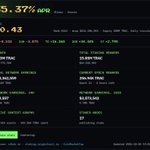
114,670 assets across 72 active context graphs on the DKG, and about 10M $TRAC in network earnings over the last year. Every write to the network is paid in TRAC, so that number is real usage, not hype.
Stats card from dkgswarm.com/stats
ethereum:0xaa7a9ca87d3694b5755f213b5d04094b8d0f0a6f

BRX retweeted
Neural for the guesses, symbolic for the ground truth. An agent whose threat intel sits on the DKG can be checked, not just trusted. That is the architecture agents touching real infrastructure actually need.
This framing lands. A network of agents building a shared, verifiable threat library on the DKG is stronger than any single plugin. Neural plus symbolic on checkable knowledge. @origin_trail $TRAC origintrail.io
Good weekly roundup. The common thread is trusted data where mistakes cost real money.
BUILDCHAIN uses the DKG so building records can be verified, not just stored. Blackbox from @umanitek sits in the Hermes plugin catalog and checks agent tool calls against a DKG threat graph.
Different industries, same rails. $TRAC @origin_trail

🧠 $TRAC (@origin_trail) WEEKLY UPDATE
OriginTrail continued highlighting real-world use cases for verifiable AI and trusted data this week.
🔹 1. BUILDCHAIN & Digital Building Records
OriginTrail highlighted how the Decentralized Knowledge Graph (DKG) can support tamper-evident building records, helping architects, owners and regulators verify information throughout a building’s lifecycle.
🔹 2. Healthcare Data & AURORAI
The project spotlighted AURORAI, a €6.9M Horizon Europe initiative using the DKG as a trusted data layer for AI-powered pandemic preparedness. Data provenance is crucial when AI supports public-health decisions.
🔹 3. AidTrust & Medicine Traceability
OriginTrail showcased AidTrust’s use in humanitarian healthcare, helping track donated medicines through distribution and treatment centres. The case demonstrates how verifiable records can improve transparency and reduce diversion or waste.
🔹 4. AI Safety Through Umanitek
The ecosystem continued promoting Guardian, which uses connected data and verifiable evidence to help detect impersonation, scams and AI-driven online harm.
📊 PRICE CHECK
$TRAC closed around $0.417 on Oct 11 and $0.401 on Oct 17, a decline of roughly 3.8% over the period. It briefly climbed near $0.44 midweek before pulling back.
🎯 WHAT TO WATCH NEXT
The major potential catalyst remains the NeuroSymbolic Marketplace’s planned mainnet rollout, designed to enable TRAC payments for metered AI inference and queries. The key question is whether real usage translates into sustained on-chain demand.
Bottom line: This week’s strongest story was ecosystem utility—not a confirmed new tokenomics announcement. Mainnet delivery and measurable marketplace activity are the next things to watch.
#OriginTrail #TRAC #AI #DePIN

BRX retweeted

OriginTrail Korea 위클리 리캡 10월 셋째 주
👉 DKG로 AI 판단의 출처·변경 이력을 검증합니다.
👉 BUILDCHAIN은 건물 기록을 검증 가능한 데이터로 연결합니다.
👉 BlackBox는 Hermes Agent 지원으로 AI 보안을 강화했습니다.

Quiet Sunday so here's the TRAC story from this week I think people slept on.
@umanitek Blackbox landed in the @NousResearch Hermes Agent plugins catalog. Before an agent runs a tool call, it gets checked against threat intel on the @origin_trail DKG plus local rules.
Audit mode just records. Block mode refuses anything at or above the severity you set. Then Trader Shield was built on top to keep trading agents away from your wallets, seed phrases and exchange keys.
Why I care as a node runner: that's an agent product people can install today that leans on the DKG for its data. More of that is the whole point of the network.
ethereum:0xaa7a9ca87d3694b5755f213b5d04094b8d0f0a6f