

Terrorologist/PCVE Specialist | Security & Political Analyst |Founder of AMNI Center for Security Study| Retweets aren’t endorsement.
Eyl
Joined September 2012
- Tweets4.4K
- Following960
- Followers2.2K
- Likes5.8K




Pinned Tweet
I utterly condemn the killing of an innocent young Doctor Dr Zakariye in Galkao. It’s heinous & unprecedented crime its kind in Puntland. Giving into urges, perpetrator must face hard justice - Somalia has become a place where knowledge and peace consider as threat.


This is evidence of how federalism has become embedded in Somalia’s political power-sharing system.
Beyond preventing the concentration of power in a single authority, federalism enables member states to exercise greater control over their representation and political interests within the Federal Government.
South West State has become a critical test ground for determining whether federalism in Somalia is merely a symbolic political arrangement or a system genuinely rooted in the country’s evolving political culture and institutional practices. Thus, South West has demonstrated that federalism is the only system through which it can share power with the rest of Somalia, period.

Waa soo dhawaynayaa Mooryaanta iyo Turkida xaaraanta is wata in dhulka laga hoos mariyo!

With all respect, the time for proposing solutions has passed, and the situation has escalated beyond the point where conventional political mediation is likely to be effective. Hassan has effectively declared a political confrontation with Somalia over the electoral process. If the country proceeds with a nationally agreed election, challenging his hardline position at this stage may come at an unacceptable human cost, potentially involving further bloodshed. Unfortunately, the opportunity to prevent such an outcome may already have been lost.
There was an earlier opportunity to hold Hassan accountable for his commitments and the agreements reached. However, you and Sharif Sakiin chose to give him political cover, allegedly prioritising personal and financial interests over the broader national interest.
At this stage, any attempt to mediate or broker an agreement between Hassan and those opposing him is unlikely to yield meaningful results. The period for political manoeuvring has passed. My recommendation is that you step aside and allow the genuine oppositions to take the lead.
You cannot credibly present yourself as part of the solution when your own actions have contributed to the problem. It is time to acknowledge that reality and allow those who remain committed to holding Hassan accountable to determine the way forward.

There is a broad agreement that the health and stability of our periodic national elections, including the coming one, lies in a free, fair and direct voting system. The question is how smoothly can we move towards that direction without any side trying to gain tactical advantage over the other side. It is essential, therefore, to handle this process with maturity and in an inclusive manner so we can set it as a threshold for all that follows
Othman retweeted

Puntland First, this is our time, the future is here. No more waiting on distant throne!

#Somalis: this is our time 🕰️
Wake up #Somalis
Wake up #today
We have the land
We have the sea &
We have the strength to rise.
🤔
youtu.be/Hes1LiWUwDc

Othman retweeted

I read Ismail H. Warsame’s article, “Grievance Is Not a Mandate”, and found its portrayal of Puntland’s position deeply unfair and rather dismissive.
It downplays the fundamental problems that emerged with the federal arrangement back in 2012, during HSM’s first administration. Puntland’s letter was the culmination of a prolonged political and institutional conflict, not some sudden expression of “frustration” or “grievances” following the March 2024 constitutional amendments, nor merely a negotiating tactic aimed at the UN.
Frankly, I find that framing deeply disrespectful to the innocent people of Puntland who have suffered the consequences of the FGS’s coercive tactics over the years.
I know something of those consequences personally. One of my own relatives was devastated when she was unable to continue her education after secondary school. And what about the development projects that were obstructed or suspended, to name just a few examples? These are real people, lost opportunities and lasting consequences, not merely political grievances to be casually brushed aside.
Perhaps it is time for a proper cost–benefit analysis.
If the original investment was a poor one, that is hardly an argument for committing yet another generation to paying for it. In economics, we call that the sunk-cost fallacy. In politics, apparently, we call it preserving national unity.
Our generation is still paying the price for decisions made by previous generations, and I see no reason why we should continue sacrificing our future to sustain a political arrangement that has repeatedly failed to deliver.
The old one-size-fits-all mentality has had its day. And historical sacrifices, however significant, are not a permanent mandate to decide the future of generations yet to come.
The founders made their choices in 1998. Our generation has the right to make its own.
Curiously, the author insists that secession is not the majority view in Puntland, while simultaneously criticising Deni for making claims about public sentiment without a referendum or polling.
Where, then, is the evidence for his own assertion?
Surely, the same democratic standard must apply to both sides.
Nor should anyone assume that the people of Puntland will simply accept another political arrangement negotiated over their heads. Every society should have a say in determining the political system best suited to its circumstances and aspirations.
As for confederation, I find the renewed enthusiasm rather predictable.
Some of us @FarahJuxa proposed precisely that arrangement years ago, only to be dismissed or accused of advocating secession. xitter.cf/farahjuxa/status/19232…
xitter.cf/dahirseed/status/19839…
Even Adeer @alihwarsame was critical of the proposal, if I recall correctly.
Confederation might have been a reasonable compromise years ago. Today, it increasingly resembles a last-minute attempt to preserve a political structure whose foundations have already given way.
And no, Puntland does not need to actively pursue separation for the existing arrangement to collapse. It seems perfectly capable of achieving that through its own failures and political miscalculations.
One must admire the consistency, if nothing else.
Puntland has no moral or legal obligation to rescue a failing political arrangement.
Ultimately, our first responsibility is to the people of Puntland, their rights, their interests and the future they choose for themselves.
Grievance is not a mandate. Neither is history.
Puntland First. Its people. Its future. Its right to decide.
Grievance Is Not Mandate: Puntland Built Somalia & Will Not Walk Away From It.
Op-Ed
✍️ Ismail Warsame @ismailwarsame
ismailwarsame.substack.com/p…
Othman retweeted

Tick-tock. Tick-tock. Time is running out.
You can refuse to acknowledge something, ignore it, or pretend it doesn’t exist. But this situation has existed for 35 years, and the South Central Somali government still refuses to have an honest conversation about it.
Now, with Israel recognizing Somaliland, more countries may follow. Whether you like it or not, and whether I agree with every development or not, burying your head in the sand is precisely how we got here.
You invited Turkey into the region, and now you are surprised that Israel has entered the equation. You push religious propaganda while ignoring the geopolitical realities staring you in the face. Turkey recognizes Israel, Pakistan 🇵🇰 has little influence over these developments, and Saudi Arabia’s 🇸🇦 position is equally contradictory. You cannot condemn Israel 🇮🇱 politically while reportedly relying on Israeli-linked technology, hardware, or software. If Israeli technology is useful enough to buy, perhaps the outrage should come with a little more consistency.
You vilify the United Arab Emirates 🇦🇪 while glorifying Turkey 🇹🇷, and then wonder how you ended up here. The hypocrisy is astonishing.
What makes this even more ridiculous is that nearly $100 billion has been spent over the past 40 years, yet you still have a weak political entity propped up by external funding, resembling a Minnesota Somali daycare centre that cannot even spell. After all that money, what exactly has been built that can resolve the fundamental political dispute?
If you want the world to avoid recognizing Somaliland, you must first offer a credible counterproposal. And what is the alternative being presented? “Please give us more money to fight the same terrorists we have been fighting for 25 years,” while other countries have managed to defeat comparable threats in far less time.
You cannot spend decades avoiding an honest conversation, undermine political agreements, demand endless foreign assistance, and then expect the reality on the ground to disappear.
The clock is ticking. The question is whether you are prepared to confront reality or whether you intend to keep pretending it does not exist.
Tick-tock. Tick-tock.

Sad reality indeed - can those who do nonsense fadhi-ku-dirir around here find a solution to this chronic mouryanism?

Today, 2 tons of bananas was $380. Out of that amount, $150 went to isbaaro extortion and $130 to transportation. That leaves us with just $100 to cover workers’ wages, fertilizers, fuel, equipment maintenance, and all our other farming expenses.
We literally working for isbaaro
We are not just growing bananas; we are working to pay the isbaaro.
How can local agriculture grow when farmers are left with almost nothing after transporting their produce to the market?
I like how you come up a conclusion about Puntland without based on any actual knowledge on the ground.
FYI Puntland has the largest and most populated cities along its longest and beautiful coasts compared to the rest of Somalia (North and South). There is no other state in Somalia has more cities than Puntland, this is yet another undeniable evidence.

Puntland has beautiful beaches and a long record of self-government, but its small population is a real constraint.
What is more striking is where its people put their money and their time. Prosperous Puntlanders can be found in almost every part of the world, yet they rarely build large businesses at home.
Their capital tends to go to Kenya, Zambia, and elsewhere. The same pattern shows up in travel: Puntlanders are more likely to holiday in Kenya, Hargeisa, or Mogadishu than in Puntland, even though their attachment to the region is obvious.
That is the puzzle. If more of them invested and took their holidays there, the region could grow faster, draw others in, and support larger cities on the scale of Mogadishu or Hargeisa.

Othman retweeted
Is Washington Rethinking Its Strategy in South-Central Somalia?
The fact that the United States 🇺🇸 describes al-Shabaab as a “tribal-based Islamist insurgency” in its May 2026 Counterterrorism Strategy is far more significant than many seem to realise.
What makes this interesting is not merely the choice of words, but what it may signal about how Washington now views the conflict in South-Central Somalia.
From being viewed primarily through the lens of international terrorism and al-Qaeda’s global network to being increasingly understood as a locally rooted, clan-based Islamist insurgency.
The Bigger Strategic Picture
This is where several developments deserve closer examination.
Look at the evolution of US policy towards Mogadishu. Look at the growing interest in Puntland, Jubaland and Somaliland. Examine AFRICOM’s airstrikes, their geographical concentration, and how military cooperation has evolved.
Then add Washington’s opposition to further funding for AUSSOM.
And above all, the recurring American frustration with a war in which towns are recaptured from al-Shabaab at enormous cost, only to be lost again once military forces withdraw.
How many times must the same town be liberated? How many times must the same offensive be financed? And for how many more years can a military stalemate be presented as a transition towards stability?
After nearly 20 years of international military presence, billions of dollars in aid, and repeated offensives against al-Shabaab, it is a question that deserves to be asked.
Is the United States beginning to reconsider not only its strategy against al-Shabaab, but its entire security policy approach towards South-Central Somalia?
Source: whitehouse.gov/wp-content/up…


Othman retweeted

Puntland Moves Toward Stronger International Maritime Security Integration
puntlandsignalmedia.com/en/a…

Is it Hasan’s business to hand pick who’s going to be Hirshabele leader or is it up to the community to elect their leader - what a stupid question!!
This is the state building mindset in south central and it’s foolish to be part of any longer.

Othman retweeted

WHO REALLY HELPED BRING DOWN THE OTTOMAN EMPIRE
This man was Thomas Edward Lawrence — "Lawrence of Arabia":
• British intelligence officer, archaeologist, diplomat
• Lived among Arab tribes, spoke their language, wore their robes 🕌
• 1916–1918: united and advised Arab forces in the Arab Revolt against Ottoman rule
• Sabotaged railways, led guerrilla campaigns, helped drive Ottoman power from the region
• And then… the betrayal — Britain & France had already signed the Sykes-Picot Agreement carving up the lands for themselves
They promised independence. They delivered division.
They used the local people to break an empire — then became the new rulers.
They never learned. One empire leaves → another takes its place → same pattern, different flag.
History doesn't just repeat — it warns. And still they do the same things all over again. ⚠️
#LawrenceOfArabia #SykesPicotBetrayal #HistoryWarns 🌍🕊️

History Repeats Itself!
The Ottoman Empire established control over the Hejaz (current Saudi Arabia) in 1517, presenting its presence as a means of defending the region against Portuguese expansion.
Ottoman rule over that part of the Arabian Peninsula continued for three centuries, until 1811, when its authority was ultimately challenged and dismantled through a series of Arab uprisings and political struggles. The rise of the First Saudi State, associated with Muhammad ibn Abd al-Wahhab and the House of Saud, was central to this historical transformation with the help of Britain, amid wider regional and international rivalries.
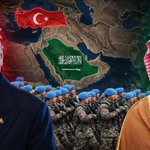
The best option of Saudi Arabia contemporary issues with Yemen is to reconcile with the Houthis, not to invite foreign countries, i.e, Turkey and Pakistan into the local conflicts - otherwise this will lead back to square one.
History offers an important lesson: Turkey’s regional ambitions should be assessed through its historical record and present-day actions, not merely its diplomatic rhetoric.
Othman