

Building continuous diffusion LMs 🚀 Research Intern @Apple MLR; PhD ML @UniofOxford; previously at @MSFTResearch, @EPFL, @imperialcollege
Paris, France
Joined May 2024
- Tweets224
- Following437
- Followers863
- Likes7.9K


Pinned Tweet
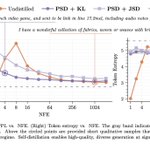
Continuous Diffusion LMs went from niche to contender this year, but the recipe is shaky: why self-conditioning? How to embed tokens? 🤨
Our new work takes your one-hot flow from 4% to 50% on TinyGSM without self-conditioning, and explores the design space of CDLMs. 🔥🚀 (1/6)
Oscar Davis retweeted

🚨 New Paper Alert, 🎤 Accepted for an oral presentation at the NeurIPS 2026 STODY workshop!
📣 Introducing: Normalizing Flow Maps (NFM): Combining few-step transport from Flow maps with tractable likelihoods from Normalizing Flows.
This is my first work with my first crop of new PhD students, @francescoshox and @tim_hitge, who genuinely knocked this project out of the park.
📄 Paper: arxiv.org/abs/2610.22711
📝 Blog: the-bose-lab.github.io/norma…
💻 Code: github.com/francescoshox/Nor…
🧵
1/8
Oscar Davis retweeted

More progress on CDLMs: self-conditioning has always been a bit of a crutch, DoubleCat/SemiCat seems to be a principled way to get rid of it🎉

Oscar Davis retweeted

oscar leave some work for the rest of us 😅
very cool idea and exciting to see more principled explorations of self conditioning!
Oscar Davis retweeted

Introducing RSI-Inference Bench from 🍎 Apple ML Research
🌐 rsi-inference.com
💻 github.com/apple-aiml-resear…
Can AI agents improve the systems that run AI?
We spent $100K API tokens, 50K GPU hours to find out. We built environments and benchmark from real-world #vLLM and #SGLang tasks, covering the full lifecycle of model inference engineering:
🚀 Day-0 Model Support
⚡ Inference Optimization
🔧 Bug Fix
→ Unsaturated: best agent at 26.7% pass@1
→ Comprehensive coverage of the inference stack
→ Verifiable rewards: binary and continuous
Watch the video to find out more!

Oscar Davis retweeted

Introducing Langevin Flow Maps
TLDR: Neural Network Potentials that learn their own stochastic pathwise solution for faster simulation.
- Transferable across molecular systems.
- Transition dynamics are preserved.
- No trajectory data are required.
Work together with @sgmccallum, supervised by @AlexanderTong7, and @JamesFosterBath.
Arxiv: arxiv.org/abs/2610.05998
Data: huggingface.co/datasets/nikl…
Code: github.com/sammccallum/lfm
Oscar Davis retweeted

Introducing SCALLOP 💜 Our new paper accepted at NeurIPS 2026 🐨
🚀 A scalable, efficient way to train few-step likelihood-available flow maps, enabling effective Boltzmann generation!
📽️ project page: tonyauyeung.github.io/scallo…
🔗 paper: arxiv.org/pdf/2606.29110
Oscar Davis retweeted

We've released the weights for Beam!!
🤗 huggingface.co/reflection
📄 Model card: reflection.ai/beam-model-car…
🧪 Try Beam in our playground & get an API key: platform.reflection.ai/playg…
📚 AND we take open model safety seriously and have posted our safety report: reflection.ai/beam-safety-re…


We built our first model!! Beam is a competitive text-only 501B-A23B MoE, openly released under the Apache 2.0 license
It’s been fun scaling the production RL/OPD stack for this over the past year. I’m so proud of the team! We attained exactly what we set out to do and ended up with a stable run on 10K GB300s that produced more than 100M rollouts across ~1M tasks that significantly improved the final performance of the model
👇 many more details in our announcement below :)
Oscar Davis retweeted

mlx-lm now supports image inputs with Muse!
I asked Muse to explain a screenshot of the profiler output from its own decode.
Muse explaining Muse. All running locally on two M5 Ultras with mlx ❤️

So proud of the MLX team!
Muse Spark Open, on your desk: 816B params at 36+ tokens/sec on 4 Mac Studio computers.
We've been hard at work on better M5 GPU Neural Accelerator support, a smoother Thunderbolt experience (including multi-cable meshes), and kernel optimizations for MoE architectures.
Oh — and MLX LM (mlx_lm.generate, mlx_lm.server) now supports the vision modality for Muse Spark Open!
More on using MLX for distributed inference of frontier-scale models on Mac Studio:
machinelearning.apple.com/re…

Oscar Davis retweeted

Introducing Quotient Recurrent Reasoners (QRR) 🚀
Looped reasoning models (e.g., TRM, FPRM) spend a large amount of loops on oscillatory dynamics that don't contribute to reasoning, wasting a lot of computation before converging. Turns out gauge equivariance helps tremendously by defining convergence in a quotient space instead of state-space, where these oscillations are part of the same equivalence class.
Super strong performance on reasoning benchmarks: Sudoku-extreme: 97.9% 🤯
Incredibly work done by my student Sumin Park @psmiziz
Check out the fascinating thread below. Also such a cool visualization! 🧵👇
@ELLISInst_Tue @MPI_IS @liquidai


Oscar Davis retweeted
Bitstream language diffusion is cool, but what about bistream diffusion for everything?
Happy to share:
Multimodal Co-Generation With Continuous Bitstream Diffusion
Highly reliable and high performance training on many modalities without any modality-specific calibration!

We need better model acceleration. This looks great 🙌

Today, we introduce Priming Models, a new paradigm for training one-step generative models from scratch.
No diffusion teacher. No flow map. No CFG. No JVP.
We believe this work will challenge how we think about building one-step models.
Joint work with @sitanch, @du_yilun, @parkwbin03, Bohyung Han.
🔥 1.19 FID one-step on ImageNet 256×256 while using substantially less compute, e.g., 12X less than Drifting-B, 6X less than Drifting-L
🎨 Scales to text-to-image generation (GenEval 0.82)
🤖 World modeling on RT-1 / Bridge-V2
Priming Model is built on one core message: [Reconstruction pretraining --> Distributional post-training].

Oscar Davis retweeted

Why don't Graph Transformers attend to the same token?
In LLMs, most sequences attend heavily to the first token, an "attention sink". Do Graph Transformers do it too?
I am happy to publish my new paper, accepted at the GDDL workshop for the @NeurIPSConf 2026 🧵
@bold_lab_ai

ALT Attention received per node on the same molecule, for three models: GRIT with its published gated score, GRIT-dotlogit where only the logit is a dot product, and GraphGPS (GINE plus dot product). GRIT spreads attention almost uniformly over the atoms. The two dot-product models concentrate it on a single atom, shown in dark red, and half of their heads form a sink.
Oscar Davis retweeted

#NeurIPS2026 Spotlight
RL for diffusion and flow models often requires expensive rollouts.
We show that flow maps enable simulation-free RL finetuning.
Introducing Wasserstein-Tilted Flow Maps (WTF)! 🤩
The key is a transport-based alternative to KL regularization. 🧵
Oscar Davis retweeted

We’re bringing natural-language control to any scientific generator.
We are very excited to introduce LLM-to-Flow Distillation (LFD), a method to adapt scientific generators to high-level natural-language discovery goals.
Starting from textual goals like “design peptides with promising anticancer activity” or “design small molecules binding to the D2 dopamine receptor”, LFD distills high-level goal-related knowledge from LLMs into scientific generators through iterative DPO on LLM-generated sub-goals.
🔥 LFD does not need task-specific proxy rewards, works with any frontier LLM via API-access, and outperforms state-of-the-art reward-guided methods such as FlowGRPO and DiffusionNFT on held-out computational evaluations. (1/6)
Oscar Davis retweeted

I'm excited that continuous dLLMs are picking up again. I often heard back in 2023-24 (when discrete/masked diffusion came out) that these were just better suited for discrete data. This never made sense to me since continuous diffusion in pseudo-time has more flexibility. #dLLM

Oscar Davis retweeted

Check out this really awesome work from Oscar! really exciting to see all the progress for continuous diffusion language models
PS: Please do check out the amazing analyses of CDLMs that are already out there:
- Why Gaussian Diffusion Fails on Discrete Data (@a__shabalin @Viacheslav91112): arxiv.org/abs/2604.02028
- CANDI (@PatrickPyn35903 @thjashin @ruqi_zhang): arxiv.org/abs/2510.22510
- FMLM* (@wognsfjq96 @wonjung_ki13109 @chandavidlee @FEijkelboom @jw9730): arxiv.org/abs/2607.00714

Tagging more usual suspects (the list is growing!): @jdeschena @sedielem @ValentinDeBort1 @ArnaudDoucet1 @baaadas @msalbergo @nmboffi @bose_joey @dario_sha @yjelid @LucaAmb @mmbronstein @JCJesseLai @JChemseddine @IAzangulov @iNikitaGushchin @pengzhangzhi1