

Your weekly journey into Web3 powered by the @ambire team
Web3
Joined July 2023
- Tweets450
- Following67
- Followers198
- Likes615







Pinned Tweet
This week, DEXes took a bigger share of crypto trading 🔑
Their share of spot volume climbed from 17.5% to 23.2%. Better onchain tools are giving traders more reason to trade without leaving their funds on an exchange, putting the old custody model in a tougher spot.
We also look at the new US Congress and what it means for crypto legislation, why an old iPhone isn’t automatically a safe wallet, and @ncsgy and @VitalikButerin 's privacy demo inside @ambire at @EFDevcon 🕵️
Plus, @ETHGasOfficial wants banks to reserve space in future Ethereum blocks, which could become a big market of its own in the future.
Quite a week. Read more here 👇
web3onfire.com/p/your-keys-t…

So, how did the US midterms affect crypto?
Going into election night, the industry was still waiting on Congress to agree on basic rules for crypto. The CLARITY Act was already stuck, and Democrats wanted stronger consumer protections and more rules around illicit finance and Trump’s crypto businesses.
Then the results came in: Democrats had won control of Congress. Traders started asking whether a bill that was struggling to move before the election now faced an even longer fight 🤔
That worry showed up in the price. BTC fell to around $75,600 as the results came in, then climbed back above $78,000 once things settled. DeFi tokens led the bounce, while TRUMP and WLFI kept falling, down about 7% and 5% 🦧
So the election didn’t end the push for crypto rules, but it changed the road ahead.
The bills now have to deal with the concerns Democrats were raising before they can move. The price recovered somewhat but the political argument is only beginning. You can safely say the playing field was reset.
Interesting times ahead.

🇺🇸TRUMP lost control of congress
democrats have taken both the house and senate, and the results are pretty wild
→ first time democrats have controlled both chambers since 2023
→ texas flipped blue for the first time since 1988
→ kansas flipped blue for the first time since 1932
→ republicans lost 7 senate seats, mostly in traditionally red states
→ trump now has a much tougher road ahead his bills, political appointments and judicial nominations will face a democratic-controlled congress
→ democrats are also preparing investigations into trump’s business dealings, including his family’s crypto empire too
and remember,
$WLFI raised $550M through token sales
$USD1 reached a $5B market cap
$TRUMP insiders cashed out $800M
$MELANIA went from a $13 ATH to 98% down
the family also made money through NFTs, licensing and royalties
$DJT announced a shareholder token program with crypto. com
→ markets initially sold off after the results, but buyers stepped in, bought the dip and pushed everything back into green today
so much for a quiet midterm election
now trump has a whole new problem to deal with
first retail got rugged by the market, now even washington is getting rugged by the election results🫠🫠


2
48
Every year crypto gets a little more corporate and then @VitalikButerin shows up

@VitalikButerin just opened Devcon and set the tone for the week.
A formally verified OS, open silicon, self-sovereign healthtech, free discourse, private communication, trustworthy AI — these are all part of Ethereum's mission.
2
32

A reminder:
xitter.cf/decentrek/status/21159…

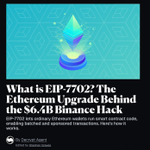
Quick notes on 7702 to dispel fud and keep your funds safe.
First thing first -- 7702 itself isn't broken. Don't panic if you are using a wallet that supports 7702 (MetaMask, Uniswap, Ambire, etc.).
To recap, 7702 is an account abstraction EIP that allows an EOA to sign a special message, called a "7702 authorization," that would insert a smart contract into the account, which enables the account to do powerful things like transaction batching, e.g. doing "approve" and "transfer" in one transaction so you can swap on Uniswap with one click.
But unfortunately the same feature also allows a hacker to efficiently move all your tokens in one single transaction. In the Binance hack, the hacker moved ETH, USDT, and 62 other tokens in one transaction, whereas without 7702 they'd have had to send one transaction per token. In this particular case, many of those transactions would've failed because Binance was still using the hacked wallet for withdrawals, so all transactions sent by the hacker would've had to compete with the legit transactions for nonces. So using 7702 did help the hacker steal as much funds as possible, as quickly as possible. Ouch!
However, in order for the hacker to use 7702, they must have either 1) had access to the private key, or 2) tricked Binance into signing a 7702 authorization. The latter is very unlikely, as it's hard to imagine Binance being so incompetent as to expose an endpoint for signing 7702 authorizations or (even worse) for signing raw messages which the hacker could've repurposed for 7702 authorizations. But I can't rule that out until the official postmortem.
What does all this mean for you?
- If you are a wallet developer, do NOT, under any circumstances, expose a way for third parties to request 7702 authorizations. This is just handing your users a giant footgun to shoot themselves with. No wallets I know of do this, so don't worry if you are a user.
- If you are a user, use a well-known wallet. 7702 does let wallet developers screw up in more ways than before, so use only well-known wallets whose developers' competence you can trust.
- If you are a company (e.g. an exchange) operating hot wallets, do NOT, under any circumstances, expose an endpoint (even if it's an internal endpoint) for signing 7702 authorizations or raw messages.
As a contributor to AA, I feel partially responsible for hacks like this, since by increasing the power of accounts, we've indeed also empowered hackers (not unlike how any new technology empowers both the good guys and the bad guys). That said, it's important to note that 7702 was only a transitional EIP, and "endgame AA" such as Frame Transactions (EIP-8141) would allow wallet owners to set up their wallets much more securely. For example, if Frame Transactions were available today, Binance could've:
- Set up their wallets as multisig contracts only (not EOAs).
- Set up "post conditions" for their `transfer()` functions, so that even if the multisig got hacked, the contract itself would perform sanity checks such as "no transfers of more than 1000 ETH without additional signers."
In short, the endgame of Ethereum UX is one with both optimal security and optimal UX, and users never have to trade off between the two. But we still have a long way to go until we get there. Back to work!
1
27

This week, @Binance reported a $6.3 billion theft, the largest in crypto’s history. The exchange says it will cover the losses, but the funds are already gone and withdrawals are still paused. Investigators say the attacker moved assets across ten blockchains in about 20 minutes. @trmlabs links the operation to North Korea’s TraderTraitor group 🇰🇵
Meanwhile, @ambire entered hardware game with Ice, its own open source signer built for @safe . That takes the team from wallet software to the device that handles transaction approval. @safe transactions can be decoded on Ice itself, so users can inspect what they’re authorizing on the signer before approving it. The design is open source too. A big step for @ambire and a meaningful addition for @safe users 💜
We also dug into copy trading: how exchanges turned “follow this trader” into a business worth billions, and what happens when the same game moves onchain. Nobody needs a trader’s permission to track their wallet, copy their buys or trade around their exits. Now some of the wallets everyone wants to follow are looking for ways to lose the followers 🤓
Also: @Zcash 's Crosslink proposal is still being tested, while influential dev @jswihart argues the added complexity isn’t worth it. The community is left waiting to see whether all that work leads to an upgrade people can actually use 🔒
Plus, other worthy reads on DeFi, tokenized carry trades and the next big opportunity in crypto.
Read more in this week’s edition 👇
web3onfire.com/p/binance-rob…


Billions flowing out of @binance and possibly other CEXes.
Everyone who's been screaming to keep your coins off exchanges for these past years:
A market for… getting away from the market?
Copy trading became a huge business. Now the traders being copied want some privacy because copytraders riding their tail can make their next trade more expensive.
Turns out a public wallet can attract an audience you’d literally pay to lose.
Digging into this in this week’s Web3 on Fire 🔥

AVAIL enters the Hyperliquid ecosystem with @ShieldTXxyz
Why Hyperliquid, and why now?
Hyperliquid is where a lack of privacy costs large traders on every trade, and public exposure is holding back desks and funds who want to trade there.
After screening 332,317 wallets over 30 days, ShieldTX studied the impact of copy-trading on seven top perp traders and found a median execution loss of 63 bps per trade.
Hyperliquid can't capture the flow that needs privacy while every position remains public. ShieldTX routes that flow to @HyperliquidX, with the enterprise-grade privacy large traders need.
We've spent months speaking with whales, trading desks, market makers and digital asset funds who want to use the platform without the public exposure. They want privacy from competitors and copy-bots, without giving up compliance.
The current solutions aren't enough:
• Hyperliquid sub-accounts link to the main account onchain
• Multi-wallet rotation gets exposed by Arkham and other analytics platforms
• Third-party privacy solutions still expose a trader's PnL onchain
ShieldTX is built to close this gap.
Every trade is placed on Hyperliquid from a brand-new Hyperliquid wallet. Nothing links the trade onchain to the trader, and nothing links the trades together. A full trading history is available to users for audits and compliance.
ShieldTX is the on-ramp for crypto-native desks today, and the institutions who come next.
1
9
74
Web3 On Fire 🔥 retweeted

what Ethereum podcasts/newsletters are you enjoying
wanna promote them on @onfireweb3
Hot Harold’s Take: Aptos has encrypted transactions on mainnet. Ethereum is working on proposals too.
If users get better fills and keep their trades onchain, order privacy could become the next thing chains compete on 👇


Crypto finally got the political power it was after. Now candidates are using industry money to argue that crypto bought its way into politics, but turns out those attacks cut both ways 🥷
Sixteen companies have objected to tokenized versions of their shares on OKXICE. @Nasdaq is building its own tokenized stock pilot in the meantime. The issue seems to be who gets to run the market 🤔
@ambire is bringing private transfers into its wallet, with @VitalikButerin set to demo the feature on mainnet at Devcon 8👀
@a16zfrontier is dropping “crypto” from the name of its $9.8B investment arm, five months after raising a $2.2B fund it called dedicated to crypto.
And Ethereum’s planned jump to a 200M gas limit hit a delay on the final testnet while devs check a contract issue.
Read more in this week’s edition here 👇
web3onfire.com/p/crypto-won-…

"AI just accessed a crypto wallet and decided to use it without authorization" if you honestly believe these isn't just marketing then you're not going to make it 🤐


1
9
127

Tokenized stocks suddenly not so bullish for the big players?
@Microsoft , Alphabet @Google , @GoldmanSachs and 13 other companies have objected to their shares trading on OKX–ICE’s planned venue.
“The future of finance” sounds a lot less exciting when it’s your stock on the blockchain and you’re not the one calling the shots 😶
okx.com/cdn/assets/okfe/web3…

2
6
78

