






Sam Omar retweeted

A Giant Korean Study of 15 Million People Just Blew a Hole in the “Lower LDL Is Always Better” Story
Imagine tracking almost 15 million adults for nearly nine years and counting every death from heart disease and stroke. That’s exactly what Korean researchers did with 14.9 million people who weren’t even taking cholesterol drugs. What they found doesn’t match the simple message that “the lower your LDL, the safer you are.” Instead, the risk formed a U-shape. People with very low LDL died more often from cardiovascular causes, people with very high LDL also died more often, and the sweet spot sat right in the middle.
For overall cardiovascular death the lowest risk landed between about 90 and 149 mg/dL. Below that range or well above it, deaths went up. The pattern changed depending on the exact problem. For heart attacks and blocked arteries the best zone was lower (around 70–114 mg/dL). For some types of brain bleeds the risk kept falling only when LDL stayed higher. In plain terms, driving LDL as low as possible protected against one kind of death while raising the risk of others.
When the scientists looked only at the higher range (100 to 300 mg/dL) they still saw a clear rise in heart-attack deaths as LDL climbed. Each jump of about 40 mg/dL raised the chance of dying from ischemic heart disease by roughly 26 percent. But that rise was weaker in women and in older adults than in younger men. Even people in their late 70s and early 80s still showed some extra risk from higher LDL for heart attacks and ischemic strokes, yet the overall picture never became “lower is always safer.”
The study is huge, it followed real people instead of just guessing from lab tests, and it only looked at folks who were not already on statins. That makes the U-shape harder to wave away. Doctors still treat high LDL when people already have heart disease or several risk factors, because the top end of the curve is real. But the data also show that pushing every healthy adult toward rock-bottom LDL numbers is not free. Too low carried its own price in this massive population.
The takeaway is simple and uncomfortable: LDL cholesterol is not a one-way street. In nearly 15 million Koreans the safest zone for dying of cardiovascular disease was not the lowest number on the lab report. Both extremes cost lives. That single finding from one of the largest studies ever done keeps forcing the same awkward question—how low is actually low enough, and for whom?

I don't understand. These companies make great products. Why doesn't the market like them?
There's enough caffeine in Energy Boost between these two beverages to be made illegal in most European Union countries and kill a small hippopotamus. But that's why I like them.

The Chaikin Oscillator watches whether big money is buying or selling a stock.
Since 1972, it has only screamed "oversold" on McDonald's four times: 1974, 1979, 2003, and 2006.
Every single time, the stock went up after. Four for four.
On average:
- 6 months later: up 47%
- 12 months later: up 64%
- 18 months later: up 91%
- 24 months later: up 105%
Right now, October 2026, it is screaming oversold again.
Sam Omar retweeted

A TON OF THINGS HAPPENED IN THE STOCK MARKET TODAY.
Here's a full recap:
1. Meta $META unveiled Muse Wonder and Muse Wonder Full, calling them its most capable AI models to date for personal AI agents and software development. Trained at Meta’s gigawatt-scale Prometheus data center, the models combine Active Memory, which carries relevant context across conversations, with Active Focus, enabling agents to persist through complex tasks, explore alternative approaches, and confirm important actions with users. Meta said the models deliver state-of-the-art performance across agent, memory, and coding benchmarks, while supporting professional workflows involving software engineering, legal, financial, and health tasks. Muse Wonder is available today through the Meta Model API and Muse Code, while Muse Wonder Full is available to Muse Code subscribers and will also roll out to the Muse app, alongside stronger safeguards for privacy, malicious instructions, and misuse.
2. Broadcom $AVGO CEO Hock Tan warned that many investors are approaching AI like “casino gamblers,” arguing that capital is increasingly being deployed without a clear understanding of the industry's long-term economics. Tan said the next major constraint on AI may not be chips or power, but capital, as AI developers must prove they can generate sustainable returns from the enormous investments being made today. He also cautioned that some companies are overspending on AI initiatives and emphasized that long-term winners will be those that can turn AI deployments into profitable businesses rather than simply building larger models.
3. The S&P 500 $SPY traded just 18.3M shares today, marking its lowest full-session trading volume since December 26, 2003.
4. Market breadth continues to weaken even as the S&P 500 remains near record highs. 84% of S&P 500 stocks are now trading at least 10% below their all-time highs, despite the index sitting just 0.2% below its record close. Real Estate has been the weakest sector, with 97% of its stocks down at least 10%, followed by Materials (96%), Utilities (94%), and Consumer Discretionary (92%), while Energy (62%), Healthcare (70%), and Information Technology (72%) have held up relatively better. Overall, 59% of S&P 500 stocks are down at least 20% from their highs, 41% are down more than 30%, and 17% have fallen by 50% or more, highlighting the growing divergence between the index and the average stock.
5. Ondas $ONDS and Palantir $PLTR announced the launch of Regna AI, a new company focused on developing specialized AI models for governments and enterprises that want to retain full control over their models, data, and infrastructure. Initially wholly owned by Ondas, Regna will leverage Palantir’s AI platform and model-training infrastructure, with Ondas serving as its first customer. The company's initial focus is on intelligence, surveillance, and defense, developing AI models designed to run directly on drones, ground vehicles, and other edge hardware, even in environments with limited or intermittent connectivity. The companies said initial customer deployments are expected to begin over the coming months.
6. Since the start of 2024, a basket of 42 AI-related stocks has generated 67% of the S&P 500’s total price return, contributing roughly 22 percentage points of the index’s 33% gain over that period. By comparison, the remaining 458 companies have contributed just 11 percentage points. Those same AI leaders have also driven 58% of the S&P 500’s total earnings growth and 81% of all capital expenditure and R&D growth since the beginning of 2024, leaving the rest of the index responsible for only about 20% of investment growth. Meanwhile, just 29% of S&P 500 stocks have outperformed the index over the past 3 years, approaching the roughly 25% participation rate seen during the Dot-Com Bubble.
7. Google $GOOGL is simplifying the Gemini experience by moving toward a single prompt box with no modes or toggles, according to Google VP Josh Woodward. He said the goal is for users to simply tell Gemini what they want and have it automatically determine how to complete the task, reflecting a broader shift in AI user interfaces across the industry. Woodward also hinted that Google is building a “personal, proactive, powerful” version of Gemini, designed to leverage users’ Google data and work more intelligently across their digital lives. He added that Google has heard user requests to make Gemini work more seamlessly with the information they already store in Google services, saying “watch this space” as new capabilities are expected to launch soon.
8. Microsoft $MSFT CEO Satya Nadella announced the company's largest commitment yet to custom AI silicon, saying the Maia chip family will begin scaling to multi-gigawatt deployments starting next calendar year and become the primary inference platform for Microsoft's products and services. Microsoft also introduced Maia 300, which Nadella said delivers 40% more tokens per watt than leading GPU-based systems. The company is already deploying Maia 200 across the U.S., Europe, and Australia, achieving up to 1.7x more tokens per watt for workloads powering Teams and Copilot. Nadella said Microsoft's strategy is to continue improving full-stack efficiency while also incorporating the latest innovations from across the broader AI ecosystem.
9. Global physical gold-backed ETFs attracted a record $30.7B of inflows during Q3 2026, marking the largest quarterly inflow on record. September alone saw $10B of inflows, following $17.9B in August, the second-largest monthly inflow ever recorded. As a result, global gold ETF holdings increased by 67 tonnes in September to a record 4,256 tonnes, surpassing the previous high of 4,176 tonnes set in February. Year-to-date, gold ETFs have attracted $38.5B in inflows—equivalent to 226 tonnes of additional gold holdings—with demand positive across every region. UK-listed funds have led country-level inflows with $9.5B, overtaking China, highlighting exceptionally strong global demand for gold.
10. Anthropic said it has reduced the amount of data harvested through AI distillation attacks by approximately 90–99% after deploying new anti-distillation defenses. The company said Zhipu attempted to distill capabilities from Claude Fable 5, but switched to an older Claude model after encountering stronger cyber safeguards. Anthropic also revealed it has turned away meaningful revenue and trillions of tokens' worth of paying traffic from suspected distillers, prioritizing model security over short-term revenue. The company said preventing unauthorized model distillation is a key national security issue, as frontier AI capabilities can otherwise be replicated at a fraction of the cost and integrated into foreign AI systems.
11. The top 10 most active options today by contracts traded were $NVDA with 2.8M contracts, $TSLA with 1.5M contracts, $META with 1.3M contracts, $MU with 1.2M contracts, $AAPL with 1.1M contracts, $SPCX with 998K contracts, $INTC with 778K contracts, $AMZN with 680K contracts, $MSFT with 648K contracts, and $AMD with 598K contracts.
12. BlackRock has downgraded U.S. equities to Neutral while turning more constructive on U.S. Treasuries, according to a new outlook from the BlackRock Investment Institute and CIO Rick Rieder. The firm upgraded short-term Treasuries to Overweight, raised long-term Treasuries to Neutral from Underweight, and cut U.S. stocks to Neutral after maintaining an Overweight stance for an extended period. BlackRock emphasized that the move reflects near-term risk management, not a change in its long-term outlook, stating it remains bullish on AI and that its core investment convictions are unchanged.
WALL STREET IS THE GREATEST SHOW ON EARTH.
Saved his life. Finest physician movie clip I've ever seen.
youtu.be/D1Tfhc18EL4?is=UJFx…
High time frame Chaikin oscillator today's reading is the 5th occurrence — and the deepest since 2006. The standing caveat: 4 signals in 50 years is a tiny sample, suggestive not conclusive.
@chaikinanalytic


youtu.be/xsiJmn1jRQQ?is=hieI…
The video is Cem Karsan (Kai Volatility) on tastylive: "Why Cem Karsan Says Stocks Ignore a Bond Market in Free Fall."
The short version: his argument is that money flows drive stocks over any stretch shorter than a year, so equities can ignore a bond selloff for a while — but bonds are the "weighing machine" that eventually sets the discount rate on everything. He's not calling a crash; his stance is stay long but own cheap downside protection.
The backtest surprised me. I tested every episode from 2000–2025 where the 10-year yield spiked at least 0.75 points in 60 trading days while the S&P sat within 3% of its 1-year high — 8 episodes, including the 2013 taper tantrum. All 8 were followed by higher stock prices at 6 and 12 months, averaging +10.7% at 6 months versus +4.6% normally. Betting against stocks on this signal lost every time. Small sample though — 8 episodes in 26 years — and today's mix is hotter: 24-year-high yields driven by real yields, with the bond fear gauge at 107 while the stock one naps at 15.
The Bear porners Venerate and deify this guy. Imagine how insane you have to be over the last 10 years to get it right even a few times and to keep coming back talking your book like you're a badass.

Jim Chanos explains why this AI boom carries more financial risk than almost any boom in history
“So, my friend Paul Kedrosky, I don’t know if you heard him recently, he had a wonderful point."
"I teach the history of financial-market fraud, but as part of it, we teach financial cycles because the fraud cycle follows the financial cycle, usually with a lag."
"And Paul made a wonderful point. I think he made it on your podcast, that major booms are either credit-related, government-related, technology-related, or real-estate-related."
"He said this is the first one in a long, long time, if not ever. I forget. I think railroads might have been the other one where all four boxes are checked."
"It’s government policy. It’s certainly technology. It’s certainly credit-driven now. And it’s real-estate-related with the buildout of data centers."
"And so you’ve got four giant drivers for this cycle that all need to be harnessed and going in the right direction, and that increases the financial risk that we’ve been talking about.”
Real rates are the opportunity cost. Gold has no coupon. If the 10-year is 12% and inflation is 14%, Treasuries are destroying purchasing power and gold’s zero yield is a bargain. If the 10-year is 4.5% and inflation is 2.5%, Treasuries pay you to wait and gold has to clear a hurdle. Erb and Harvey found a correlation of about −0.82 between real rates and gold from 1997 to 2012. A Chicago Fed study estimated that a 1 percentage point rise in the long-term real rate lowered the real gold price by about 13%. World Gold Council work shows strong average real returns when real rates are negative and roughly flat returns once real rates are above about 2.5%.
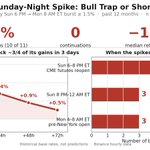
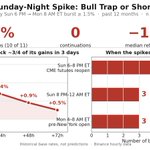
Studied every Sunday-night/Monday-AM Bitcoin burst (≥1.5%) of the past year: 11 events → 10 bull traps, 1 chop, 0 continuations. Median return 72h later: −1.9%. The 4–8am ET spike isn't a short squeeze, it's thin-liquidity exhaust. Fade the vertical move, not the trend.

year performance & accuracy review of Bob Moriarty (2016–2026):
Where He Excelled (The Detail)
The Rhodium Call (Historic Hit): Flagged rhodium sub-$1,000/oz in 2016 as a once-in-a-lifetime supply crunch before it exploded toward ~$30,000/oz by 2021.
Sentiment Extremes (~75% Hit Rate on \pm6-Mo Windows): Nailed major turning points using DSI (Daily Sentiment Index)—buying the literal bottom in miners/metals in early 2016 and the March 2020 crash, while fading overbought retail manias in 2021.
Pragmatic Market Psychology: One of the few resource veterans to aggressively de-mythologize "naked short manipulation" conspiracies, constantly teaching investors to take money off the table after a double rather than marry speculative micro-caps.
🤖 Made with AI

muse.ai/s/david-hunter-track…
Directionally right, sometimes timing wrong, just enough correctness to make it a contrarian false prophet


Sam Omar retweeted

So the opening acts cancelled and his own band quit. Ed Sheeran says hold my beer. 😉
Readers added context they thought people might want to know
Ed Sheeran has not performed since his opening acts all canceled on September 17th - his last concert was September 5th and his next will be September 19th. This performance was from his "Loop Tour" earlier the same year.
pastdates.edsheeran.com
edsheeran.com/#tour
Sam Omar retweeted

🚨 BREAKING: Claude can now map out your retirement better than most people charging $3,000 ever will.
Here are 6 prompts to figure out exactly when and how you can retire.
(Save this before it disappears).