

Celebrating the flowers of These Isles. 🏴 🏴 🏴 🇮🇪
British Isles
Joined March 2026
- Tweets441
- Following190
- Followers27
- Likes294


My first introduction to Sir Richard Francis Burton was through this portrait. Having been unfamiliar with the man and his achievements, at first, I didn’t appreciate how effectively Frederic Leighton had captured Burton. From the portrait alone, I surmised that this was a man with many tales to tell, his disposition shaped and his face weathered by an adventurous life. As a soldier, explorer, linguist, translator and writer, Burton proved to be precisely such a man.
In 1853, Burton undertook one of the most audacious ventures of his career: a pilgrimage to Mecca disguised as a Muslim pilgrim. Burton remains one of the few European non-Muslims to have entered the holy city, and meticulous preparation enabled him to perform the rites of the Hajj convincingly. As one would expect, his vivid account of the exploit secured his place among the celebrated explorers of the Victorian age.
Burton’s subsequent expedition to East Africa brought him to Lake Tanganyika in 1858, thereby expanding European geographical knowledge of the region. The journey also formed part of the wider Victorian quest to establish the source of the Nile.
Reputed to have mastered over 25 languages, Burton immersed himself in the customs, beliefs and literatures of the societies he encountered. His linguistic aptitude also enabled him to produce acclaimed translations of The Arabian Nights and the Kama Sutra, works which inevitably challenged the sensibilities of Victorian Britain.
I suspect that Leighton’s portrait is so compelling because it serves as an introduction to a man of intrigue. Only having learned something of Burton’s extraordinary life can we appreciate just how much the portrait seems to convey: the countenance of a man shaped by adventure, intellectual curiosity, and encounters with worlds far removed from his own.

On the anniversary of a monarch’s death, it is natural to reflect upon the legacy left behind. ‘Bad King John’ is perhaps not the most flattering epithet to have acquired but there are only so many ways to dress-up military failures, territorial losses, conflict with the Church and baronial confrontation.
This fourteenth-century miniature was produced more a century after King John’s death in October 1216, and appears in an English manuscript of laws and statutes. Hunting was a traditional expression of rank and royal privilege, and thus monarchs were frequently depicted in this setting. Yet, within a manuscript concerned with English law, one wonders why the king so closely associated with the Magna Carta is instead portrayed as an aristocratic hunter, mounted atop a noble steed, surrounded by hounds and in pursuit of a stag.
Of course, not every royal image was intended to be a commentary on a monarch’s reign, and hunting scenes were common in medieval manuscripts from the thirteenth century onwards. Nevertheless, the contrast between King John’s historical reputation and this particular depiction invites us to reflect upon the power of imagery. If this illustration were the only surviving evidence we had for King John, what might we think of him?
#KingJohn #English #Manuscript

‘And their eyes were opened and they recognised him’ (Luke 24:31).
Today, the Church celebrates Saint Luke, traditionally honoured not only as an Evangelist, but also as the patron saint of artists.
This seventeenth-century engraving of Saint Luke, made in 1653 by the English engraver William Faithorne (c. 1620–1691), offers a fitting meditation on that association. We see Luke depicted with the tools of a painter, working on an image of the Virgin and Child, with the ox beside him: the traditional emblem of the third Evangelist.
The portrayal of Saint Luke painting Our Lady and Christ has a rich history in the art of Christendom. In this motif, Luke may be understood to embody the conviction that the making of an image can itself become an act of devotion: a means of contemplating and honouring the sacred. Faithorne’s engraving invites us to contemplate Luke the Evangelist and to honour him as the patron saint of artists, thereby bringing together two forms of creation: the written word and the visual image. The inscription beneath the figure describes Luke as ‘The holy Artist with Inspired Pen’.
Thus, on the Feast of Saint Luke, we may use such images to reflect upon the relationship between art and faith, between seeing and understanding. Though our eyes are drawn to paper marked by words or images, our minds are invited to contemplate that which lies beyond.
#StLuke #Feast #ChristianArt #ArtHistory

A small glimpse of the rich beauty within Shrewsbury’s St Mary’s Church.
Looking up towards the ceiling, I was struck by the sight of these three distinct architectural features, all contained within a single frame.
At the centre stand the sweeping, round-headed arches of the nave arcade, with their carefully worked stone mouldings and clustered shafts crowned with foliate capitals.
To one side of the arcade, dark timber beams have their simplicity punctuated by golden ornaments. Beyond the great stone arches lies one of St Mary’s celebrated treasures: the nave’s fifteenth-century carved oak ceiling. Even from this partial glimpse of its richly patterned panels, curved crossbeams, and intricate carvings of angels and animals, its magnificence is striking.
Perhaps it is the transition between these different colours, materials and styles that I find so beautiful: from the simplicity of the dark timber to the cool tones of the stone arcade, its appearance softened by the skill of medieval masons, and finally through to the warm, almost glowing oak beyond. Each element has its own character, yet together they create a wonderful display of craftsmanship and history.
#ChurchArchitecture #Shrewsbury

🏴 Ceiriog’s beautiful poem, Y Mynyddau Mawr, seems to be the perfect way to mark Shwmae Su’mae Day, a celebration of the wonderful Welsh language.
Aros mae'r mynyddau mawr,
Rhuo trostynt mae y gwynt;
Clywir eto gyda'r wawr,
Gân bugeiliaid megis cynt.
Eto tyfa'r llygad dydd,
Ogylch traed y graig a'r bryn;
Ond bugeiliaid newydd sydd
Ar yr hen fynyddoedd hyn.
Ar arferion Cymru gynt,
Newid ddaeth o rod i rod;
Mae cenedlaeth wedi mynd,
A chenedlaeth wedi dod.
Wedi oes dymestlog hir,
Alun Mabon mwy nid yw;
Ond mae'r heniaith yn y tir,
A'r alawon hen yn fyw.
(My fellow Anglophones may like to read an approximate rendering below).
#Welsh #Poetry #Wales

The great mountains still remain,
The wind roars over them;
Once again, at break of dawn,
Shepherds’ songs are heard as before.
Once again the daisies grow,
Around the feet of crag and hill;
But new shepherds tend them now,
On these ancient mountains still.
The customs of Wales of old
Have altered with the years;
One generation has gone by,
And another now appears.
After a long and stormy age,
Alun Mabon is no more;
But the old tongue lives in the land,
And the old songs still live on.
📍The Guildhall, Bath
In the autumn of 1777, preparations were underway to furnish and equip the city’s magnificent new centre of civic government and administration.
The Guildhall was built between 1775 and 1778 according to the designs of Thomas Baldwin, one of Bath’s notable Georgian architects. Constructed from local honey-coloured stone, its classical façade reflects the influence of Palladian architecture and the enduring traditions of civic governance, whose roots reach back to Classical Antiquity. With imposing columns, intricate stonework, and a decorative triangular pediment crowning its central elevation, the building conveys the dignity and importance of civic life.
At its pinnacle stands Lady Justice, presiding over the building with her sword and scales, symbols of authority and the fair administration of the law. Since the late medieval period, Justice has often been depicted blindfolded, signifying impartiality before the law. Here, however, Bath’s eagle-eyed Lady Justice gazes out over the city, inviting us to reflect upon the careful examination of evidence in the pursuit of justice.
The committee records of 14 October 1777 offer a fascinating glimpse into the everyday preparations surrounding the Guildhall. Alongside arrangements for chairs, bells and even hat pins, we find another charming detail: the lighting of five lamps in front of the building. James Tucker was paid ‘£4 1s 0d’ for his lamp-lighting services from 14 October 1777 to 20 January 1778.
With Lady Justice’s watchful gaze and lamps illuminating the streets below, what skulduggery could possibly go unnoticed?
#Bath #Classical #Georgian #Architecture #Justice

Bibliography:
‘Bath’s Georgian Guildhall: The Building and Early Occupation of the ‘New Hall’ 1774 to 1780’. Published online via historyofbath.org.
An apt day to admire the golden glow of the sun shining over our beautiful English countryside.
#Dove #Sunset #EnglishCountryside #MiracleOfTheSun

12 October 1537 brought the most welcome news to Henry VIII: the birth of a son.
In the Queen’s Apartments at Hampton Court Palace, Henry’s third wife, Jane Seymour, gave birth to the future king, Edward VI, allaying fears over Henry’s succession.
This magnificent portrait, painted around 1545 by an unknown artist of the British School, offers a fascinating glimpse into the ambitions of the Tudor dynasty.
At its centre stands Henry, surrounded by his children: Mary, Elizabeth, and his long-awaited male heir, Edward. It is a carefully constructed statement of royal authority and dynastic continuity, with the rich costumes, formal arrangement and commanding presence of the King projecting an image of strength and stability. Yet, one cannot ignore the poignant inclusion of Jane Seymour, who died just twelve days after the birth of Edward.
With the benefit of hindsight, we know that the stability projected through this portrait did not endure. Edward became king at the tender age of nine but died a few years later, at just fifteen. Both of his older sisters, Mary and Elizabeth, would wear the English crown, each ruling during a turbulent chapter in the kingdom’s history.
In this respect, the portrait is more than a celebration of the Tudors; it is a reminder of the fragility of dynastic ambition. What Henry had so desperately sought in Edward’s birth was the promise of a secure and enduring succession, yet history would unfold very differently. The painting thus captures the aspirations of the monarchy at a moment when the future of the Tudor dynasty seemed assured, its royal sitters oblivious to the turmoil that lay ahead.

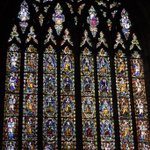
Only yesterday, Pope Leo XIV reflected upon how art is not ‘mere aestheticism’ but rather a means of proclaiming the Gospel. One such creation that embodies this theme so beautifully is the fourteenth-century Jesse Window at St Mary’s Church in Shrewsbury.
Rising from the reclining figure of Jesse, a vine branches out to embrace the kings and prophets of Israel, leading our eyes towards the fulfilment of their history in Christ. Glass, lead and light become a visual proclamation of salvation history: the material world shaped by human hands to convey a divine message.
As His Holiness suggests, matter can be understood as memory, and art as a means of preserving history for future generations. This sentiment seems especially true of this particular Jesse Window at St Mary’s. Dating from c.1340–53, it is thought to have been installed originally in the Greyfriars Church at Coleham, Shrewsbury. Following the dissolution of the friaries in 1538, it is believed to have been transferred to St Chad’s, where it remained until the collapse of the church’s tower. As St Chad’s was not rebuilt, the window was moved to St Mary’s in 1792, where its lights were restored and rearranged.
The survival of the window has allowed its glass to carry the image of Christ through centuries of change, preserving the faith and craftsmanship of generations past. Here, we see Pope Leo’s themes of matter, memory and beauty converge. More than an object to admire or a relic of a vanished age, the window stands as a witness to the intertwined Testaments, inviting posterity to contemplate how, and indeed why, the Christian story endures.
In its imagery, we see Christ prefigured in the history of Israel; in its survival, we trace the history of the window itself and the significance of its message. Together, expressed through exquisite craftsmanship, these two histories bear witness to the enduring truth of Christ.
#JesseTree #StainedGlass #ChristianArt


‘On Michaelmas Day the Devil puts his foot on the blackberries’, so says the old Irish proverb.
According to the folklore of these isles, Old Michaelmas Day, traditionally observed on 10th October, is the last day on which blackberries should be plucked from the bramble. For on this day, it is said that Lucifer was cast down from Heaven, falling from the skies straight into a blackberry bush. Cursing the fruit and its wickedly spiky stems, the Devil spat upon the berries, scalding them with his fiery breath, before stamping upon them to ensure that they were truly unfit for consumption.
So heed this warning while ambling through our beautiful countryside this October…a most unwelcome visitor may have been lurking nearby!

In Newman’s Oxford, where faith and reason meet.
Cor ad cor loquitur.
#JohnHenryNewman #DoctoroftheChurch
