

Founder, Marbles Health | Forbes30u30 | Stroke Rehab, Depression, Cognition, OCD, ADHD with neuromodulation
India
Joined October 2016
- Tweets347
- Following790
- Followers531
- Likes1.8K






Researchers strapped cameras to little children’s heads, and what they learned is changing how we train AI.
One famous AI vision model, CLIP, learned from 400 million images paired with text.
A baby learns to see with far less, and with blurry eyes.
Here is how a baby’s vision develops:
⠀
• It starts out very blurry at birth
• It sharpens slowly over the first months
• Faces and big shapes come in first
⠀
When researchers trained AI on head-camera footage from young children, the models still learned useful visual skills from a tiny slice of that data.
And when they trained AI blurry first, the way babies see, the models got better at recognising objects in new situations.
The order matters for people too.
Children born with cataracts that are removed later miss that early blurry stage, and some show lasting difficulty recognising faces.
I work on brain health every day, and I keep coming back to how much timing shapes the brain.
It turns out AI might learn better with something like a childhood.
Sources: Radford et al., ICML 2021 (CLIP); Orhan et al., NeurIPS 2020 (head-camera models); Cai et al., CVPR 2026 (blurry-first training); Le Grand et al., Nature 2001 (cataracts and face recognition)

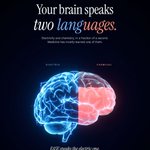
Your brain speaks two languages at once, and medicine has mostly learned one of them.
Every time a brain cell sends a message, two things happen in a fraction of a second:
• An electrical pulse runs along the cell
• At the end, it releases a chemical messenger
• That chemical sparks the next cell’s pulse
So every thought, mood and memory you have runs on electricity and chemistry working together.
Medication is how medicine learned to work with the chemical part. It adjusts those chemical messengers, and for millions of people it genuinely helps.
But for around 60 to 70% of patients, medication only gets them part of the way, and that’s where the electrical side comes in.
Gentle brain stimulation works with that electrical side, helping specific brain areas get back into a healthy rhythm while medication keeps doing its job on the chemistry.
That is the idea behind EASE at Marbles Health, a second pillar of care that sits right next to medication.

After college, I had one dream: study at UC Berkeley, one of the best universities in the world. I never went, and this month I’m in Silicon Valley anyway.
In 2019, I joined a one-year program after graduation, mostly because Berkeley was one of its partners.
Berkeley is famous for studying the human brain, and I was sure this program was my way in.
My plan looked simple:
• Finish the one-year program first
• Get into Berkeley to study the brain
• Start my own company a few years later
Then one project in that program changed everything.
We were working with brain signals, and it introduced me to devices that gently send electrical signals to the brain to help treat conditions like depression.
The more doctors and patients I spoke to, the clearer it became that this treatment worked, but most people could not access it.
So I stopped planning to study the brain and started building for it.
That project became Marbles Health.
I never went to Berkeley, and today I’m a short drive away, pitching the company that detour created.

Brain health makes up 13% of what the world needs from healthcare.
It gets less than 5% of what the world spends on it.
That gap is exactly why this market keeps growing while most of healthcare has flattened.
• In 2000, the global mental health market was around $190 billion.
• Today it is $460 billion.
• By 2035, it is projected to cross $680 billion, roughly ₹60 lakh crore.
Here is what most people miss about that number.
Almost all of it goes to medication and therapy, the two tools we have relied on for 70 years.
They work, and they help millions. But for 6 out of 10 people, they only take the brain part of the way.
The next $200 billion of growth will not come from more of the same.
It will come from treatments that work with the parts of the brain we have only just started to understand, the electrical side and not just the chemical one.
That is the market we are building for.
Sources: WHO (share of disease burden), WHO Mental Health Atlas 2024 (mental health spending at about 2% of health budgets), IMARC Group (2025 market size), Towards Healthcare (2035 projection), STAR*D trial (treatment response). The 2000 figure is an estimate based on historical growth rates.

Clinicians read stroke on an MRI every day, but seeing the same lesion at cell level has been much harder.
On 11 October, PM Narendra Modi released an atlas that could help close that gap.
It's called C-STROKE, built at IIT Madras's Sudha Gopalakrishnan Brain Centre, which he also dedicated to the nation. The atlas comes from one stroke-affected brain:
→ Over 1,000 tissue sections carry detailed annotations.
→ The MRI scans link to micron-level tissue images.
→ Markers show inflammation, hypoxia and axonal injury.
→ The whole brain is reconstructed in 3D.
So you can pick a region on the scan and see what was happening in the tissue underneath.
The centre plans to map 100+ human brains the same way:
→ The maps will cover foetus to old age.
→ Some will come from brains with neurological disease.
At Marbles, we work with the living brain. Every neuromodulation decision we make depends on how well we understand the circuits we're reaching, so better maps help us and everyone else in this field.
None of this happens without the families who chose to donate, and I think they deserve as much credit as the scientists.

Nobody in the Valley has asked me, “Has anyone done this before?”
I’ve been here for a while now, pitching a second pillar of medical care alongside medication: portable, non-invasive neuromodulation with brain data monitoring.
The honest answer is that nothing like it exists yet.
Here, that’s where the conversation starts, not where it ends.
The response is “yes, and,” then “what would it take?”
The more ambitious the idea, the more people lean in.
Back home, one of the first things a founder is asked for is a precedent.
Someone who has already done it, so backing you feels safe.
The questions I hear back home:
• Has anyone done this before you?
• Who else has made this work?
The questions I hear in the Valley:
• Yes, and what else could it do?
• What would it take to build this?
I wish we saw more of the Valley’s energy in India.
I’m a little homesick for it already, and I haven’t even left.

She was 43, a homemaker in Hyderabad, doing everything her standard treatment recommended, and still getting worse every week.
Here is what her treatment looked like before EASE:
• Living with bipolar disorder for 1.5 years
• On medication since May 2025
• In a low phase since April 2026
• Five weeks of therapy before starting EASE
Despite all of this, her mood, sleep and appetite kept sliding.
Her psychiatrist, Dr. Priyanka Mahajan, added 20 sessions of EASE to her existing treatment.
Nothing else changed: 20 minutes, twice a day, for 20 days.
Her depression score dropped from 28 to 6, which is clinical remission (no longer clinically depressed), and her anxiety score went from 28 to 9.
By the halfway mark, the heaviest symptoms had already lifted. Her family noticed first.
She was sleeping and eating again, back at dinner, back in conversations, back to being herself.
Medication balances the brain’s chemistry, and EASE works on its electrical activity.
Together they reach what either one alone cannot.
Doctors often ask me, “Do you have a patient like mine?” Yes, here is one.
EASE is CDSCO-approved and used by psychiatrists across India.
If you are a clinician and want to see more cases like this, my inbox is open.

At 21, I rejected a job most people dream of.
At 23, I started a company during a pandemic.
At 25, I ran out of money and almost quit.
At 27, I figured it out just before it was too late.
At 28, Forbes put me on their list.
The timeline only makes sense looking backward.
As a neurotech founder, this is the Nobel Prize I have been waiting years to see.
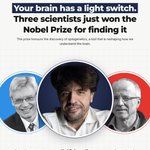
This week, Karl Deisseroth, Peter Hegemann and Georg Nagel won the Nobel Prize in Medicine for optogenetics, and the story behind it is beautiful.
It started with a tiny green alga. Hegemann and Nagel found a protein inside it that opens up the moment light hits it.
Deisseroth then placed that protein inside nerve cells, and suddenly scientists could do something remarkable:
- They could switch brain cells on with light
- They could switch them off just as easily
- They could see which cells drive our behaviour
Using this tool, researchers even found the exact cells holding a mouse's fear memory, and brought that fear back with light alone, with no danger around.
But the part I love most is why it happened. Deisseroth is a psychiatrist who saw patients who were not getting better, and he wanted to understand what was really happening inside their brains.
That is the same gap we are working on at Marbles Health, taking brain science from the lab into the clinic.
Congratulations to all three of you.

"Our generation is getting dumber" is one of the laziest takes on the internet right now.
Every few weeks a reel goes viral quoting some IQ study and everyone panics.
So let me say this clearly as someone who studies the brain for a living.
IQ tests measure one very specific type of intelligence.
Pattern recognition, working memory, and processing speed.
That is it.
They do not measure creativity, emotional intelligence, adaptability, street smarts, or the ability to learn a new skill from a YouTube video in 30 minutes.
A farmer who cannot solve a matrix puzzle but can read weather, soil, and seasons is not dumb.
A 16-year-old who never memorized a phone number but built an app that 10,000 people use is not dumb either.
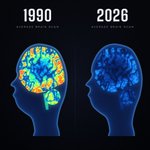
What actually happened since the 1990s is that intelligence shifted.
We stopped storing information and started learning how to access, filter, and apply it. That is not decline. That is adaptation.
Your grandfather memorized 50 phone numbers.
You know how to run a business from your phone.
Different skills. Different era.
Neither is smarter.
Stop measuring a fish by its ability to climb a tree and then calling the whole generation stupid.

I had stickers on my hostel cupboard at 19 that said "build a company the world uses."
Not a vision board or a Pinterest aesthetic.
Just handwritten stickers inside a cupboard in my single room at IIIT Delhi, arranged in a pathway like step one, step two, step three, leading up to that one line at the very top.
I never showed them to anyone.
Partly because I was not sure anyone would take it seriously, and partly because I was not sure I believed it myself yet.
But every morning I would open that cupboard to grab my things, and those stickers would look back at me before anything else did.
At that point I had no business background, no co-founder, no idea what neuroscience even was.
My father is an Air Force lawyer and my mother is a biology teacher.
Nobody in my family had ever built a company.
All I had was a feeling I could not explain and a cupboard that remembered it for me.
Six years later, the device we built at Marbles Health is :
→ Treating depression in 75+ hospitals across India.
→ Over 18,000 brain stimulation sessions delivered.
I still think about that cupboard sometimes.
The stickers worked.

I met the man who spends $2 million a year trying not to die.
Bryan Johnson sold his company to PayPal for $800 million.
Then he did something nobody expected, he turned his own body into a science experiment.
→ He takes 100+ pills every single day.
→ He has a team of 30 doctors monitoring every organ.
→ He finishes eating by noon,
→ He sleeps by 8:30 PM,
→ He exercises 6 hours a week,
→ He measures everything, his blood, his skin, his brain, his biological age.
The results are hard to ignore.
He is 48 years old.
His heart and lungs test like an 18-year-old's.
His biological age measures at 38.
His body ages roughly 8 months for every 12 that pass.
He claims he has not aged in 6 years.
His goal is not to live longer.
It is to make death optional by 2039.
When I met him in Mumbai, I expected to meet someone obsessed with living forever. Instead, I met someone obsessed with understanding the body, especially the brain.
That is where our worlds overlap.
He is trying to keep the brain from aging.
We are trying to fix the brain when it gets sick.

A few people will point out that Bryan was diagnosed with autoimmune gastritis in June this year, so let me address it directly.
Yes, he was.
And it is the most honest part of his story.
He spent $2 million a year, ran every test available, and his body still developed a chronic condition he could not prevent.
What the protocol did do was catch it.
11 yrs of low ferritin readings in his own data is what led to the diagnosis.
Most people with this condition find out decades later,
often only after it has caused something worse.
That is the real lesson.
You cannot buy your way out of biology.
But you can measure your way into catching it early.
The body is not a machine you can perfect.
The brain even less so.
It is an organ, it gets sick, and the earlier you can see what is going wrong, the better your options are. That is exactly why we build what we build.
You would never look at your best friend
and say "you are not good enough."
But you say it to yourself 40 times a day
and wonder why your brain feels broken.
Why do you forget why you walked into a room the moment you step through the door?
It is not your memory failing.
Your brain is doing it on purpose.
Scientists call it the Doorway Effect.
When you pass through a doorway, your brain treats it as the end of one scene and the beginning of another.
It literally files away everything from the previous room and starts fresh, as if someone hit "new tab" in your head.
Your brain evolved to do this because it was trying to keep you safe.
In a new environment, you need to be alert to new threats, so your brain clears the old information to make room for processing the new space around you.
The fascinating part is that the memory is not gone, it is just archived.
That is why when you walk back to the original room, you suddenly remember what you came for, your brain reopens the old file.
Your brain is not broken.
It is doing exactly what millions of years of evolution designed it to do.
The problem is that evolution never accounted for you walking to the kitchen to grab a charger. Your brain still thinks you are walking into a cave.

Telling someone with depression to "stay strong" is like telling someone with a broken leg to walk it off.
We would never do that with a broken bone because we can see it on an X-ray.
It is physical, it is real and literally nobody doubts it.
Depression is just as physical.
Parts of your brain that control how you feel, how you think about yourself, and how you focus literally start working differently.
We can see it. We can measure it.
It shows up on a brain scan the same way a fracture shows up on an X-ray.
But because you cannot see the brain from the outside, we tell people to try harder, stay positive, go for a walk, be grateful.
You would never hand someone crutches and say "now run." So why do we hand someone a pill and say "now be happy"?
Medication helps millions of people and I will never dismiss that. But 6 out of 10 people on it never fully recover because it only treats part of what is broken.
I watched someone I love go through exactly this.
That is the reason our company exists today.
The brain deserves the same respect as every other organ in your body.

I changed 9 cities before I turned 18.
Every three years, my father's Air Force posting would uproot us.
New school, new classroom, new faces staring at the new girl.
And just when I would finally start to belong, the transfer order would come again.
I never got to keep my friends.
The only friendship I managed to hold onto from childhood is from 6th standard, a girl from a Navy family who refused to let the distance win.
Everyone else faded.
For the longest time, this felt like a curse.
I used to wonder what it would feel like to grow up in one place, to have friends who knew me since kindergarten, to walk down a street that felt like mine.
I never got that.
But what I got instead was something I did not recognize until much later, the ability to walk into any room, anywhere, knowing absolutely nobody, and figure it out.
Every transfer taught me the same lesson: you will be alone, you will be new, and you will be fine.
That is not confidence.
That is adaptability trained into you by repetition.
And it turns out, building a company is just walking into unfamiliar rooms for the rest of your life.
The thing that used to feel like my biggest curse turned out to be the best skill I have.

Every second podcast right now talks about the brain.
How to focus better, sleep better, be more productive and detach from screens.
Good conversation, and I am glad it is happening.
But here is what almost all of it misses.
They talk about the brain like it is a productivity tool.
Something you optimize for better output.
The brain is also an organ.
It gets sick, like any other part of your body.
And when it does, we still do not fully understand why.
The treatments we have today help, but they only address part of the picture.
And most people never think to ask what else might be going on inside the brain that we are not treating yet.
That is the real reason to care about neuroscience.
Not to fix your morning routine.
To understand what is happening when something in the brain stops working right, and to find better ways to fix it.
We think about this every single day because it is the entire reason our company exists.
The trend of talking about neuroscience will fade.
The question will not.

In 2021, I walked into AIIMS Delhi every day for 3 months to prove that brain stimulation for brain health actually works.
A portable headband that sends mild electrical signals to specific areas of the brain to treat different conditions. Think of it as medication, but for the brain's electrical networks instead of its chemistry.
To validate it, we ran clinical trials at AIIMS Delhi during the peak of COVID. 25 patients, twice-a-day stimulation sessions for depression, over 10-days.
We wore double masks, gloves, full protective gear.
Our parents were terrified.
We were walking into a COVID hotspot every single day when the rest of the country was told to not even venture to the local park.
Meanwhile, our hardware components from South east asia were stuck in customs with no timeline.
We could not even build a proper prototype because basic chips were impossible to procure.
Both pillars of our business, clinical proof and the physical product were frustratingly slow to move forward.
Looking back, I genuinely do not know how we got through it.
But I remember this clearly, it was fun. It was fuelled by blind optimism of building a better future.
