


Wall Street's research moat has a GitHub problem.
Microsoft is part of it.
This Japanese gold-trading clip sent me down a rabbit hole.
I went looking for a bot. I found the parts for a quant desk.
meet the OPEN QUANT STACK.
RD-Agent + Qlib + LEAN.
> proposes new factors and model ideas
> writes code and runs experiments
> feeds results into the next research cycle
> trains models and evaluates portfolios
> backtests with configurable fees and slippage
> supports paper trading and live broker execution
RD-Agent works with Qlib. LEAN handles execution once you wire in your strategy.
Idea → code → test → feedback → repeat.
The research department itself is becoming programmable.
A quant desk is becoming something you assemble.
Repos below


this might be the most POWERFUL open-source AI trading setup i've seen this year.
the Fed moves TRILLIONS. most traders still wait for Powell to speak before making a move.
but there's a way to track how the market is pricing his next decision BEFORE it happens.
i found a workflow that combines quantitative Fed probability models with a Jane Street-inspired AI trading desk.
here's the setup:
→ track probabilities of every possible Fed rate decision
→ map CPI, payrolls and Fed speeches to probability shifts
→ detect major changes in market expectations before FOMC
→ use AI agents to analyze what's driving the repricing
→ backtest how those shifts affect different assets
→ filter out false signals and enforce strict risk limits
the insane part isn't getting AI to predict the Fed.
it's building a system that turns the world's biggest macro events into measurable, testable trading signals.
Wall Street has spent decades building infrastructure around this exact problem.
now you can start building your own.
stop reacting to Powell. start analyzing what the market knows before he speaks.
repos below.


A $93B HEDGE FUND. TWO INPUTS. THREE OUTPUTS.
Coatue's Head of AI described a hedge fund as a function.
External context + internal context go in.
What to buy, how much and when come out.
I turned that mental model into a build prompt.
Here is the architecture:
1. INGEST
News, prices and filings through APIs. Everything an investor sees on a work screen should be available to an agent.
2. REMEMBER
Positions, liquidity, risk requirements and previous investment cases. Coatue's advantage includes decades of documented internal context.
3. MAP
Break the decision into nodes. Define each input, output and branch. One step's output becomes the next step's input.
4. ROUTE
Code for explicit rules. ML for statistical relationships. LLMs for complex text. People for tasks that require human interaction and judgment.
5. EVALUATE
Give each node a measurable quality target. Without a target, changing models and prompts is just turning knobs.
6. DECIDE
Compress the evidence into selection, size and timing. Keep the reasoning traceable to the inputs.
The goal is to maximize decision quality at every step.
Your agent can read today's news.
Can it remember why yesterday's investment thesis failed?
Save the prompt before building your next trading agent.


wall street spent 30 years building trading systems that retail traders were never supposed to compete with
that advantage is starting to disappear
S&P 500 futures. AI bias at 59 - bullish
sellers aggressively hitting the bid. price refusing to move lower
CVD divergence. seller absorption. VWAP confluence
then aggressive buyers step in
a +4R trading opportunity emerges from something most retail traders would have completely missed
the signal wasn't a magical AI prediction
it was the combination of market structure, real order flow, and machine-generated context
jane street. citadel. two sigma. hudson river trading
these firms built billion-dollar operations around one fundamental advantage
turning massive amounts of market data into systematic, testable decisions
not guessing. not chasing indicators. not asking an AI chatbot which stock will explode tomorrow
data. hypotheses. backtesting. statistical validation. risk management. execution
for decades, building that kind of infrastructure required millions in capital, advanced mathematics, and teams of quantitative researchers
that barrier is collapsing
Claude can now connect to quantitative research infrastructure through QuantGPT
historical market data. strategy research. backtesting. performance comparisons. validation workflows
QuantGPT Pro adds cloud execution for user-written strategies connected to Alpaca
what once required multiple specialized tools and serious engineering expertise is becoming accessible through an AI interface
and that's where the real disruption begins
AI can help identify a market hypothesis
quantitative infrastructure can test whether the hypothesis survives historical data
order flow can provide context for what buyers and sellers are actually doing
execution systems can turn validated rules into monitored trading operations
none of this guarantees a profitable strategy
but it fundamentally changes who gets to investigate one
the average retail trader is still collecting indicators and searching for the perfect entry
the next generation is learning to build research systems that can reject bad strategies before real money is involved
the biggest shift in trading isn't that AI can predict the market
it's that the tools to research, test, and execute systematic strategies are moving beyond institutional trading desks
wall street spent decades making quantitative infrastructure an exclusive advantage
ai is making access to that infrastructure a completely different game
most traders are still looking for the next signal
the real opportunity is learning how to build the system behind it


i nearly lost my mind when i realized how simple this setup was.
AI can test 100 variations and hand you the luckiest backtest as "alpha."
this prompt puts Claude Code, Grok Bot and Jev on that exact problem.
> Claude Code builds the desk.
> Grok Bot keeps research running 24/7.
> Python attacks the backtest with fees and unseen data.
> Jev checks live conditions before each candidate entry.
failed checks block the trade. code controls the orders and risk.
paste this into Claude Code with your strategy, exchange and risk limits.
start with the backtest you trust the most.


this is f$$king insane
the trader goes to sleep.
the trading desk keeps working.
here's how to build a 24/7 Jev setup for block-speed crypto trading.
the goal is simple -
read the order book as new blocks land
filter dangerous conditions before taking risk
let hard rules control every order
Jev's published response time is 70–500 milliseconds. narrow questions in, structured answers out.
no paragraph standing between the market and your execution code.
here is how to build the setup:
1. open claude code and scaffold an async Python worker. run "pip install typesafe-sdk", configure your API key, pin "jev-1.13.0" and start in paper mode.
2. connect one market: MON/USDC on Kuru. stream new Monad blocks, read the book and recent trades, timestamp every snapshot. keep one model request in flight and process the newest state.
3. calculate spread, depth imbalance, aggressive buying versus selling, short-term volatility and inventory in code. give Jev those numbers with recent history. don’t pay AI to do arithmetic.
4. ask six independent questions in one call: market regime, direction over the next 10 blocks, flow toxicity, liquidity stress, setup quality and pressure to reduce exposure. define the answer options and scoring criteria explicitly.
5. code applies the trading rule: quote toward the directional bias only when quality clears your tested threshold and the flow gates pass. use post-only limits, reject stale answers and enforce position, order-size and daily-loss caps. risk controls keep running when Jev doesn’t.
6. replay recorded order books on an untouched period. include fees, gas, execution delays and conservative fill assumptions. then paper trade continuously, logging rejected setups, fills, drawdown and whether the model’s probabilities match outcomes.
$0.042 per million input tokens. output is free.
the expensive part is finding out your beautiful backtest assumed fills you would never get.
let Jev judge the conditions.
let code price the order.
let the kill switch have the final word.


this 46-second clip made me question every price on Polymarket.
the idea is simple:
use stocks and options to build a probability model, then compare it with prediction-market prices.
take one question: which company finishes first by market cap at the deadline?
here's the Jev setup i'd build:
ALPACA-PY → equity prices and option chains.
QUANTLIB → pricing and volatility tools for a custom probability model.
POLYMARKET SDK → prices and order books for the corresponding contracts.
Jev → reads settlement rules and relevant evidence, checks the model’s assumptions against the contract, and sorts candidates:
INVESTIGATE. WATCH. SKIP.
code measures the gap. Jev evaluates the context.
one outcome. two estimates.
the disagreement becomes your research queue.
that's what stuck with me:
a market price is a hypothesis you can test.
and the tools to start testing it are already on GitHub.
repos below

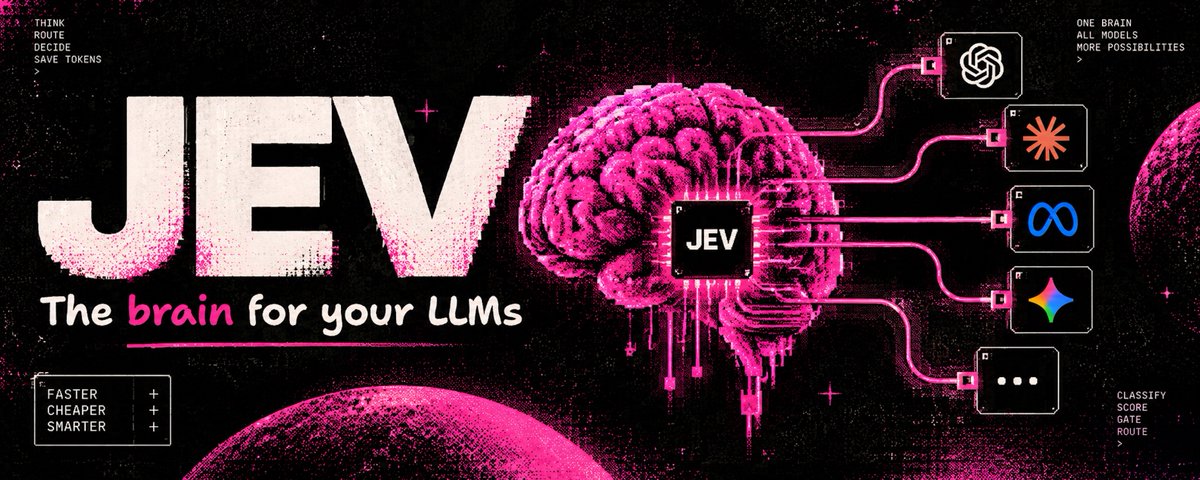

the trader everyone notices has a wall of screens
the quiet developer nobody notices is building a system that can run without them
one spends the night watching candles
the other spends it reading three github repos
an sdk. a trading loop. a decision lab.
at first it looks like a pile of code
then the pieces start connecting
market data becomes a question. Jev evaluates it. code turns the answer into an action.
buy. sell. wait.
the developer starts with one market and one decision
then adds the rules that make the system worth running
when to ignore a signal. when to stop trading. when to ask for another opinion.
every decision leaves a record
every bad decision becomes something they can investigate and improve
what looked like a secret trading desk becomes a project they can take apart
the tools to start are public
you can inspect the loop, change the questions and test your own version
one person finishes the night looking for someone else's next signal
the other has started building a system they understand
both wanted to get closer to the market
one kept watching
the other opened github
the three repos are in the pinned comment
This quoted post is unavailable.

THIS IS F**KING INSANE
but Opus 5.5 can help you turn the liquidity walls on a screen like this into a trading strategy you can ACTUALLY TEST.
the clip shows the market view. here is how to build a research workflow around this kind of data:
Opus 5.5 + NautilusTrader + Databento.
Opus develops hypotheses and writes code.
Databento supplies market data.
Nautilus replays the events and evaluates the strategy.
how to set it up:
1. install NautilusTrader and configure its Databento adapter. choose one instrument and historical order-book/trade data. data access and model calls have their own costs.
2. define what "a wall" means: displayed size, distance from price and how long it stays there. specify how disappearing orders affect the signal.
3. ask Opus for 3 testable hypotheses linking that liquidity to executed trades and the subsequent price response. each needs entry, exit and invalidation rules.
4. have Opus implement the rules as a deterministic Nautilus strategy. the model does research; the strategy processes market events.
5. replay the recorded data with fees, spread and explicit fill assumptions. a touched limit order does not automatically mean you got filled.
6. test on untouched sessions and raise execution costs. keep a record of every variant you tried.
7. freeze a survivor and paper trade it with a compatible feed and simulated execution. live orders need a separate broker adapter and hard limits.
the glowing level is the hypothesis.
what happens next is the test.
forget the bookmarks and just do it.


this feels like a f*cking cheat code
a trading bot can cite 10 sources and still have zero evidence for the trade
RAG finds the closest passages. the closest passage can still be last quarter's guidance or the sixth copy of the same headline
feed that straight to the LLM and a search match can become your reason to buy
you just turned similarity into conviction
put Jev between retrieval and generation
does this passage actually support the claim?
does it contradict the setup?
is it only talking about the same ticker?
Jev returns structured judgments. code keeps useful evidence, preserves contradictions, and drops the noise
a second check asks whether the surviving context is enough to answer
if it isn't: more research or WAIT
3 repos to build the stack:
-> FinMem: layered memory for an LLM trading agent
github.com/pipiku915/FinMem-…
-> jev-reranker: Jev reranking and evidence filtering before generation
github.com/hotchpotch/jev-re…
-> QuantDinger: paper/live trading with a Jev decision gate before entry orders
github.com/OpenByteInc/Quant…
$0.042 per million input tokens. output is free
10,000 total input tokens across the Jev checks = $0.00042
data, embeddings and the writing model have their own bill
the catch: an evidence score is not a win rate. keep the rejected candidates and paper trade the full loop. configure failed checks to block new entries while keeping exits available
"let RAG find the context.
let Jev check the evidence.
let code decide whether an order is allowed."
bookmark this before your bot mistakes a citation for an edge

jev is making the calls on polymarket for fractions of a cent. your next trading rival might not be human
this one spends the round saying no
jev returns a decision. the software checks it against the entry threshold
the call shown in the log: 485ms. $0.000250
the output stays below the threshold. the bot holds flat while bitcoin moves and the clock runs down
no trade is still a decision. it just doesn't give you a position to brag about
that's where jev fits: small judgments the software can use directly, without generating another explanation at every fork
the model judges. code enforces the rules. the log shows what happened
before asking whether your ai can find a winning bet, ask whether it can leave a market alone
bookmark it

we built a local Jev-style AI trader. its most important result was an order that never got sent.
Cloudflare's Jev-compatible Clef had three choices: NORMAL, WIDE, PAUSE. No BUY button. No permission to change position limits. Code owned the order book, quotes, cancels and fills.
We ran a stress replay. As order flow turned one-sided, the bot moved from NORMAL to WIDE and pulled its quotes back. When the pressure persisted, it moved to PAUSE and stopped sending new orders.
Then came the result that mattered more than the mode switch: an unsafe book stopped new orders in code, without waiting for Clef's next answer. The model could change how the bot quoted. It could not talk the bot past a hard stop.
The log showed the chain from market snapshot to model choice to quote action to risk veto. It also kept compute and trading costs beside those decisions.
No green P&L screenshot. The result was a bot that could refuse its own model before an order reached the exchange.
save this, then open the piece below

the trader everyone follows is trying to call the next move
the builder nobody follows is automating the decisions between the chart and the order
both are looking at order flow. one needs to stay at the screen. the other is turning parts of that work into software
that's the opportunity hiding behind jev
most conversations about ai trading start with the same question: can it find me a winning trade?
a more useful starting point is the decision you keep making by hand
does this sequence match the setup? has the evidence changed? continue, wait, or send it for review?
those questions can become a repeatable loop
our stack gives each part a specific job
the llm researches and develops the trading thesis
jev reads the current state and chooses from answers we defined in advance, with probabilities attached
code calculates exposure, enforces the limits and handles permitted orders. exchange records confirm what actually filled
unclear evidence goes to review. hard limits run independently of the model
now each judgment has an input you can replay, an answer you can inspect, and an outcome you can check
that's why jev belongs here: the software needs a decision it can branch on, and repeatedly generating an explanation adds work to that path
start with one recurring judgment. define its possible answers. test the loop in paper mode
save this before your next session
the opportunity is hidden in the part of trading you still repeat by hand
A developer finds a trading bot on GitHub on Friday night.
He pairs CloddsBot with an OpenAI Dot, gives the bot a test account, and goes to sleep.
By morning, the account is up $2,000.
The interesting part is how the two agents divided the work.
CloddsBot scanned Polymarket, Binance, and other markets for opportunities. Its trading and risk systems handled the orders.
Before the run, the Dot checked the setup and risk limits. Overnight, it reviewed market data, signals, filled orders, and risk events through a protected read-only connection. Its cloud computer kept working after the developer closed his laptop.
In the morning, he opened more than a P&L figure. He could trace what the bot found, what it tried to trade, and what actually filled.
A few years ago, that workflow would have looked like a small trading desk. Here, it started with a public GitHub repo, a personal cloud agent, and one developer making the final call.
Repo: github.com/alsk1992/CloddsBo…