



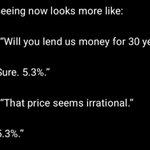


Part 3: The road where we make it through. Everyone asked what could be brought back through the doors. Hardly anyone asked how much life might be lived through them.
Part 2: Then the race began. At Ada's bakery it showed up as an oven nobody could repair, because the electrician had gone to work on the great portals.
Part 1: At first, the doors to the other dimension were so small that only numbers could get through. Ada's grandmother bought one for her bakery, and it gave her back her evenings.
The full 11-minute film is on YouTube, and there's an illustrated book version as a free PDF. Both are here: the-little-doors.vercel.app

Superintelligence sounds like it's going to suck. But I don't think so.
It helps to stop thinking about computers doing everything and imagine fiction about our world instead. Here's a bedtime story about the singularity that does just that. Shorter clips in the thread.
If you've seen the viral music videos made by Opus 5.5, then you've seen how powerful AI models have become. We're in the endgame of Nick Bostrom's thought experiment that makes everyone wonder, "Am I living in a simulation?" Well, if the models keep getting more powerful, maybe!

April 15, 1912. A science teacher is on the Titanic's deck when a crew member calls up: "Any ladies on your deck?" "No." "Then you had better jump."
AI models are now strong enough to simulate experiences like this one. This version is by Claude Opus 5.5. ancestorbench.com/c/beesley-…
it's all fun and games until the absurdly cute chatbots from HR put a meeting on your calendar in mid 2027
june 2025. at the time, it was moderately controversial to believe in superintelligence at all wired.com/story/mark-zuckerb…

don't blame me, I voted for extreme intelligence


“Supreme Intelligence,” probably because of its relationship to the Supreme Court, is losing badly to both “Superior” and “Extreme Intelligence.” Therefore, we are going to take “Supreme Intelligence” OUT, deleting it as a qualifier, and let you vote for the Final Two: Superior Intelligence, or Extreme Intelligence. A fresh Vote begins now! President DONALD J. TRUMP

> ... at this point, saying that AI will cure cancer is more a cliche than it is inspiring, and most people think it is deceptive. The thing that will work is *actually curing cancer*.
what a time to be alive

1/2 Thanks Gavin for an especially thoughtful exchange. I don't usually spend much time on social media but I wanted to engage here because it really brings out the heart of an important conversation.
First, on regulation, I think that “either concentrate it in the hands of a chosen few companies and politicians via regulation or distribute it widely” is a false choice. I know that there’s a sort of Silicon Valley shorthand where regulation = regulatory capture = concentration of power, but I’ve always found this to be an overly simplified picture of the world. Many people outside this bubble think of regulation as something that constrains corporate power and benefits ordinary people. I don’t necessarily agree with that perspective either, rather I think it’s complicated and really depends on what the “regulation” consists of. But in particular I think that those in the “regulation = regulatory capture = concentration of power” frame often underrate the decentralizing power of objective and fair institutional processes. A crude analogy is that the formal court system can sometimes feel stuffy and elitist, but it does a much better job of defending the rights of vulnerable individuals than the alternative, mob justice. At their best, institutions can vest power in ideas rather than people, and thereby decentralize that power.
This is why Anthropic has always made its policy proposals very carefully. We try very hard to make proposals that disadvantage (slow down) frontier AI companies while *advantaging* smaller competitors. California’s SB53 (which we supported), and even the much-maligned SB 1047 (which we were ambivalent on), completely exempt any company below a certain amount of revenue or model training costs from being covered at all (it was $500M for SB 53, lower for 1047 but we objected to that). More recently the testing process we’ve advocated for at CAISI and the White House involves more rigorous tests for frontier models than off-frontier models — something that differentially advantages challengers. Similarly, the “Pacing the Frontier” letter envisions (or at least Anthropic’s preferred implementation of it envisions) modulating the pace of the very best models while not constraining those who are catching up. This hurts the business interests of the frontier labs and helps challengers, including open-weights!
Overall my view is that AI is *structurally* a technology that tends to concentrate power, for reasons that have nothing to do with regulation (more to do with the extreme implications of the scaling laws). Open-weights do help some with this but are nowhere near a sufficient solution because they simply shift the concentration somewhat to those with the most compute and chips (which are roughly the frontier labs plus maybe hardware providers). By contrast I think the right “rules of the road” can simultaneously (a) address AI’s cyber/bio/alignment risks, (b) institutionally constrain the power of the frontier AI companies, and (c) leave room for open-weights models while also addressing the specific risks that they bring.
BTW I do not think that the events of the last few months have “failed to result in [my] preferred regulatory path”. The approach that the Trump administration is reported to be taking — pre-deployment testing for frontier models, and also testing of open-weights models when they get closer to the frontier — is one that I am very supportive of, though of course I have to see the details to be sure. I am also supportive of Demis Hassabis’ ideas around a FINRA-like entity. This contrasts with six months ago when most of the industry was still pushing for preemption of all state regulation and no apparent federal approach either.
I wanted to buy almonds last week on a trip to New York, but they were locked up. I've never seen almonds locked up before. I think we should abolish prisons for almonds

Reasoning effort mainly changes how many output tokens are used. But most spend is input tokens. Adjusting reasoning effort when you're hitting limits is the wrong move. Use Terra high (or max/ultra) if you don't care about latency.
this is pretty much the plot of Her (2013)


