



Nikhitha retweeted

Sam Altman (CEO of Open AI):
"You no longer need to write prompts."
In just 38 minutes, he explains how to use ChatGpt at a level that most people can't even imagine.
It's talk he gave to stanford students. A friend sent me the recording last night.
After watching it, I realized I was only taking advantage of about 15% of what this tool can really do.
Watch it in full and then read the guide l leave below on how to create a system that prompts itself.
Nikhitha retweeted

MOTHER ON SRI RAMAKRISHNA
What a unique man he was! How many minds he illumined! What unceasing bliss he radiated! Day and night his room echoed and re-echoed with laughter, stories, talk and music.
HOLY MOTHER SRI SARADA DEVI



Nikhitha retweeted

A RARE GENIUS FROM ANDHRA PRADESH- TRANSFORMATION FROM A YOGI / SAINT TO A NUCLEAR SCIENTIST -
The Life of Dr. Prof. Swami Jnanananda (1896–1969)
Prof. Swami Jnanananda (1896–1969) was a distinguished Indian nuclear physicist and yogi, famously described as
"the saint from the east and the scientist from the west."
He is best known for his pioneering work in establishing nuclear research in India and for his synthesis of spiritual philosophy and modern science.
Developer of the thick Magnetic Lens Beta-ray Spectrometer.
Early Life and Spiritual Journey :
Birth:
Born as Bhupathiraju Lakshminarasimha Raju on December 5, 1896, in Goraganamudi, West Godavari district, Andhra Pradesh, India.
Family Background :
His father, Rama Raju, was a wealthy landlord and Vedic scholar. Growing up in a house filled with ancient scriptures, Jnanananda developed a deep interest in spirituality and mathematics from a young age.
Renunciation :
At the age of 21, inspired by buddha he left home for the Himalayas to pursue spiritual practices. He spent approximately 10 years there, practicing yoga and studying Vedic literature.
Sanyasa:
He was initiated into Sanyasa (monkhood) by Swami Purnananda, who gave him the name Swami Jnanananda.
Philosophy :
During his spiritual period, he authored the Purna Sutras (or Purna Sastras), a major work on Vedic philosophy.
His Major Philosophical Works :
1. Purna Sutras (Available in Sanskrit, Telugu, Hindi, and German).
2. The Philosophy of Yoga (Lectures on Raja Yoga).
3. The Essence of Indian Philosophy.
4. Science and Religion.
5. Transcendence (A study of the state of Samadhi).
Authored Nuclear Physics Textbooks
The Elements of Nuclear Physics (1962): A comprehensive 580-page textbook used by generations of Indian postgraduate students.
Nuclear Models and beta-decay (1975, Posthumous): A deep dive into the theoretical structures of the atomic nucleus.
Academic and Scientific Achievements :
Initially traveling to Europe in 1927 to print his philosophical books, Jnanananda developed an interest in physics that led to a world-class academic career.
Dresden University (Germany):
In 1927, Jnanananda traveled to Germany to publish his philosophical writings. While there, he attended a lecture by Prof. Dember on Einstein's Theory of Relativity.
Finding his mathematical background insufficient to grasp the complexities, he decided to master the subject.
He remarkably completed a German undergraduate course in Physics and Mathematics in just two years (by 1929), financing his studies by giving over 150 lectures on Yoga across Europe.
Charles University (Prague):
Conducted research on High Tension and X-ray Physics under Prof. Dolshek. He was awarded a Doctor of Science (D.Sc.) in 1936 for developing precise methods in X-ray spectroscopy.
University of Liverpool (UK):
During World War II, he worked under Sir James Chadwick (the discoverer of the neutron).
He earned a Ph.D. (1943) for his research on Beta-ray spectroscopy and the development of the "Thick Magnetic Lens Beta-ray Spectrometer."
Key Details of His Contribution :
Thesis and Design:
In 1943, he submitted his PhD thesis at the University of Liverpool titled "Thick magnetic electron lens Beta-ray spectrometer, its theory construction and its application for the measurement of energy spectra."
Innovation:
Unlike "thin lens" spectrometers that use a narrow coil, Jnanananda's design utilized a thick lens (a more extended magnetic field).
This provided a much greater focusing efficiency and allowed for the investigation of high-energy radiations that previous instruments struggled to capture.
Performance:
His spectrometer was notable for its ability to focus high-energy electrons (up to 15 MeV in theoretical design, with tests confirmed up to 3.2 MeV), which was quite significant for nuclear physics research at the time.
University of Michigan (USA):
Continued research on radioactive isotopes and completed his book High Vacuum: Principles, Production, and Measurement (1947).
University of Michigan , AnnArbour :
Research on Radioactive Isotopes
At Michigan, Dr Jnanananda utilized the university’s advanced cyclotron and research facilities to conduct extensive investigations into the energy levels of various radioactive isotopes. His work provided precise data on the decay schemes and energy spectra of:
Uranium-X1 (Thorium-234) , Gold-198: Antimony-124, Tantalum-182, Tungsten-185 and Iridium-192.
Publication of "High Vacuum: Theory, Analysis, and Measurement" (1947).
While in the United States, he finalized and published his influential technical book, "High Vacuum: Theory, Analysis, and Measurement" (1947).
This book became a standard reference for physicists and engineers working on vacuum technology, which is essential for the operation of particle accelerators and spectrometers.
Establishment of Indian Nuclear Research :
upon his return to India in 1947, Dr. Prof. Swami Jnanananda was invited by the Government of India to join the newly established National Physical Laboratory (NPL) in New Delhi.
His appointment was part of a broader effort by the post-independence government to recruit top-tier Indian scientists working abroad to help build the country's scientific infrastructure.
Role and Contributions at NPL (1948–1954)
Initial Appointment: He joined as a Senior Scientific Officer in 1947/48.
Promotion:
Due to his expertise in high vacuum technology and nuclear instrumentation, he was promoted to Assistant Director and Head of the laboratory/division in 1950.
Infrastructure Building:
He was instrumental in drafting the comprehensive development plans for the NPL.
Specifically, he focused on establishing nuclear measurement facilities and vacuum standards, drawing directly from his research at the University of Michigan and the University of Liverpool.
Technical Standards: His book, High Vacuum, which he finished in the USA, served as a foundational guide for the laboratory's experimental setups during this period.
Contributions to Andhra University :
Transition to Andhra University
In 1954, while still at NPL, he met with a serious car accident near Bhimavaram. During his recovery, he was approached by the Vice-Chancellor of Andhra University, who invited him to establish a dedicated nuclear research department.
Academic Pioneer:
He established a separate Department of Nuclear Physics on July 1, 1956—one of the first of its kind in India.
Infrastructure Development:
He designed and oversaw the construction of a dedicated building for the department (completed in 1958) and equipped it with state-of-the-art instrumentation.
The Swami Jnanananda Laboratories: These laboratories became a hub for nuclear research, specializing in beta-ray and gamma-ray spectroscopy.
Legacy: The university's research center was named the Swami Jnanananda Laboratories for Nuclear Research in his honor.
Mentorship and Human Capital
Perhaps his greatest contribution was the "Academic Pillar" he created through his students.
He guided scores of scholars for their D.Sc. and Ph.D. degrees.
His students went on to lead research at the Bhabha Atomic Research Centre (BARC) and the Tata Institute of Fundamental Research (TIFR), effectively "seeding" the Indian nuclear program with trained experts.


Nikhitha retweeted

🚀 Launching the Corporate Mitra Learning Journey!
ICAI launches the Corporate Mitra LMS to empower learners with knowledge & practical capabilities to support MSMEs.
📅 31 Aug 2026 | 5:30 PM
🔗 live.icai.org/cm/31082026
🎓 Learn. Apply. Facilitate. Enable.

Nikhitha retweeted

Words of great wisdom from 400BCE, or even earlier...
Have a great day and a great week!
.


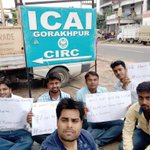
Protests at Dhanbad Branch of ICAI
#icaipresidentmissing #dearicaiplesechange @canacofficial @caparveensharma


If protest are going at your local ICAI branch. Please take pictures and tag me. I ll retweet. #dearicaiplschange #DearICAIAmend39_4


Please don't do any messages to members.
They will have to amend.
#icaipresidentmissing
#dearicaiplesechange
#DearICAIAmend39_4

We Students are Fighting for our rights and this ICAI is in the mood of Navratri Celebration..
Very Shameful.
#icaipresidentmissing
#ICAIamend39_4
#icaipleasechange
@canacofficial
@caparveensharma


#icaipresidentmissing
Missing since yesterday...
Was not at home or ICAI Head Office..
Supposed to have celebrated Birthday while students were protesting against ICAI
Please find him as soon as possible and Contact ICAI
