
AI, Agents, and more AI.
California, USA
Joined March 2010
- Tweets936
- Following265
- Followers112
- Likes529






If you’ve been on call, you know that sinking feeling. Wishing the teams behind the screens a breakthrough soon.
#Microsoft #MicrosoftOutage #outlookdown

304




One idea that stuck with me was Satya's framing of models as "insider risks" from "Models as Insider Risks in the Super Intelligence Era". It reinforced a hypothesis I’ve been thinking about — and gave it a clearer architectural direction:
The enterprise AI race may not ultimately be about who has access to the smartest model. It may be about who controls the boundary around it.
Enterprises have spent decades protecting their IP, customer data, business logic, permissions, and operational context. As agents gain the ability not just to read that information but to act on it, sending all of that context to increasingly powerful external models creates a very different risk surface.
And this is where I think smaller, private, and domain-specific models become much more interesting.
Not because they will outperform frontier models on raw intelligence.
Because for many enterprise tasks, you may not need the world’s smartest model. You need sufficient intelligence inside a system you can control.
Use frontier models when the task requires frontier reasoning. But keep sensitive context, permissions, execution, verification, and audit inside an enterprise-controlled boundary — potentially using smaller models much closer to the data.
The architecture starts looking less like:
Enterprise → Model Provider → Intelligence + Context + Action
and more like:
Enterprise-controlled context + policy + actions → Model as an interchangeable intelligence layer
That distinction matters.
Models will keep getting smarter. They will also become increasingly interchangeable.
Enterprise context, IP, permissions, governance, and the authority to act are not interchangeable.
The moat may therefore move from who provides the intelligence to who controls the context and action around that intelligence.
Rent the intelligence. Own the control plane.


20


I’ve been seeing this shift in my own work — increasingly operating from the terminal, where the UI becomes secondary and what matters is giving agents the right context, tools, and control.
I think enterprise software is heading the same way.
The opportunity isn’t to put an AI/API layer on top of SaaS built for humans. It’s to reinvent the systems underneath it for agents — around context, state, governance, and action.
That’s the part of the “Infinite SaaS Factory” idea that resonates most with me: AI doesn’t eliminate systems of record. It forces us to reinvent them.
1
25

Gaurav Nigam retweeted

We instituted an official AI Writing Policy at @Clay.
Massive thanks to @sophiebits on our engineering team who wrote this.
Originally this was just for eng, but other teams found it so helpful we expanded it company-wide.
Here are the four guiding principles:
1. You must stand behind every idea and sentence
It is your responsibility to make sure that the entire document is representative of your own thoughts before you share it.
2. Writing is thinking
Spending time on the writing process teaches you more about your topic. If you circumvent this process, you will walk away with a poorer understanding of the subject matter.
3. More time should be spent writing a document than consuming it
If you generate a document from a short prompt then ask your readers to go through the longer output, you are disrespecting their time. They can talk to ChatGPT themselves if they want to.
4. Longer is not better
AI makes it easy to generate long docs, and it loves padding them with sentences that say nothing. If you're producing docs from a short prompt, consider just sharing the prompt.
You can read (and borrow) the full policy below. Hopefully we all communicate a bit more clearly now :)

Gaurav Nigam retweeted

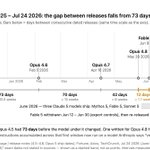
Opus 5.5 performs at the level of Fable 5.1. It's ~30% faster and ~40% cheaper than Opus 5 per task.
In Claude Code:
- 5-hour session limits increase 20% today
- Opus 5.5 is priced lower, so it goes 25% further within limits
- Pro, Max, and Team users get a reset to use anytime




Independent evaluators ran Opus 5 against a held-out puzzle suite called Witness. Its ARC-AGI-3 jump didn't transfer: 43.4 vs kimi-k3's 42.8, both within noise. Be skeptical of what benchmark gains actually generalize to.
1
45
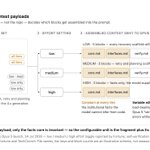
Deletion is asymmetric. A stale behavior block costs a few hundred tokens. A load-bearing one you cut buys a silent regression on the one task you didn't test. That asymmetry is the whole argument for measuring instead of guessing.
1
12
Full piece, with the method for building your own held-out task set before you delete anything: nigamg.com/blog/half-your-cl…
18
Opus 5 shipped with a user-facing effort dial: low, medium, high. Anthropic claims the model is stronger at verifying its own work. If that's real, some behavior blocks may be redundant at high effort and still necessary at low. Nobody's tested this publicly.
1
23
Every context file has two kinds of blocks. Facts about your repo (this migration locks a live table) never expire. Behavior patches (don't weaken a failing test) are scar tissue from one model's specific mistake on one specific day.

1
24
