
Physicist/ML researcher creating artificial universes. @nichg@sigmoid.social
Joined November 2012
- Tweets7.4K
- Following241
- Followers2.1K
- Likes4K





Experiments with #stablediffusion... Its very hard to get it to generate images with average value outside of the 0.4..0.6 range, even if you fine-tune on a solid black image. Turns out its a property of the noise distribution. i.i.d 512x512 Gaussian has very close to zero mean.
Nicholas Guttenberg retweeted

How can Transformers and other nets implement general-purpose learning algorithms in-context? Training on 2^14 tasks leads to strong generalization. Diff. to scaling laws, the memory size matters more than parameter count!
Meta-Learn Workshop #NeurIPS2022
louiskirsch.com/gpicl

Nicholas Guttenberg retweeted

Powderworld is a lightweight simulation environment for understanding AI generalization, supporting:
- modular & emergent ruleset
- expressive RL task space
- 10k timesteps/sec via GPU
Paper: arxiv.org/abs/2211.13051
Blog + Online Demo: kvfrans.com/static/powder/
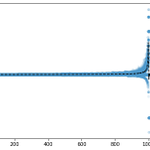
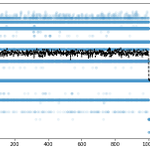
Interesting dynamics of inference... Imagine a coin flip process, except you entertain hypotheses that after 1,2,3,...,K flips the sequence will repeat. This is the distribution of predictions that the next flip will be tails as you observe more and more for K=1000

So the cluster would have the biggest impact on expected values of things just before you stop believing in it entirely...
Is there such a thing as an 'addictive experiment' in science: an experiment which no matter how many times it has been repeated, never seems unimportant to repeat again? (e.g. remains asymptotically interesting in the limit of infinite observations)
Hm, maybe this works. Imagine a sequence of heads or tails. Base model space might be an iid biased coin with beliefs over the bias of the coin. Now add to that model space 'repeating sequences of length N where elements of the sequence are biased flips' for all values of N
Messing with the LMS scheduler in Stable Diffusion. One trick I've found is to use scheduler.add_noise to do partial re-diffusions, e.g. starting halfway through given a starter image. So I can basically let it drift an image by iteratively rediffusing.
Any reason why Stable Diffusion style autoencoder + diffusion on latents couldn't be used for very long self-consistent text generation - like 30k tokens+? Have people already done this?