

A new foundation for direct and secure device communication.
Joined August 2022
- Tweets330
- Following70
- Followers68
- Likes224




Pinned Tweet
It’s time to own your life again.
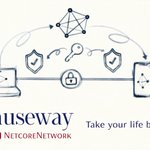
Today, we have released the first version of Causeway that allows you to do just that.
Install now at netcore.network/causeway
Why yes, check it out here netcore.network/causeway


If you want to remotely access a smart fridge, you should:
a) have to prove authority and authenticity in a trustless way and
b) access data directly from the fridge via an encrypted p2p tunnel. Also, permission to listen doesn’t need to mean permission to control.
Here2help
NetcoreNetwork retweeted

A lot of commentary on this is blaming internet connectivity itself, which is throwing out the baby with the bathwater (sad, wrong).
If you want to remotely access a smart fridge, you should: a) have to prove authority and authenticity in a trustless way (decentralized networks can help you here) and b) access the data directly from the fridge via an encrypted p2p tunnel. Also, permission to listen doesn’t need to mean permission to control.
Not every problem, but many begin with how communication occurs over the internet. For a message to get from Device A to Device B, it’s often a multi-hop process that requires reliance on third-parties for things like identity, coordination, and storage. Every hop and third-party reliance adds a set of vulnerabilities. For a simplified example, if you use Google as an identity provider and Google has an outage or gets hacked, you won’t be able to get your message through even though your devices may both be online and working.
The fix lies in stripping out dependencies and reducing data flows to only exist when necessary between authorized parties. This minimizes attack surfaces and maximizes signal-to-noise ratio.
Two critical characteristics of a better system:
1. Identity without a central gatekeeper. You control your identity through cryptographic keys. A decentralized network coordinates connections and acts as the trustless authority.
2. Encrypted communication between devices. A peer-to-peer layer connects devices directly whenever possible, with end-to-end encryption. When a relay is necessary due to difficult network topologies, it forwards encrypted data without being able to read it.
The headline next week will likely be something that sounds different, but has the same underlying pattern.

BREAKING: 🇫🇷 A major cyberattack has hit supermarket refrigeration systems across France, reportedly causing fresh and frozen food to spoil after hackers remotely manipulated temperature controls.
According to BFMTV, the attack began overnight from Sunday into Monday, targeting older versions of refrigeration-control software supplied by Danish company Danfoss.
The attackers allegedly exploited the systems’ defrosting function, forcing refrigeration equipment to heat continuously instead of keeping products cold. Temperatures were reportedly set as high as 50°C, destroying entire stocks of food within hours.
Several major supermarket chains have been affected, including Intermarché, Super U and E.Leclerc. Metro stores and independent businesses, including butcher shops also have been impacted.
Around 150 Intermarché stores are reportedly affected, according to industry sources cited by BFMTV. The full number of affected locations remains unclear.
The financial damage is already significant. In Haguenau, Alsace, an Intermarché store reportedly lost its entire frozen-food stock, worth approximately €50,000. A nearby Super U allegedly had to discard both fresh and frozen products, with losses estimated at €220,000. An E.Leclerc store in the same town was also affected, although its losses had not yet been calculated.
The combined losses reported at the Intermarché and Super U stores in Haguenau alone amount to around €270,000. Nationwide damage could reach several million euros.
Intermarché reportedly confirmed the incident in an internal communication, warning that several stores had suffered losses of frozen products. Coopérative U also acknowledged the attack and established crisis teams to assist affected stores and coordinate with refrigeration specialists.
Technical investigations are ongoing, and the full extent of the damage has yet to be established.
Authorities and companies are still working to determine the full circumstances of the attack. The identity of the perpetrators has not been confirmed.


NetcoreNetwork retweeted
Really simple, direct p2p use cases of late. Ada is my cofounder's tortoise that we're keeping an eye on while he's travelling, and the directory I'm sharing has a few videos and a photo that I wanted to get to another coworker without a reduction in quality.
Features:
- free
- zero backend/cloud/third party
- encrypted, direct connections between devices
The connections appear local (you can see the localhost ports they're assigned), but are actually traversing NATs across different networks. This is automatically handled by Causeway.
The file sharing was just one line in my terminal to expose a directory on my laptop. I couldn't message or email the videos because the individual files were too big and would have to be compressed, so this allowed my coworker to download them directly from my machine at their native quality.


Direct, p2p connectivity should be the default.
p2p in today’s world has wildly different assumptions from p2p in the early 2000s, and it is not only viable now, but should become a default.
One massive change to be leveraged is that my phone is pretty much always on. This is true for a LOT of people: we don’t like to let our phones die or turn off. This is important because the beauty and curse of p2p is that the 2 devices communicating must be, well, open to communication. If Ankita’s laptop wants to send something to my laptop, they must both be alive for the duration of the send.
But, since our phones are pretty much always on, with increasingly better resources (I’m looking at you, 2 TB iPhone Duo) they can act as gateways of sort if need be.
This is just one example of changed assumptions. Another big one is improved infrastructure. Again, we use phones that have dynamic IPs. We find ourselves behind hard symmetric NATs quite often. Most people aren’t network engineers, don’t know what this means, and just want apps that work. Tech like Causeway takes out the networking complexity and just hands your devices connectivity on a silver platter.
Improved underlying infrastructure also fixes the monetization issues of both old p2p apps and current centralized apps. Old p2p apps were very difficult to monetize due to their architecture. It generally required goodwill, which is unreliable. NetcoreNetwork solves this.
Centralized apps have a different economic problem: they’re often “free” for the user, because their business model is to sell as much data about the user as they can harvest. The reality is they’ve introduced a third party that didn’t need to be there: themselves. This is also a clear security risk, all of your data routes through their hands, adding an additional term to the threat model equation.
And on the thread of security, p2p is much better than it used to be. Protocols like Wireguard and WebRTC support encrypted tunnels for traffic so your data is safe. Causeway has these options built in.
Why does this matter? Freedom and quality of life. You can read some of my other writing for more on that.
Good things take time.
I have been patient for 4 years. Not trying to over-sell something we didn’t have ready, nor trying to generate hype with raise announcements or bought followers. Nothing inherently wrong about those things, just not what I wanted to do.
Tomorrow @netcorenetwork launches Causeway. It is our flagship product.
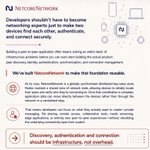
Causeway enables better utilization of devices. It facilitates direct connectivity between peers whenever possible, and utilizes the underlying distributed NetcoreNetwork for identity, authentication, and coordination.
Good things take time.
Causeway is coming soon 👀
One use case we’re testing: connecting self-hosted tools across different networks.
Here’s Immich running on one machine and being accessed + used by another peer through its own localhost.
Self-host what you want & let Causeway handle the connection


The Origin Story
(and just a generally delightful and engaging read)
eejournal.com/article/the-in…

Announcing Causeway: the private, direct route.
Read the press release and sign up for the waitlist here: netcore.network/causeway

The missing layer for a peer-to-peer internet is here.
Direct connectivity finally has a decentralized foundation. Causeway is the connectivity ecosystem that kills the last centralized dependencies.

We provide the coordination layer that allows devices to discover, authenticate & connect directly. Now we’re building on that foundation with a new connectivity ecosystem designed to make that infrastructure directly usable by developers.
Stay tuned.
The foundation of our technology: a distributed key value store that achieves consensus through the novel leaderless RIPSTIK mechanism. Meet NetcoreNetwork.

NetcoreNetwork handles the underlying connectivity, so developers can focus on what they want to build.
netcore.network
