

Journal of the Sociedade Brasileira de Ictiologia. Open Access journal publishing research on freshwater and marine fishes of the Neotropics.
Brazil
Joined September 2014
- Tweets683
- Following122
- Followers932
- Likes249


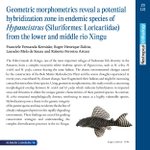


Environmental damage in the Xingu River is driving endangered catfish toward hybridization, threatening the genetic identity and survival of rare Amazonian species. ni.bio.br/1982-0224-2024-010…

Fish in Amazonian headwater streams show that body shape and anatomy strongly predict how species feed, move, and use their habitats, revealing clear ecological patterns in nutrient-poor environments. ni.bio.br/1982-0224-2023-013…

An integrative taxonomic analysis confirms that Proloricaria prolixa and P. lentiginosa are distinct species, differentiated mainly by coloration, the presence of anterior predorsal plates in P. lentiginosa, and a 3.1% genetic divergence.
ni.bio.br/1982-0224-2024-010…

Mitochondrial DNA analysis of 15 commercially important Brazilian fish species revealed no consistent geographic or life-history-based genetic structure, with most species showing historically stable populations in the southwest Atlantic.
ni.bio.br/1982-0224-2024-006…

94
This study analyzed the external and internal morphology of Psammobatis extenta, P. lentiginosa, and P. rutrum to clarify their taxonomy and provide an identification key for Brazilian species.
ni.bio.br/1982-0224-2024-007…
doi.org/10.1590/1982-0224-20…

1
82
The study assessed the conservation status of the continental ichthyofauna of Ceará, recording 85 fish species, 17 of which were classified as threatened.
ni.bio.br/1982-0224-2024-008…
doi.org/10.1590/1982-0224-20…

79
This study examined the reproductive biology of the splash tetra Copella arnoldi and found that spawning is synchronized with the rainy season, showing two reproductive peaks that align with increased precipitation.
ni.bio.br/1982-0224-2024-005…
doi.org/10.1590/1982-0224-20…

This study found that silver arowana populations in the Amazon basin are genetically structured, with higher genetic diversity in the western region, suggesting west-to-east dispersal and isolation by distance.
ni.bio.br/1982-0224-2024-008…
doi.org/10.1590/1982-0224-20…

Rineloricaria buckupi, new species, is described from coastal basins in southeastern Brazil.
ni.bio.br/1982-0224-2024-008…
doi.org/10.1590/1982-0224-20…

This study examined how head bone morphology in Loricariinae species relates to their diet, revealing that structural differences in the suspensorium and branchial arches correlate with varied food item consumption.
ni.bio.br/1982-0224-2024-011…
doi.org/10.1590/1982-0224-20…

This study used genome-wide ddRADseq to assess the relationship between Gymnogeophagus labiatus and G. lacustris.
ni.bio.br/1982-0224-2024-005…
doi.org/10.1590/1982-0224-20…

Templo® caused significant DNA and cellular damage, but the vertical flow constructed wetland system removed 95% of the herbicide, reducing its toxic effects.
ni.bio.br/1982-0224-2024-012…
doi.org/10.1590/1982-0224-20…

In Basilichthys microlepidotus, 11 copy number variants (CNVs) were linked to pollution, suggesting subtle adaptation despite weak population structure.
ni.bio.br/1982-0224-2024-008…
doi.org/10.1590/1982-0224-20…

3
106
This study provides key length-weight and length-length relationships for 51 freshwater fish species, offering new growth data for several species and essential parameters for conservation and fisheries management.
ni.bio.br/1982-0224-2024-004…
doi.org/10.1590/1982-0224-20…

3
87
Key genes involved in fatty acid metabolism are differentially expressed in Petenia splendida across developmental stages, with peak expression in larvae at 20 days post-hatching and in the liver and intestine of adults.
ni.bio.br/1982-0224-2024-009…
doi.org/10.1590/1982-0224-20…

2
88
Fewer than one-third of endemic fish in the Tocantins-Araguaia basin have genetic data, with major gaps linked to limited phylogenetic knowledge.
ni.bio.br/1982-0224-2024-004…
doi.org/10.1590/1982-0224-20…

Say hello to Hoplisoma noxium and Hoplisoma tenebrosum!
ni.bio.br/1982-0224-2024-010…
doi.org/10.1590/1982-0224-20…
