

Postdoc @CILVRatNYU. Prev: PhD @UCSanDiego, intern @nvidia, @MetaAI, @UCBerkeley, BS/MS @DTU_Compute. I like robots 🤖, plants 🪴, and they/them pronouns 🏳️🌈
San Diego, CA
Joined August 2018
- Tweets325
- Following735
- Followers2.7K
- Likes1.1K


Pinned Tweet
Super excited to share the last paper of my PhD: "Hallucination in World Models is Predictable and Preventable"✨
We train a 350M-param generative world model on a large dataset w/ 210 tasks and show that we can predict *when* hallucination happens and use that to fix it!
🧵1/n
Belated life update: I defended my PhD at UCSD earlier this year. Huge thanks to my advisors @xiaolonw @haosu_twitr, and to all my amazing collaborators!
I’m now a postdoc at NYU working with @LerrelPinto @ylecun on world models + robots ✨
Nicklas Hansen retweeted

JEPAs can 𝐧𝐨𝐰 jointly imagine what happens and what to do next!
Meet 𝐋𝐞𝐖𝐀𝐌: A JEPA for the real world with
32.3× faster planning, 19 ms per plan
Improves success 28.6% → 89.7% on contact-rich manipulations
But also ... 🫶 a WAM for everyone with
17M · 1 GPU · 1 hyperparameter
Works on a real robot, not just a simulation !!
👉 le-wam.github.io/
Submission deadline is tomorrow Oct 4!

🤖 Excited to announce our CoRL 2026 workshop: Pretrain to Adapt! 🔗 corl2026-robotcl.github.io
How should we pretrain robot policies not just to perform well today, but to adapt effectively to new tasks, environments, embodiments, sensing modalities, etc?
To keep the conversation going beyond the workshop, we’re hosting a Slack community for anyone interested in robot pretraining + adaptation. Join our Slack to connect with fellow researchers!

Nicklas Hansen retweeted
TC-WM is accepted at #NeurIPS2026! 🎉
A generic visual representation isn’t always a good latent state for planning and control.
For control, we need more than visual fidelity. Instead, we aim for task-centric representations that reflect physical dynamics and task-relevant information, while still leveraging the scalability of visual foundation models.
Compared with DINO-WM, TC-WM learns a lower-dimensional representation with higher latent-space utilization and diversity. These improvements translate into stronger performance, especially with the clearest gains on 3D contact-rich manipulations.
Webpage: minghaofu.com/tc-wm/
Paper: arxiv.org/abs/2605.25620
Code: github.com/MinghaoFu/TC-WM
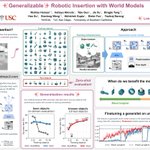
I'm in Pittsburgh for IROS 2026 and will be presenting our work "Generalizable Robotic Insertion with World Models" tomorrow morning. Stop by our poster at G11 for a chat about world models, robot learning, and beyond! ✨

Really excited to be part of this workshop! What makes a pretrained policy easy to adapt is still an open question, and we'd love for you to join the discussion! Submission deadline is Oct 4 ✨
🤖 Excited to announce our CoRL 2026 workshop: Pretrain to Adapt! 🔗 corl2026-robotcl.github.io
How should we pretrain robot policies not just to perform well today, but to adapt effectively to new tasks, environments, embodiments, sensing modalities, etc?
To keep the conversation going beyond the workshop, we’re hosting a Slack community for anyone interested in robot pretraining + adaptation. Join our Slack to connect with fellow researchers!
Nicklas Hansen retweeted

Children learn to walk by falling. Robots fail too—but we usually throw those failures away.
Yet failed rollouts tell us something successful demonstrations cannot: what bad actions actually lead to.
So, can robots learn from their failures too?
Introducing FACT: Failure-Aware Causal Training for World-Action Models.
🔗website: fact-wam.github.io/
📄arxiv: arxiv.org/abs/2608.10232
💻 code: github.com/Bariona/FACT
Nicklas Hansen retweeted

Pretrained ViTs see the world in rich, dense detail. Most policies pool it to a single vector before acting, discarding most of it.
We introduce Patch Policy: a minimal architectural extension that enables transformer-based policies to consume dense tokens directly, no billion-param VLM required. It outperforms a fine-tuned 7B VLA by 18% with ~0.7% of its parameters, enabling robust, precise manipulation.
Nicklas Hansen retweeted

1/
Most world models focus on generating high-fidelity futures: realistic videos, longer rollouts with expressive visual foundation models.
For control, we need more than visual fidelity. Instead, we aim for task-centric representations that reflect physical dynamics and task-relevant information, while still leveraging the scalability of visual foundation models.
Introducing TC-WM – a task-centric world model that learns grounded dynamics in a compact latent space while keeping the scalability of video foundation models.
- Technical blog: aetherlabs.ai/articles/task-…
- Paper: arxiv.org/abs/2605.25620
- Project: minghaofu.com/tc-wm
- Code: github.com/MinghaoFu/TC-WM
By Minghao Fu, Fan Feng, Nicklas Hansen, and Biwei Huang. (UC San Diego)
#WorldModels #RobotLearning #Robotics #EmbodiedAI #PhysicalAI #AI

Nicklas Hansen retweeted

RL training for LLMs involves exposure to problems in the “Goldilocks zone” of difficulty: not too hard, not too easy.
But difficulty is not the only thing that matters.
Problem type matters, too.
And LLMs do not see or organize problem types the way humans do.
This is the starting point of Manifold Bandits.
The fundamental issue is this: when using RL to train LLMs, there will always be problems that are more productive for the policy at a given training iteration. Across a dataset, there are an astronomical number of possible batch orderings; uniform sampling is unlikely to consistently land on the most useful ones by chance.
This is why many adaptive curriculum learning and difficulty-aware methods focus on the policy’s “optimal learning zone,” avoiding examples that are already trivial or still impossible for the LLM to solve.
But problem type is usually treated differently.
Task decompositions within a training set are often manually defined according to human semantics, or ignored entirely, with an entire dataset/domain treated as “one task,” despite the immense heterogeneity seen even in small training datasets.
It is generally understood that LLMs may not share our concept of difficulty. But it seems less recognized that LLMs may not share our concept of problem type, either. In both cases, training the LLM according to our own semantics can obscure fine-grained learning dynamics that could otherwise be exploited.
In this work, we seek to derive an adaptive curriculum learning method that caters not only to the policy’s ability, but also its perception: its latent organization of tasks.
Driven by the manifold hypothesis and the Bitter Lesson, we leverage computation to derive curriculum structure from the policy’s latent geometry, then use Bayesian inference over that structure to guide search and learning over the training set. The result is Bayesian Manifold Curriculum (BMC): an algorithm that does not just try to find problems of the right difficulty, but instead orchestrates training effort across diverse and interacting problem types.
More technically, we frame problem sampling for LLMs as a manifold-structured bandit problem with endogenous non-stationarity. The tl;dr is that the problems/arms are diverse, structured, and interact through policy updates, so the typical non-stationary bandit framing is not quite the right fit for training LLMs. BMC is derived from this new framing.
🌐Website: darrienmckenzie.com/manifold…
📰Paper: arxiv.org/abs/2606.19750
💻Code: github.com/DarrienMcKenzie/m…
🧵1/N

Nicklas Hansen retweeted

Very proud of @ncklashansen . I started working with Nick when I was a postdoc at Berkeley. I think one day Yu Sun told me there is a guy seems sharp and we should get him to do test time training, and that is how everything starts.
Nick’s first work is continuous learning of agents during deployment, that is 2019, and I think it still is the right thing to do even now. Or maybe just getting caught up?
Since then, Nick has been pushing the direction of world model, the line of TD-MPC, long before world model is popular. I guess our work is a bit RL focus and do not have so many fancy pixels.
Nick’s final work at PhD kind of connects the pixels prediction back and does a comprehensive analysis of the hallucinations in world models and how it affects decision making. This draws a good conclusion to his PhD works.

💡Importantly, we find that not all data is created equal; some data collection strategies are more effective at improving the model than others! Our curiosity approach nearly matches expert policy and human data collection while being completely autonomous.
6/n
We built a super cool interactive web-based paper (with a live demo!) so definitely check that out!
Everything is open-source: code, model, dataset
🌐 Interactive paper: nicklashansen.com/mmbench2
📄 Paper: arxiv.org/abs/2606.27326
Work with my PhD advisor @xiaolonw 🙌
7/n
Nicklas Hansen retweeted

See Nicklas Hansen's amazing work on robot perception, planning, and action in dynamic environments (NVIDIA Graduate Research Fellow and PhD candidate at @UCSanDiego). ✨🤖 #NationalRoboticsWeek
Learn more about Nicklas's work. ➡️ nvda.ws/4lv85eb

TD-MPC2 just got ~5x faster! The update is available in a separate "speedups" branch at the moment and will be merged into main soon. Special thanks to @VincentMoens for his help with this!
