

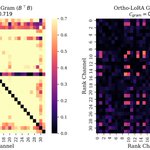
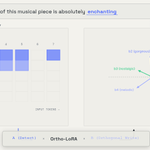

Can we eliminate superposition from inside a model rather than observing it from the outside?
Instead of attaching multi-million parameter SAEs post-hoc, we trained LoRA to unpack task representations into an orthogonal, monosemantic basis on demand.
Links and quick breakdown👇

Compared to SAEs
We benchmarked Ortho-LoRA directly against a matched Top-K SAE (k=32, 4x expansion) hooked at the same layer:
• 112x fewer parameters.
• +23% forward latency overhead for the SAE.
• Ortho-LoRA preserved task loss (0.658).
Full writeup, code, and paper draft:
📝 Research note: unfoldinglabs.ai/research/or…
💻 Code: github.com/unfoldinglabs/ort…
📄 Paper: github.com/unfoldinglabs/ort…
Came across this great talk which feels more relevant than ever. Got me thinking, AI is commdifying ideas but kinda cool to think that, used with intent, it could also enable new ways to turn any idea into an intuitive playground. youtu.be/oUaOucZRlmE?si=s0JZ…
I wonder what could be a strong enough counterweight to this cognitive dependence. For now it seems to be mostly lack of awareness. Curious given how fast ChatGPT spread while frontier AI (agents etc.) remains contained (see xitter.cf/karpathy/status/210936…)
Read: arxiv.org/pdf/2609.03344

Dusting off this tweet from April because this gap in shared understanding of LLM capability is *widening*. It's now less "two groups of people speaking past each other" and more a sharp funnel.
- Napkin math somewhere around 6B people (~75% of the population) have barely come in contact with LLMs at all.
- Around 1-2B (~20%) are casual and infrequent users of free-tier ChatGPT-like products. This group sees derpy chatbots and treats them a bit like a better Google search, a writing aid, or etc. Maybe an agent tries to book you a flight. I have non-tech friends who (reasonably, imo) say they have not much use for it at all. Even many professionals outside of math&code are in this tier. For example, execs and many other functions spend a lot of their time talking to other people, so while they understand what is happening intellectually, it is still second-hand and a bit abstract.
- Now we get to professional use of frontier-grade LLMs in math&code. Somewhere around 20M people (0.2%) see first-hand that large, complex projects that used to take them weeks/months can now be completed by agents with a prompt. Building apps, copying apps, translating apps, decompiling apps from binaries... This has all happened very quickly and recently - less than 1 year ago, I was writing code manually by hand, typing memorized computer code commands into a code editor character by character, occasionally pressing Tab to autocomplete a little chunk of code.
- And finally we get to the ~5,000 people (~0.00006%) with access to frontier-grade systems internally. The external world has seen the preview. It looks like swarms of thousands of agents collaborating over weeks on software mega projects: minting zero days, running cyber attacks and defenses at machine speeds, discovering new science, advancing the frontier of mathematics. Things that would have taken top professionals in the industry years of work. Meanwhile, human review and comprehension are starting to fall behind. For example, people are still involved in the "archeology" of the OpenAI-HF incident from many months ago. Mathematicians may be poring over the 722 manuscripts on frontier mathematics for a while.
The funnel is driven by a combination of factors:
1. The impact scales with ambition, problem size, and horizon. A question with a paragraph answer barely stresses the system. You need a reservoir of big, difficult problems that you really care about. This aspect drives the consumer / professional dimension of the funnel.
2. The jaggedness of the system (which I have written about a lot separately). Capability peaks in domains that are digital, verifiable and economically valuable. This is because LLM capability emerges from reinforcement learning on verifiable rewards on a curated environment mixture driven by revenue potential. This aspect primarily drives the area (e.g. math&code) dimension of the funnel.
3. Access. Free-tier, paid-tier, internal.
So this is the weirdness of the moment. The general public has mostly not interacted with these systems. When they have, it looks like a derpy chatbot. The majority of professionals still see only a modest uplift. And a small sliver of professionals are experiencing the vertigo of the curve going vertical. And it is all happening at the same time.


Nassim retweeted

For the first time, scientists have mapped the complete brain and central nervous system of an adult male fruit fly — a key model organism in science. 🪰
Working alongside HHMI Janelia Research Campus and the scientific community, @GoogleResearch scientists and researchers used AI to combine millions of 2D images into 3D neural shapes, reconstructing a record-breaking 166,000+ neurons. This foundational map of the adult male fruit fly brain can help accelerate our understanding of the brain, and is a major milestone in neuroscience.

ALT Vibrant 3D digital reconstruction of a fruit fly brain against a white background, displaying a dense, intricate network of multicolored neural fibers and cell bodies in shades of blue, cyan, orange, and purple.

ALT A complex 3D visualization of a fruit fly brain, featuring a dense, symmetrical network of thousands of tiny, multicolored neurons and fine, interconnected fibers in shades of blue, magenta, orange, and green against a solid white background.
Nassim retweeted

A 35B language model running on an iPhone using only 1–2.5 GB of peak memory.
No cloud. No remote server. No desktop GPU.
Today, we’re open-sourcing Edge0 — a framework for running large AI models fully on-device.
Nassim retweeted

Introducing Atlas:
The world's first multimodal world model that generates image and video frames with pixel-perfect camera control and reconstructs them in 3D.
Model the world, move the camera, and simulate space & time.

Nassim retweeted

Introducing SAM 3D, the newest addition to the SAM collection, bringing common sense 3D understanding of everyday images. SAM 3D includes two models:
🛋️ SAM 3D Objects for object and scene reconstruction
🧑🤝🧑 SAM 3D Body for human pose and shape estimation
Both models achieve state-of-the-art performance transforming static 2D images into vivid, accurate reconstructions.
🔗 Learn more: go.meta.me/305985
Nassim retweeted

You've seen these paintings a million times.
But never like this.
Using nano-banana, Seedance, and Kling, I brought them into our modern world, creating an unlikely romance in Central Park, New York City.
Enjoy:
