






Shawn Simister retweeted

happy birthday to skills, they turn 1 today 🎂
feels like a lot more


Shawn Simister retweeted

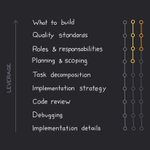
More DAGs should be drawn this way. In a pipeline like the one below, the nodes form a list, so each node can be a table row with metadata beside it.
Parallel branches are the main limit, but horizontal space is cheap!
Yeah, and things like Mars rovers which have a bunch of custom softwy and hardware for specific tasks and go through a lot of verification
I often work with a paper notebook but it’s a different style of thinking than brainstorming with an agent that has access to all of my past brainstorms and can bring in connections to ideas from years ago
We shouldn’t be automating away user intent. If the agent can predict what to do next it should just do it.

In this case I picked the source material. But I’m also experimenting with having it search for sources

My UI isn’t nearly as fun but I did some experiments sort of stepping through concept space across a number of related articles

Shawn Simister retweeted

we need ways to make it clear what is…
- explicitly specified
- hinted at
- an agent assumption
any amount of the above is fine, but once code is in the codebase there’s no way to tease out what’s what

we've mostly gotten past the slop issue in this new world of working together with AI
the next problem is people keep accidentally undoing functionality
this is happening because everyone is more in everyone else's business. hit an issue? fix it right away without nagging anyone
the problem is it's unclear how intentional the current behavior is and what absolutely should not be rolled back
you can say tests should be this. but they don't capture the fact that you discarded seemingly valid solutions 1-4 and settled on 5. someone later (an agent) might thing "oh 3 is simpler"
any additional document also doesn't feel like it solves the problem because it's yet another thing that can drift
where is the source of truth for how your software is supposed to work?
Love the stepped walkthroughs. I've been working on something similar xitter.cf/narphorium/status/2065…
Shawn Simister retweeted

an early experiment for Live Ink, a new feature coming to Vignette. annotate anything, anywhere -- and your agents can do the same.
obviously need to incorporate voice input, too. i mean come on.

i frequently use the MacOS screenshot and annotation tools with my agents. this works well enough. the built-in annotations are a huge pain, though. very clunky.
i've tried other tools in the space and they're usually feature bloated and aren't tailored to my particular needs.
so, as one does nowadays, i built my own tool, Vignette. my goal was to keep the best parts of Apple's native tools, while enhancing and streamlining them for modern agent workflows.
it's free, open source, and very customizable. oh, and agents can send you their own annotated screenshots. this has unlocked some surprisingly effective collaborative moments! more to come here.
vignette.pete.design

How do you keep track of all those prototypes? I have a big web of obsidian notes pointing at mine but there must be a better way
Shawn Simister retweeted

We built a nice free tool at @k_dense_ai on top of Jev from @typesafeai called Citation Telephone which follows a cited claim back through the papers it cites, reads each one, and shows where the claim came from and what changed on the way.
k-dense.ai/blog/introducing-…

Shawn Simister retweeted

recommended reading, though i still disagree, as explained on @syntaxfm early this year.
for code, both memory and docs are not efficient. your codebase is all you need. make it modular, make modules small, at most, have a little maintained map of where what is.
liao.gg/blog/agents-dont-nee…
Shawn Simister retweeted

For years, maybe a decade, I've wanted to build a writing tool that just did a few things I couldn't find anywhere else.
A system that mimicked how I think when I write. A system that provided clear affordances, features, and places to do the things I wanted to do. A way to play with my writing as I'm writing it. A way to settle into just the right way to say something.
It never made sense to make it a 37signals product because it's not commercially viable, nor would it be worth pulling people off their other work to hack on this. Plus, it would have taken months the old way.
So this weekend I just made it myself, with Claude's help.
It's called Write_On and the short video walks you through it.
Essentially it's "alternative control" at the word, sentence, and paragraph level, plus a way to dim stuff back, and stash stuff near by. Not version control, but alternative control. You'll see what I mean when you watch the video below.
So here it is. Write_On.