nandan (@nandanito) header
nandan (@nandanito) profile picture

Physics → software → quantum. Interested in how information becomes knowledge. Exploring at the intersection of quantum computing and machine intelligence.

Tokyo, Japan
Joined January 2013
Photo by nandan (@nandanito)Photo by nandan (@nandanito)Photo by nandan (@nandanito)Photo by nandan (@nandanito)Photo by nandan (@nandanito)Photo by nandan (@nandanito)Photo by nandan (@nandanito)Photo by nandan (@nandanito)Photo by nandan (@nandanito)Photo by nandan (@nandanito)
Bayes’ Rule is the ultimate mathematical cheat code for upgrading your opinions with actual evidence instead of just stubbornly doubling down!😊 xitter.cf/matheorems/status/2120…
Bayes' Theorem You Can See A probability is a share of the dots. P(A) is the part of the box covered by circle A, and P(B given A) is the part of A that is also in B: the lens divided by A. Slide the circles around and every number updates: apart, the lens is empty and both conditionals are 0; tuck B inside A and P(A given B) becomes 1. The lens is the same in both directions, so P(B given A) P(A) = P(A given B) P(B) and dividing gives Bayes' theorem: P(B given A) = P(B) P(A given B) / P(A) P(A given B) = P(A) P(B given A) / P(B) The bottom box computes each one from the other side, live, and it always lands on the same number as the picture above.
5
89
4
651
23,082
Our Euclid space telescope has released its largest dataset yet, revealing over 900 million galaxies! Covering an area of sky equivalent to 9500 full Moons, the data lays the foundation for an unprecedented 3D map of the Universe. Read more: esa.int/articles/about-us/di…
68
229
24
958
62,765
42
361
15
2,826
127,601
No other traveler has ever journeyed so far from home. Voyager 1 is about to become the first human-made object to reach a distance of one light-day from Earth, or about 16 billion miles. ½
338
5,340
626
22,494
1,836,635
nandan retweeted
From Developer Events to AI Gadgets: How Developers Build with M5Stack The event ends. The building continues. 🚀 Discover how developers are using M5Stack to bring ideas into the physical world—and keep creating long after the event.💡 👉 Read the full blog: bit.ly/4f9T8we #M5Stack #AIHardware #DeveloperCommunity
4
21
5
131
10,396
nandan retweeted
Happy November! This month Voyager 1 will become the first spacecraft to reach 1 light day from Earth. 🔭 #astro
111
2,544
225
14,464
1,667,866
🫡My current status✅ 📡We recently revealed the irregular surface of Betelgeuse, the famous red supergiant in the constellation Orion. ⭐️The observations show bright hot spots and an irregular, corrugated outline, shaped by the enormous movements taking place inside the Star.
12
105
13
743
20,351
Can you move tokens confidentially on the XRP Ledger? Yes, under XLS-96, and as I write this only on Devnet. I built the core of a receivables facility on it and ran it to see exactly what it hides. The short answer: amounts, not relationships. Hidden from the public: each holder's balance, and the amount of each Send between confidential balances. Public: who pays whom, when and how often. Every amount converted into or out of confidential form. And some zero balances: the ledger writes a fixed encryption of zero, which anyone can recompute from public inputs, for a new balance, an inbox just merged and a position clawed back. I matched it byte for byte against live Devnet state. The issuer reads every balance, always. XLS-96 keeps a second copy encrypted to the issuer's key, and no setting turns it off. That is by design, and it means "confidential" here is confidentiality from the public. If the token allows clawback, the issuer can also destroy a confidential balance. Keys cannot be rotated or recovered, in XLS-96 or, as I write this, on Mainnet, Testnet or Devnet. A draft standard, XLS-99, proposes both. In the facility, that means the float, which suppliers drew on which days, and every tranche retired at the end are public. Each supplier's limit, draws and what it owes are not, though the public totals still bound them. Eleven issues went upstream to the XRPLF repositories; five are resolved so far. The write-up's claims cite rows of a public claims register, and the register keeps its own corrections. I am running the same study on EVM chains. Those results will follow. A research project on Devnet: not audited, not production-ready. Write-up: buff.ly/yZUYYCw Demo: buff.ly/gQ161xG Code: buff.ly/BcHYMo5 Independent work; not affiliated with Ripple. #XRPL #DigitalAssets #Tokenization #Privacy
1
31
Who can read what, in one table. Anyone sees who pays whom and every amount going in or out. Only the holder's keys can spend a balance. The issuer reads every balance and every transfer amount.
8
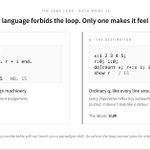
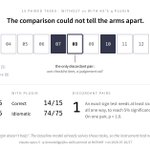
Here is a perfectly good q program: a counter, a loop, an accumulator, and it prints 15. It will still be correct next year, in production. That is the problem. @kxsystems' q has every reflex you brought from Python or Java, and the answers come out right, so nothing ever nudges you toward the one-word version, sum. Article 4 of my array-thinking series. J does not forbid loops either. But to write one you step outside J's ordinary notation: a definition block, a different assignment, a lone ) to close it. Five lines of visibly foreign machinery, where the array version is two characters. In q the loop is one ordinary line. That feeling of having wandered off is the whole case for a short detour through J before q. The detour sends three habits back with you, and two of them break on the way home. One breaks loudly. J writes a mean as +/ % # (sum divided by count, with no data mentioned); the same text does not parse in q at all, so it can never ship. One breaks silently, and ships. The 3-period moving average of six numbers in J: 3 (+/ % #)\ 1 2 3 4 5 6 gives 2 3 4 5: complete windows only. The same request in q (in q, / starts a comment, and this one shows what the line returns): 3 mavg 1 2 3 4 5 6f / 1 1.5 2 3 4 5 Six results, ramping up through partial windows. Neither is wrong. Both are called "the 3-period moving average". Read q's first value as a full window, the way J's would be, and you are two positions early, with no error. Last week's article took q's as-of join apart; this one is about a quieter gap. Also in it: whether the shift actually takes, using my earlier eval of KX's q plugin (with and without the plugin, all three loop-to-array tasks were solved, and why that carries little weight), and why J rather than APL or BQN. Every snippet is copied from a lesson that runs in CI, on KDB-X Community Edition and J 9.7.1. Article 4 of 5: buff.ly/UdAEy91 Independent work; not affiliated with KX or Jsoftware. #kdb #ArrayProgramming
1
46
The two places the J detour misleads you, in one picture. The mean written with no data in it fails to parse in q, so it can never reach production. The moving-average windows can: J's first result is q's third, and nothing complains. Respect the silent one more.
1
8
The core step of a quantum attack on Bitcoin and Ethereum now fits in under 900 logical qubits within Google's gate budget. In three published attack designs, the machine would shrink by zero to about 28%. On October 13, Jieyi Long of Theta Labs posted an 893-qubit circuit to ECDSA Fail, an open benchmark for the point addition that Shor's algorithm repeats to recover a private key. A day later he posted an 874-qubit version. Both stay below the 1,175 qubits and 2.7 million Toffoli gates Google proved for its own circuit in March. Narrower circuits exist, down to 676 qubits, but all of them exceed Google's gate count. The 676-qubit one needs about 150 times as many. Pierre-Luc Dallaire-Demers, a co-author of the ECDSA Fail paper, put the physical saving at 25% for the IonQ, Oratomic and Google attack designs. I checked each one. - Google: about a quarter, if every part of the machine shrank with the qubit count. - Oratomic: nothing with its published codes, and at most 16% with a code sized for 893 qubits. - IonQ: about 28% fewer ions, but longer attempts, because the circuit needs about 1.6 times IonQ's Toffoli gates per addition. Nobody has compiled a full attack around either circuit yet. postquantum.com/security-pqc… #QuantumComputing #PostQuantumCryptography #PQC #QuantumSecurity #Cryptography #Bitcoin #Ethereum #Cybersecurity
21
55
16
215
32,905
pandas has merge_asof, Polars has join_asof, DuckDB and ClickHouse have an ASOF JOIN. The as-of join isn't q's secret. What's different in q is that @kxsystems' aj comes apart into two primitives you already know, standing on a sort you're responsible for. Article 3 of my array-thinking series. group finds each symbol's rows once, for the whole quote table. bin finds the latest quote time at or before each trade. The edge cases come with bin. Three quote times and their bids: times:0 2 5; bids:99 99.1 99.4 bids times bin 3 2 -1 gives 99.1 99.1 0n. A trade at 3 takes the quote at 2. A trade at exactly 2 takes that quote: a tie counts. A trade at -1, before any quote, gets 0n, q's null. Nobody wrote a special case. The price: bin assumes the quotes are sorted and never checks. q can stamp a column with a flag that records the grouping; nothing records the time order inside each symbol, and that is the half that decides correctness. Drop the flag and you get the same table. Drop the sort and, on the lesson's data, you get a different one, silently. Also in the article: J as the control, an excellent array language that wasn't built for this join, and the bug a reviewer found in a lesson that was already verified green. Every snippet runs in CI. No timings, by choice. Article 3 of 5: buff.ly/spG2JoR Independent work; not affiliated with KX. #kdb #TimeSeries
1
1
3
99
The two primitives in one picture. group finds the symbol's block of rows; bin finds the position inside it. Sorting by symbol first makes the block, sorting by time second makes bin right, and only the first half can be recorded by a flag.
1
10
With latest board for 4.7" e-paper display. Build your e-reader for just $25. #m5stack #ereader #epaper #DIY
#M5StackNew 🎉 PaperDIY Assembly & Complete Kit Released PaperDIY Assembly & Complete Kit are DIY e-paper development board kits, including main control board, 140mAh lithium battery, e-paper display and acrylic screen pressure plate, suitable for building desktop information displays, electronic labels, maker DIY projects, and embedded hardware development experiments. ✨Features ✅ ESP32-S3R8 core controller (16MB Flash, 8MB PSRAM, 2.4 GHz Wi-Fi) ✅ 4.7" e-paper display, 960×540 resolution, 16-level grayscale display ✅ Onboard DC 3.7V battery connector, Low-power power management design ✅ 140mAh lithium battery, microSD card slot * PaperDIY Assembly Kit: assembly completed by the user, PaperDIY Complete Kit: includes a pre-installed 3D-printed enclosure, with hardware assembly completed at the factory. 🛒 Get Yours: Official Store: PaperDIY Assembly Kit: bit.ly/4jYssSu PaperDIY Complete Kit: bit.ly/3TW9Lo3 AliExpress: PaperDIY Assembly Kit: bit.ly/4i79YNj PaperDIY Complete Kit: bit.ly/4s4mLEw #M5Stack #M5StackNew #IoT #EINK #EPaper #DIYElectronics #Makers
3
97
nandan retweeted
The AI Scientist v3 is out: The Agentic Scientist. GitHub: github.com/SakanaAI/AI-Scien… Blog: pub.sakana.ai/agentic-scient… arXiv: arxiv.org/abs/2610.18933 The Agentic Scientist is the 3rd iteration of our automated AI Scientist research system, and the shift this time is from “one agent writes a paper” to “a scaffold of parallel agents orchestrates the full research loop.” The system now orchestrates a pool of parallel workers that share memory and distilled conclusions. Crucially, it features Evidence Generation: isolated agents automatically run controlled baselines and ablations to prove why an idea actually works. It works as a co-scientist. We used a development version as a co-scientist to explore biologically plausible learning rules. The agent handled the empirical heavy lifting, proposing mechanisms and running experiments. We stayed in the loop to steer direction, verify results, and moderate claims. That feels like the right division of labor for where the technology actually is. This resulted in a new biologically plausible learning algorithm, and the resulting paper was accepted at ALIFE 2026 as an oral presentation. We are also releasing AutoIllustrate. It generates editable draw.io vector figures instead of uneditable, hallucinated raster images. Real scientists need vectors, not pixels. I am an SVG junkie ;) Incredible work by Robert Lange, Luca Grillotti, Yutaro Yamada, Rujikorn Charakorn, and the team!
The Agentic Scientist: Orchestrating Coding Agents for Automated Scientific (Co-)Discovery Blog: pub.sakana.ai/agentic-scient… GitHub: github.com/SakanaAI/AI-Scien… arXiv: arxiv.org/abs/2610.18933 Since 2024, we’ve used The AI Scientist as a way to test how far AI alone can take scientific research, from v1 to v2 to the paper published in Nature earlier this year. The Agentic Scientist is the next step in that line of work, built for the era of coding agents. Coding agents such as Codex and Claude Code now carry out long software tasks on their own. Handing them a research problem, however, tends to produce a strong hyperparameter optimizer rather than a scientist: scores go up, but ideas stay narrow, and the reasons for the gain are rarely examined. The Agentic Scientist makes the research loop explicit. It wraps off-the-shelf coding agents in a scaffold that controls what they see, what they write, how they are evaluated, and how results are handed to the next stage. Parallel workers test hypotheses against rubrics defined before any experiment runs, share successes and failures through a common memory, and then ablate the winning program to generate evidence. We used an early version of the system to study Error Diffusion, a biologically motivated alternative to backpropagation. Our researchers set the question and the rubric, chose directions at each stage, and verified the results, references, and claims before submission. The resulting paper was accepted as an oral presentation at ALIFE 2026. In autonomous runs, the system also raised Doc-to-LoRA retrieval accuracy from 52% to 98% on multi-needle tasks and designed a learned evolution strategy that improves over its CMA-ES reference on unseen tasks. Alongside it we release AutoIllustrate, a pipeline for scientific figures that keeps an editable draw.io file as the source of truth, so every diagram can be corrected by hand. Humans define the question and the standards of evidence; agents expand the experiments researchers can run. We call this Co-Discovery, and we are releasing both systems as open source for the community to build on.
96
286
18
1,843
88,485
nandan retweeted
New paper from the team at Sakana AI: Recursive Self-Improvement through Multi-Agent Self-Supervision (MASS) How do we keep improving AI when the tasks become too complex for humans to reliably evaluate? For open-ended research, we eventually hit a "supervision bottleneck." If we use the model itself as the solver, optimizer, and evaluator, it gets trapped in a homogeneous loop, reinforcing its own blind spots rather than correcting them. To break this loop, we drew inspiration from Marvin Minsky’s Society of Mind. What if you prompt a single model to organize copies of itself into a structured team, then distill what the team learned back into the base model? MASS alternates between two loops: 1/ Workflow Optimization: the model iteratively evolves its own multi-agent workflows, figuring out how subagents should communicate and route information to each other. 2/ Workflow Internalization: fine-tune the shared model on the successful multi-agent trajectories so the coordination behavior gets baked into the weights. After two cycles with a 27B open-weights model, performance improved 1.2-1.6x per output token on tough research benchmarks (MLR-Bench, ScienceAgentBench, DSBench). Multi-agent traces were also much better training data than single-agent ones. The model learns faster from jointly learning high-level orchestration and bounded subagent execution. The results showing that the model can bootstrap its own coordination skills by organizing copies of itself into teams feels promising as a mechanism towards self-improvement. Blog: pub.sakana.ai/mass/ Paper: arxiv.org/abs/2610.12176 Incredible work by Hyunin Lee, Jinglue Xu, Jeffrey Seely, Yujin Tang, and our collaborators from UC Berkeley (Somayeh Sojoudi, Matei Zaharia, Donghyun Lee)!
Introducing Multi-Agent Self-Supervision (MASS): Recursive self-improvement through collective intelligence Blog: pub.sakana.ai/mass/ As AI systems tackle increasingly open-ended research problems, human experts may struggle to assess results and guide further progress. The model itself may be the best available optimizer and evaluator. The challenge is obtaining useful self-supervision within that homogeneous loop, where a model risks reinforcing its own blind spots rather than correcting them. We ask whether a model can learn from the collective intelligence of its own team. We introduce Multi-Agent Self-Supervision (MASS). One shared model solves tasks through a team of virtual subagents, searches for better multi-agent workflows, then uses its own judgments to select the best ones. Training on the best team’s executions provides self-supervision by distilling the team’s collective experience into the shared model. We ran two cycles using a 27B open-weights model on synthetic open-ended research tasks. After the second cycle, score per output token reached 1.2-1.6x the base model's level across four research benchmarks. Three key results: First, MASS enables role generalization within an RSI loop: training only on task-solving data from the optimizee naturally improves the capabilities of both the optimizer and the evaluator. Second, multi-agent trajectories are more efficient training data than single-agent trajectories for RSI. Third, optimizer capacity, rather than evaluator capacity, can be the bottleneck in the speed of improvement. We believe the community needs to investigate homogeneous RSI carefully to support AI safety. When a model is also its own evaluator, shared blind spots could allow mistakes to be accepted as progress and reinforced through training. For AI to improve beyond human expertise safely, we need to understand these failures and preserve effective ways to detect them and intervene. Paper: arxiv.org/abs/2610.12176 Code: github.com/SakanaAI/mass This work was a collaboration with researchers at UC Berkeley.
95
248
23
1,754
96,414
nandan retweeted
Recently learned that Schmidhuber’s Formal Theory of Fun and Creativity, covering compression progress and intrinsic motivation and their relationship to beauty, curiosity, art, science, music, and jokes, was published in a Japanese scientific journal in 2009. jstage.jst.go.jp/article/sic… It is wild that this framework: compression progress as the basis for beauty, curiosity, art, science, and even jokes, was laid out in full formal detail in a Japanese journal 15 years ago.
Jürgen Schmidhuber proposed a Formal Theory of Fun and Creativity in the 1990s.🤔 people.idsia.ch/~juergen/cre…
47
123
39
1,418
120,982
Took a while, but here it is, a mega write-up on language models for text classification and, of course, Jev. It's basically a visual guide to RNNs, CNNs, transformers, and calibration, with hands-on experiments on accuracy and efficiency.
81
335
17
2,464
160,210