





The Evolution of the Guitar Volume Pedal, 1930s–2026
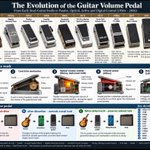
The volume pedal allows amplified guitar control without interrupting playing. Hawaiian and lap-steel musicians used foot controls before World War II to soften attacks and extend perceived sustain. Unlike tremolo, a volume pedal provides continuous amplitude control.
By 1948, Rowe Industries of Toledo, Ohio, offered the DeArmond Model 600. Its rocking metal treadle mechanically operated a potentiometer, changing output without external power. The foot effectively replaced the hand on the guitar’s volume knob.
During the 1950s, Paul Bigsby developed a combined volume-and-tone pedal. Forward-and-back movement controlled volume, while side-to-side movement adjusted tone. Fender introduced its own volume pedal in 1954, followed by the dual-axis Volume Tone in 1958. Both remained in Fender’s catalog until 1984.
Pedal-steel players demanded smooth, repeatable control. Goodrich Sound, founded by Philip Goodrich in 1965, specialized in this market. Its cord-operated models, including the later H-120 family, translated treadle movement into potentiometer rotation. The founding date is not the Model 120’s introduction date.
The next important change was optical control. Tel-Ray/Morley pedals became prominent during the 1970s, using a lamp, movable shutter and photosensitive component instead of a mechanically driven audio potentiometer. DeArmond also produced an optical model, the 1630. Optical designs reduced potentiometer contact wear, although their light sources and electronic components still required maintenance.
Ernie Ball introduced its volume pedal in 1977. An aluminum treadle and cord-driven potentiometer offered a straightforward, unpowered design. Later versions accommodated different source impedances, and its familiar mechanism became a pedalboard standard.
As rack processors and electronic instruments proliferated, BOSS expanded the category with FV-series pedals. The later FV-500H and FV-500L offered high-impedance mono and low-impedance stereo versions, respectively, plus expression outputs.
Active and contactless designs further changed the technology. Hilton developed infrared-controlled pedals; Telonics introduced digitally selectable response tapers while preserving an analog audio path. Lehle’s Mono Volume, introduced in 2015, used a Hall-effect magnetic sensor to control an analog voltage-controlled amplifier, avoiding a conventional audio potentiometer. The smaller Mono Volume S followed in 2022, adding USB MIDI capabilities.
Ernie Ball’s 2020 VPJR Tuner integrated active volume control and a digital tuning display. By 2026, pedals could attenuate audio directly or transmit expression and MIDI control data to another device.
Passive pedals can load high-impedance pickups and change treble response, particularly with long cables. Buffered or active designs help manage impedance, while expression pedals generally carry control voltages rather than guitar audio.
Placement remains fundamental. Before overdrive, a volume pedal changes the signal driving distortion; afterward, it changes the distorted signal’s level. Positioned before delay or reverb, it can silence new notes while existing repeats and reverberation decay. The underlying purpose has not changed: precise musical dynamics underfoot.
Sources:
Fender - Vintage Fender Effects
fender.com/articles/behind-t…
DeArmond - Original Effects and Factory Records
musicpickups.com/effect-unit…
Goodrich Sound - Company History
goodrichsoundcompany.com/goo…
Morley - Tel-Ray Product History
morleyproducts.com/tel-ray-i…
Ernie Ball - Volume Pedal History
ernieball.com/guitar-accesso…
BOSS - FV-500H/FV-500L
boss.info/us/products/fv-500…
Telonics - FP-100 Technical Manual
telonics.com/products/proaud…
Lehle - Mono Volume S
lehle.com/lehle-mono-volume-…
Ernie Ball - VPJR Tuner Introduction
blog.ernieball.com/accessori…

Pickup Covers, Baseplates and Magnetic Effects, 1946–2026
Pickup covers and baseplates influence electromagnetic pickups. Three mechanisms matter: magnetic-field shaping, eddy-current damping and electrostatic shielding. Confusing them has fueled decades of myths about covered and uncovered pickups.
A vibrating steel string changes magnetic flux through a pickup coil, inducing voltage. Ferromagnetic steel can redirect that flux, often changing inductance. Conductive metals support eddy currents that oppose changing fields, adding signal losses. Grounded covers intercept electric-field interference but cannot cancel magnetic hum like a humbucker.
Gibson’s 1946 P-90 established one enduring arrangement. Its plastic soapbar or dog-ear cover introduces essentially no eddy-current damping. Beneath the coil, two Alnico bar magnets couple to adjustable steel pole screws through a steel keeper. The metal baseplate, typically brass in classic versions, supports the assembly rather than functioning as a Telecaster-style ferromagnetic plate.
Fender’s 1950 Esquire and Broadcaster bridge pickups demonstrate a different purpose. Derived from lap-steel designs, they employ a steel plate beneath the Alnico rod magnets. Early plates were zinc- or copper-plated to resist corrosion and facilitate soldering. The steel influences flux distribution and increases inductance; its conductivity also produces eddy-current losses. Substituting brass does not reproduce the magnetic contribution of steel.
The Telecaster neck pickup makes the contrasting case. Its metal cover surrounds the coil and supplies shielding when properly grounded. Many vintage covers used brass, whose relatively high conductivity can damp the resonant peak. Thin nickel-silver covers generally produce smaller losses; replacement materials and thicknesses matter.
In 1957, Gibson’s Seth Lover-designed PAF humbucker combined two coils, steel screws and slugs, a bar magnet, a metal baseplate and a plated cover. Nickel silver—an alloy of copper, nickel and zinc, containing no silver—became favored for covers because it produces less eddy-current damping than comparable brass. Removing a cover may change resonance, but does not alter winding counts, magnet composition or humbucking operation. Original solder seams are also valuable evidence for collectors.
Gretsch’s 1957 Filter’Tron, developed by Ray Butts, demonstrates the importance of geometry. Its metal cover leaves substantial openings around the polepieces. Those openings change possible eddy-current paths; the complete pickup also differs from a PAF in coil dimensions, spacing and magnetic design.
Fender added another solution in 1962. The Jaguar’s notched ferromagnetic steel claws surround its single-coil pickups, influencing magnetic-field distribution while providing some shielding when grounded. They should not be confused with nonmagnetic decorative covers.
Material comparisons require care. Plastic adds negligible conductive loss; brass and copper can introduce appreciable damping; nickel silver is generally less conductive; low-carbon steel both redirects flux and conducts eddy currents. Thickness, openings, pickup height, potentiometer values and cable capacitance can matter as much as material selection.
From 1946 to 2026, these components remained central to pickup design and restoration. The decisive lesson is that a cover, baseplate or claw must be evaluated as part of the complete electrical and magnetic system, not judged by appearance alone.
Sources:
Helmuth Lemme - The Secrets of Electric Guitar Pickups
buildyourguitar.com/resource…
Guitar World - The History of Gibson P-90 Pickups
guitarworld.com/features/p-9…
Guitar World - The History of Fender Telecaster Pickups
guitarworld.com/features/fen…
Guitar World - Filter’Tron Pickup History
guitarworld.com/features/eve…
Fender - The History of the Jaguar
fender.com/articles/behind-t…
Seymour Duncan - Pickup Cover Materials
forum.seymourduncan.com/thre…

The History of the Gibson Flying V, 1958–2026
Gibson’s Flying V originated in 1957 under company president Ted McCarty, who wanted futuristic instruments capable of competing with Fender’s increasingly modern designs. Alongside the Explorer and proposed Moderne, the Flying V represented Gibson’s departure from conventional guitar styling. Its design patent was filed in June 1957, and production began at Gibson’s Kalamazoo, Michigan, factory in 1958.
The original Flying V featured a Korina body and set neck, rosewood fingerboard, two PAF humbuckers, gold hardware, ABR-1 bridge and distinctive V-shaped string-through-body anchoring. Natural-finished Korina, also called white limba, gave the guitar its characteristic appearance.
Commercial reception was disappointing. Gibson’s shipment records document just 81 Flying Vs in 1958 and 17 in 1959, totaling 98. Additional instruments were assembled from remaining original components during the early 1960s. Those later examples sometimes featured nickel hardware and patent-number humbuckers rather than gold hardware and original PAFs.
Despite weak initial sales, musicians including Lonnie Mack and Albert King demonstrated the guitar’s potential. Gibson redesigned the Flying V in 1966–1967, replacing Korina with mahogany, enlarging the pickguard, rearranging the controls and introducing a short Vibrola on many examples. Approximately 175 second-generation instruments shipped through 1970.
The limited 1971 Flying V Medallion commemorated the forthcoming 1972 Olympic Games. Approximately 350 were shipped, featuring numbered medallions, mahogany construction and fixed bridge-and-tailpiece arrangements.
The Flying V returned to regular production in 1975, recording 1,872 shipments that year. Hard-rock guitarists increasingly adopted the design, transforming a former commercial failure into an established performance instrument.
In 1979, Gibson introduced the Flying V2, a substantial redesign featuring a sculpted, laminated walnut-and-maple body, ebony fingerboard, gold hardware and unusual boomerang-shaped humbuckers. Later examples received conventional Dirty Fingers humbuckers. Production ended around 1982.
The 1981–1983 Heritage Korina series returned to the original 1958 construction concept. These instruments restored Korina bodies, period-style appointments and through-body string anchoring.
Manufacturing also changed. Gibson opened its Nashville, Tennessee, factory in 1975, operating alongside Kalamazoo until the original Michigan plant closed in 1984. Factory attribution for transitional instruments requires individual verification.
During the 1980s and 1990s, the Flying V evolved through experimental metal-oriented designs, redesigned headstocks, high-output pickups and historically inspired models. The 1990s Flying V ’67 reissues restored much of the familiar late-1960s styling.
Gibson’s 2007 Reverse Flying V inverted the conventional body design, demonstrating the company’s continued willingness to experiment. Later Gothic, Faded and artist-oriented versions expanded the model family.
Following Gibson’s 2019 product-line restructuring, the Flying V continued through standard Nashville production, particularly 1970s- and 1980s-inspired models, alongside historically detailed Custom Shop reproductions.
In 2026, Gibson Custom introduced a 1971 Flying V Medallion Reissue and a Michael Schenker Collector’s Edition, reinforcing the instrument’s historical importance.
From 98 original shipments to worldwide recognition, the Flying V evolved from a radical commercial disappointment into one of Gibson’s enduring designs.
Sources:
Gibson - 1958 Korina Flying V
gibson.com/products/gibson-c…
Chris Gill - The History of the Gibson Flying V
guitarplayer.com/gear/gibson…
Tony Bacon - Flying Vs & Explorers: A Timeline
reverb.com/news/flying-vs-an…
Vintage Guitar and Bass - Gibson Flying V
vintageguitarandbass.com/gib…
Gibson - 1971 Flying V Medallion Reissue
gibson.com/en-eu/blogs/gibso…

The Evolution of Reverb, 1939–2026
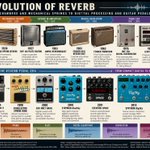
Reverb persists after its source stops through reflected waves. Early engineers relied on halls, churches and recording rooms. Unlike echoes, reverb blends reflections; decay, pre-delay and wet/dry balance shape the perceived space. Its path to guitar pedals took nearly a century.
In 1939, Laurens Hammond filed a patent describing a mechanical spring reverberation system for electronic organs. Transducers vibrated coiled springs, creating decay without a reflective room. In 1947, recording engineer Bill Putnam demonstrated another approach by placing a loudspeaker and microphone in a Chicago studio bathroom. The Harmonicats’ “Peg o’ My Heart” helped establish studio echo chambers.
German manufacturer EMT introduced the 140 plate reverberator in 1957. Instead of springs, it excited a suspended sheet-steel plate, whose vibrations were converted back into an electrical signal. Large and costly, plates became studio fixtures.
Spring reverb moved into guitar equipment in 1961. Ampeg’s Reverberocket was among the earliest commercially successful amplifiers with built-in reverb. Fender also introduced its tube-driven 6G15 Reverb Unit, with Dwell, Mixer and Tone controls. Fender’s 1963 Vibroverb incorporated spring reverb into a combo amplifier; subsequent Princeton Reverb, Deluxe Reverb, Super Reverb and Twin Reverb models brought it to broader audiences. Surf music popularized spring reverb.
Digital technology eliminated the need for physically vibrating components. The EMT 250, introduced in 1976, was a pioneering commercial digital reverberator. Lexicon’s 224 followed in 1978, using programmable algorithms and a separate controller to create convincing simulated spaces. Yamaha’s SPX90, introduced in 1986, made digital reverb, delay, pitch shifting and modulation accessible through a comparatively affordable rack processor. Digital processors recreate this complexity using short delays, filtering, diffusion and feedback, making reverberation adjustable without maintaining a physical acoustic or mechanical system.
The decisive pedalboard breakthrough came in 1987 with the BOSS RV-2, the first compact digital reverb pedal. Its processor required external power. The 1994 RV-3 added improved processing, expanded delay functions and battery operation, making the format more convenient.
Danelectro’s 1999 Spring King took the opposite approach: it housed genuine mechanical springs inside a stompbox, with a kick pad that could physically disturb them. Electro-Harmonix’s Holy Grail, available by 2002, simplified digital reverb into Spring, Hall and the flange/reverb hybrid Flerb settings.
Increasing processing power transformed pedals into sophisticated spatial workstations. Strymon’s blueSky arrived in 2010 with several algorithmic reverb types and shimmer effects. Eventide Space followed in 2011, providing twelve algorithms, while Strymon’s 2013 BigSky expanded presets, MIDI integration and more elaborate processing.
The 2024 BigSky MX combined advanced algorithms with convolution reverb, which processes captured impulse responses of actual spaces or equipment. By 2026, a single pedal could evoke a spring tank, a studio plate, a concert hall or a wholly synthetic atmosphere. Most spring and plate pedal settings therefore simulate historical hardware digitally. Reverb had traveled from architecture to machinery to mathematics, while retaining the same fundamental purpose: placing a sound within an audible space.
Sources:
Hammond - Original Spring Reverb Patent
patents.google.com/patent/US…
Universal Audio - The Basics of Reverb
uaudio.com/blogs/ua/the-basi…
Universal Audio - Origins of EMT Reverb
uaudio.com/blogs/ua/emt-reve…
Fender - Vintage Fender Effects
fender.com/articles/behind-t…
Mix - Lexicon 224 Digital Reverb
mixonline.com/technology/197…
BOSS - History of Delay and Reverb Pedals
articles.boss.info/echoes-in…
Eventide - Space Reverb
eventideaudio.com/pedals/spa…
Strymon - BigSky MX
strymon.net/product/bigsky-m…

The History of Gretsch, 1883–2026
Gretsch began in Brooklyn, New York, in 1883, when German immigrant Friedrich Gretsch established a small workshop manufacturing banjos, drums and tambourines. Following his death in 1895, his 15-year-old son Fred Gretsch Sr., assisted by his mother Rosa, assumed control.
Under Fred Sr., Gretsch expanded into a major American musical-instrument manufacturer and distributor. In 1916, the company opened its ten-story factory at 60 Broadway in Williamsburg, Brooklyn. By 1920, Gretsch claimed to be America’s largest musical-instrument manufacturer.
The company began selling Gretsch-branded guitars in 1926 and introduced electric guitars in 1939. Fred Sr. retired in 1942. His son Fred Jr. briefly assumed leadership before entering military service, leaving his brother William “Bill” Gretsch in charge. Bill died in 1948, and Fred Jr. returned as president.
The 1950s and 1960s became Gretsch’s golden age. Its Brooklyn factory expanded guitar production while the company’s drum business prospered through jazz endorsements. Partnerships with Chet Atkins and other musicians strengthened its position. The British Invasion generated enormous demand, particularly following George Harrison’s appearances with Gretsch guitars. Guitar production reached a company record in 1965.
On July 31, 1967, Fred Gretsch Jr. sold the business to Baldwin Piano Company, ending 84 years of family ownership.
Baldwin relocated guitar manufacturing from Brooklyn to its existing Booneville, Arkansas, facility in 1970. The move disrupted established production methods and dispersed experienced workers. Two factory fires in 1973 compounded the problems. Former factory manager Bill Hagner subsequently operated manufacturing under contract until Baldwin reassumed control in 1978.
Baldwin also experimented with limited guitar production in Ciudad Juárez, Mexico, during the late 1970s. Declining demand, corporate instability and unsuccessful restructuring eventually ended regular Gretsch guitar production around 1981. Baldwin’s parent company entered bankruptcy in 1983.
Fred W. Gretsch, the founder’s great-grandson, and his wife Dinah worked to restore family control during 1984, completing the return in January 1985. Headquarters moved to the Savannah, Georgia, area, while American drum manufacturing was reestablished in Ridgeland, South Carolina.
Reviving the guitar business required an entirely new manufacturing arrangement. Longtime executive Duke Kramer helped reconstruct original specifications and selected Terada Musical Instrument Company in Nagoya, Japan, as the principal manufacturing partner. Regular Gretsch guitar production resumed in 1989.
During the 1990s, Gretsch rebuilt its dealer network, expanded international distribution and introduced lower-priced Korean-made instruments.
A major restructuring followed in late 2002, when Gretsch reached an agreement with Fender Musical Instruments Corporation. Beginning in 2003, Fender managed guitar development, manufacturing, marketing and distribution, while the Gretsch family retained ownership of the brand.
Manufacturing expanded through Terada, Dyna Gakki and FujiGen in Japan; Peerless and Samick in South Korea; Yako in China; and contract factories in Indonesia. In 2004, Gretsch established its American Custom Shop inside Fender’s Corona, California, factory.
By 2026, Gretsch had reached its 143rd year, evolving from a Brooklyn family workshop into an internationally manufactured guitar brand while remaining under Gretsch family ownership.
Sources:
Gretsch - Official Company History
gretsch.com/about/
Gretsch - The Baldwin Era
blog.gretschguitars.com/2013…
Gretsch - 1984: The Year Today’s Gretsch Was Saved
gretsch.com/2024/04/40-years…
Tony Bacon - How Gretsch Guitars Came Back from the Brink
reverb.com/news/the-rebirth-…
Fender - Gretsch Custom Shop Manufacturing History
fender.com/newsroom/271879-g…


【桜山本店】
本日もご来店ありがとうございました。
グリーンカラーのギターをお探し中の方へお薦め品のご案内です。
「Soloking MS-1 Custom 24HH QMT TQWSF」
キルトトップに"Turquoise Wakesurf"カラーの美しい1本✨
ご来店の際はご試奏もぜひ!
デジマート
digimart.net/cat01/shop3780/…
#エレキギター


🎸 PRS Tekton "Floyd" Neon Green #821
💰 $2,999 · Brand New Condition
🔗 Link in bio
#guitar #guitarporn #reverb #prs #theguitarpit


Joe Bonamassa’s 1968 Fender Telecaster Thinline B-Bender
#FamousGuitars #guitar #Fender #Telecaster #BBender #JoeBonamassa #TeleTuesday


1964 Fiesta Red Fender Telecaster, 1955 Sunburst Tele and an old 1960 Bassman #amp #guitar #Fender #Telecaster #TeleTuesday


Remembering on his birthday blues legend Muddy Waters - Muddy Water's "The Hoss" 1958 Fender Telecaster (serial no. 026176) #guitar #Fender #Telecaster #FamousGuitars #MuddyWaters


