

Building agentic tools for nonprofits (@compassbykarma) and funders (@karmahq_)
San Francisco, CA
Joined March 2009
- Tweets535
- Following1.5K
- Followers1.5K
- Likes1.1K




Pinned Tweet
We just launched a new product: Karma Compass 🎉
It's the first piece of something bigger we are building: an agentic operating system for nonprofits.
We're starting with board management because every nonprofit has a board, it's time consuming and they don't get enough out of their boards, we hope to change that.
If you're on nonprofit staff or a board, I'd love for you to give it a try!
Also follow @compassbykarma for future updates.
compass.karmahq.org/


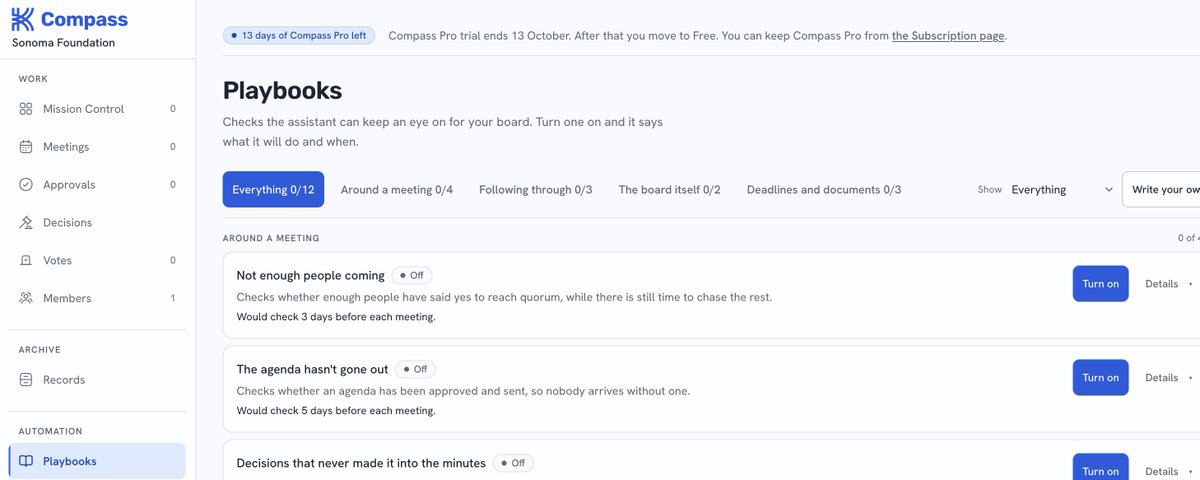
As of this week, Karma Compass works as a connector in Claude, ChatGPT or any agent you use. Ask "What is still open?" and get your board's answer without opening another portal. Find more details and more features we shipped in the latest waypoints edition.


We launched Karma Compass a couple of weeks ago. Since then we’ve been onboarding nonprofits, talking to them every week, and fixing what gets in their way.
Waypoints is our weekly update on what we built from those conversations. Here’s the first one.

Mahesh Murthy retweeted
Our goal with Karma Compass is to take our website visits to 0! That's right, if Compass succeeds, no one will be visiting our website or logging into the portal.
Wait, what?! Let me explain :)
Board members are volunteers with day jobs. The last thing they need is one more portal and one more password. So on Compass they don't log in at all. They just work through email.
We want the same for EDs. If you spend your day in email, Claude, ChatGPT, or your team runs on Slack or Teams, Compass should show up there and do the work there.
To clarify, we still want every nonprofit board using Compass, the world's best board assistant :) We just never want them to have to visit us to do it.
The tech term for this is headless software. I think of it as software that comes to you.
Mahesh Murthy retweeted
Week in Karma Compass (Sep 28 – Oct 2, 2026)
Every week, we share all the features and fixes we released in Karma Compass. Enjoy this week's updates!
We officially launched Karma Compass out of beta! Thanks for all pilot users for giving us invaluable feedback. We launched on LinkedIn, X, Product Hunt, Hacker News and X.
compass.karmahq.org/
Features that went live this week:
1. See your board's progress
The Progress dashboard shows how follow-ups are moving, with charts and a date range you choose. The range stays in the address, so you can share a link to exactly what you were looking at.
2. You can now edit categories right in the "kind of work" table, and pick a follow-up's category from a dropdown. Compass proposes a category, and you always have the last word.
3. Keep your library tidy
You can now delete a document from the board library.
4. Get help without leaving the app
Chat with support is now built into Compass. When you write to us, our team sees your board role, so we can answer faster and with the right context. There is also a support email, support@karmahq.org, in the sidebar and on the landing page.
5. A smarter assistant
The assistant now opens fresh after a break, so you start from a clean page instead of an old thread. If an older conversation can't be listed, it still offers a new one.
6. When an email is held, Compass says why and groups it with the meeting it belongs to. If you'd rather it not go out, you can drop it. Only people allowed to drop it see that option.
7. More accurate minutes
- Every motion a transcript states is kept.
- Recusals and attendance are read in full.
- Only the lines that need a person's review are flagged, so you spend your time on what matters.
8. Email and sharing
- A board turns its own email on, with no staff review in front of it.
- Link previews now refresh when we update our share image.
9. Smaller fixes
- Overdue dates follow your local day.
- Playbook emails reach the right audience.
- Playbooks count board members, not addresses, when members share an inbox.
10. Behind the scenes
We shipped a dozen production releases this week, and ran a security and data-handling pass on how Compass talks to AI providers.
> Compass is free to start, with a two-week Pro trial. Start at compass.karmahq.org/
> Tell us what you think at hello@karmahq.org.
> Follow this page for more updates.
We just launched Karma Compass on Product Hunt 🚀
Our AI board assistant drafts agendas, generates meeting minutes, and follows up on tasks giving nonprofit leaders more time for their mission.
Would love your support! Take a look and upvote if you like what we’re building
producthunt.com/products/kar…

The new AI model Jev by @typesafeai is all over my X timeline with some really interesting usecases.
It got me thinking about nonprofit use cases of Jev. Say your CRM has 1,000, 10,000, or even a million donor records. Jev could score each record for something specific like “likely to respond to personal outreach.” Then it's easy to just rank those scores and give your fundraising team 10 people worth looking at today. At TypeSafe’s published price of $0.042 per million input tokens, this could be cheap enough to run every day instead of doing one big segmentation exercise every few months.
Another example: Someone emails asking about a program. Jev could score whether the message probably needs:
- a phone call
- a personal email
- an automated reply
- spam review
And it would use relevant context from your CRM when producing those probabilities. For ranking and routing work with clear rules and a human override, I think there are a lot of possibilities here. Still thinking this through.
Karma's mission is to connect funders with causes worth backing. Donor advisors do exactly that for a living, and they spend hours on research to do it well.
Today we're launching a tool that does the heavy lifting for them 🚀


When something gets easier to do, people don't just do the same amount faster. They do more of it.
My hypothesis applied to philanthropy: If AI agents make donating easier, the result isn't just donors saving time. The result is donors give more often, test more causes, support more nonprofits, and move money in smaller, more frequent increments.
Today, donating to 10 nonprofits is annoying. You have to discover organizations, compare them, open 10 websites, fill 10 forms, enter payment details, save receipts, and track what happened. No one is going to do that.
If an AI agent can do most of that work, the cost of giving attention drops.
And when the cost of giving attention drops, the volume of giving decisions goes up. I find that interesting and worth validating.

What a world it will be when your young kids cough and sneeze on your face and you don't fall sick!
This is such a great initiative!

Today we're launching Intercept: a $500M philanthropic initiative to make respiratory infections, like the common cold and flu, a thing of the past.
We treat respiratory infections as a minor nuisance, but that’s really not the case. Most of us will spend 5% of our lives (!) sick from these viruses, they kill 1M people a year, cost $600B annually in productivity, and periodically threaten civilization through pandemics.
So, if they’re such a big problem, why haven’t we dealt with them yet? Last year we convened ~40 leading scientists, pharma R&D leaders, biotech investors, and regulatory experts to better understand that.
We heard two main reasons:
(1) First, it’s just technically very challenging: respiratory viruses represent hundreds of distinct, mutating strains across several families. Fortunately, recent breakthroughs make this newly possible.
(2) Second is a lack of funding: broad-spectrum solutions have historically been underfunded, in part because they’re not a great fit for most philanthropic or commercial funding (and while COVID generated a burst of activity around preventing and understanding respiratory infections through an influx of new funding, that hasn't been sustained).
We think that with enough focus and funding, this might be solvable. Intercept is a $500 million philanthropic initiative that will take advantage of new tools to catalyze the development and deployment of two types of products: broad-spectrum preventatives and air cleaning technologies.
This problem is undoubtedly difficult. But it’s more tractable now than it’s ever been. We think we should give it our best shot.
We’re enormously grateful to our anchor funders: @stripe, @AnthropicAI, @TheFluLab, @FoundationOAI and individuals from Jane Street.
And, I’m very excited to be building this with @incredutility and the rest of the team.
Mahesh Murthy retweeted

Announcing Ethlabs: a non-profit R&D lab for Ethereum and ETH
Our mission is to make Ethereum the settlement layer of the global economy.
The internet became global because shared protocols created a common language between networks. Private systems remained useful, but bounded. Finance is approaching a similar moment. As value, assets, and markets become digital, the world needs shared settlement infrastructure.
Ethereum is uniquely positioned to become that shared base layer, the neutral foundation on which users, institutions, and agents can transact without intermediation.
What we believe:
• We believe credible neutrality matters. Ten years of uptime and the lowest counterparty risk. Ground that cannot be pulled away by any one country, institution, company, or person.
• We believe ETH matters. The most valuable, programmable store of value. A decade of broad distribution, deep liquidity in onchain markets, and maximally trustless asset on Ethereum.
• We believe DeFi matters. Markets, liquidity, credit, exchange, and coordination, open to anyone.
• We believe adoption matters. Principles do not change the world until people benefit from them.
We sit between two worlds: real usage from the builders at the frontier, and the protocol that has to support it. We work with users, applications, wallets, L2s, infrastructure teams, institutions, ETH holders, core devs and researchers, then turn what they actually need into protocol work, shared standards, infrastructure, and shipped products.
Ethlabs is independent but Ethereum is a shared project. We are one node in a much larger network of stewards. This is the multi-node future.
We have spent the better part of the past decade contributing to Ethereum core research and development.
We are opinionated and transparent. We move with urgency, learn in public, and course-correct when we’re wrong.
We are building a lean, talent-dense team for people who want to do the most important work of their careers: join@ethlabs.org
The last couple months I've spent a lot of time with nonprofits and foundations. The problems they're working through are remarkably close to what we've been solving at Karma in web3, just at a much larger scale.
Excited to start working on this side too. First free tool for nonprofits and foundations is live: karmahq.xyz/nonprofits/find-…


If you are an R&D funder, highly recommend this tool.
And special shout-out to the website designer 🫡

At @IFP, we’ve spent the past 3 years thinking about all the different ways the US government & philanthropy fund R&D.
Until now, R&D funders haven’t had a systematic way to match the innovation problem to the right funding tool.
We built THE ATLAS OF INNOVATION to fill that gap.
atlasofinnovation.org
Alongside @UChi_MSA, we’ve boiled down thousands of hours of research into a handful of questions covering how much the R&D funder knows about:
- the problem they want to solve
- the solution it should have
- the team that should build the solution
Why the Atlas matters:
The US government spends close to $200 billion every year on R&D. And after the Anthropic and OpenAI IPOs, there will be hundreds of billions of dollars in new philanthropic giving.
Choosing the correct funding approach to the social problems they’re trying to solve will mean the difference between success and failure.
For example, NSF research grants have helped seed breakthroughs from MRI machines to search engines, but grants aren’t built to deliver the kind of industrial speed and scale that a project like Operation Warp Speed required.
Picking the wrong funding approach can leave programs behind schedule, over budget, or without anything to show for all the money they spent.
How we built the Atlas:
1. We began by creating a matrix of dozens of considerations that a thoughtful policymaker or funder would ideally weigh before deciding how to fund a project.
2. We looked at every major funding approach, from grants to R&D tax credits to advance market commitments, analyzing when they work well and when they fail to meet the mission.
3. We spent months deep in the weeds of contract theory and incentive design, looking at historical examples and the state-of-the-art research in innovation economics.
4. We then worked to turn that research into a tool that time-strapped policymakers and philanthropic funders could rely on at the start of an innovation funding cycle.
5. Three years later, we are launching just that: a new (and visually stunning) website to help funders decide how to best incentivize innovation. And all they have to know… is what they currently know about their innovation goal! The Atlas takes care of the rest.
How to navigate the Atlas:
Answer questions about your goal to find the funding approach aligned with the information you have.
Each funding mechanism has its purpose for particular technologies and specific moments in development.
There shouldn’t be an ARPA for every field, just like we don’t need a prize or AMC for every innovation. The Atlas helps you navigate those tradeoffs.

Mahesh Murthy retweeted

Filecoin Public Goods Funding is open! Apply if you're supporting:
1. Core infra maintenance
2. Delivering against RFPs focused on work in key verticals inc. Web3 Builders and Web2 Object Storage
Info: filecoin.io/blog/Announcing-…

I have been talking to lot of nonprofits and looks like they are already using ChatGPT, Claude, Gemini, Microsoft Copilot chat for basic chat and prompts but haven't had the time to take it further.
So I'm offering free 2-hour 1:1 workshops to help nonprofits level up. Just sitting with you for two hours and working through real stuff in your actual workflow.
Depending on where you are, we can go:
1. Starting out: drafting, editing, summarizing RFPs, plain-language rewrites with ChatGPT, Claude, Gemini, Microsoft copilot chat
2. Mid-level: reusable prompts for your common application types, Projects to keep funder context organized, drafting from prior submissions
3. Advanced: prospect research, agent workflows, automating reporting cycles
You actually can get quite far with basic ChatGPT, Claude, Gemini or Microsoft copilot subscription without using any specialized AI powered software. Most teams just haven't had time to figure out how to use what's already there.
It's free because honestly, I learn a ton from sitting and working through with you.
If this sounds useful, grab a time: cal.com/ai-workshop

Mahesh Murthy retweeted

New blog post: The third wave of American philanthropy
Hundreds of billions of dollars in new philanthropic capital will soon become liquid. The OpenAI Foundation holds 26% of OpenAI, worth about $220B at today’s valuation. Anthropic’s seven co-founders have pledged to give away 80% of their wealth and have instituted the most aggressive donor matching program for employees in tech history.
How much does this all add up to? And how meaningful is that in the context of philanthropy today?
I was doing some simple napkin math to wrap my head around the scale of what’s coming, and radicalized myself in the process. I had dramatically underappreciated the scale of the philanthropic capital that’s about to become available and the corresponding gap in talent and organizations that will be needed to make the most of it.
This piece aims to directionally sketch the scale of what’s coming, the gap in operational capacity needed to absorb it, and what we can do to fill it.
(Link to full post in reply)
