
Partner at The Ohio Fund. Investing across the economy in the State of Ohio. Former seed/early stage investor and software founder.
Cincinnati
Joined March 2009
- Tweets1K
- Following806
- Followers703
- Likes1K




Mike Venerable retweeted

To: any company with a support number
Please do not make me navigate a tree where at each node you constantly remind of your webiste. I know you have a website. I tried to do what I wanted the website. I do not want to call you. Pretty much no one wants to call. I'm calling you because I have no other choice. So please God, just let me either get through to an agent or put on a queue without navigating. Heck, to even *find* your phone number took me a while because you bury it on your "contact us" page.
Mike Venerable retweeted

Patrick Collison is insanely smart. Feels like he's in a category of one in being a CEO that is also this level of verbally intelligent and insightful

Assorted things I've been mulling over regarding agents in the economy:
• Companies are in some sense the original superintelligence. It's often the case that they can use their amortized cognitive surplus to advance their interests against those of certain consumers: relative to the optimization capacity of companies, consumers can be inattentive, underinformed, irrational, etc. (Think, say, of some of the classic insurance upsells at the end of a booking process, which is typically priced substantially above what a regular policy would cost.) Herbert Simon introduced the idea of bounded rationality, and firms often end up benefiting from it. Thanks to personal agents, we will probably get somewhat more rational in how we engage with companies.
• How exactly will outcomes change? Well, certain kinds of price discrimination will work less well (how do coupons work if every agent hunts fastidiously for them?), and certain kinds of customer cross-subsidy will change (today, people who forget to cancel subscriptions subsidize those who don't). Taken across the economy as a whole, I'm not sure what the incidence of all of this will be.
• In corporate strategy, people have long debated the relative importance of distribution and product quality. Perhaps you've made something better, but does anyone know about it? Won't people just continue to buy the ACME Corp Mousetraps? Personal agents will, I think, act as a kind of structural subsidy for product quality. How would markets look different if individuals always spent at least 10 hours researching their purchases? On the margin, focusing on making a product better is, I think, going to become a more effective strategy for companies. This is good!
• It true, a corollary is that information about product quality will become more important and impactful. Today, most people have very limited ability to aggregate and integrate such data, but agents will have insatiable thirst for such signals. (It's often said that data is becoming more valuable because it helps in the training of models. That's obviously true, but I think there's a secondary way in which it's more valuable simply as a complement to cheaper intelligence.)
• A big question is whether agents will increase superstar effects (rational agents all settle on the same product) or increase dispersion (because everyone has slightly different tastes and preferences, which agents are good at eliciting, finally overcoming the artificial clustering we've been subjected to).
• Many internet companies have monetized demand routing, which is in turn often predicated on short attention spans. "I'll click on the first thing I see." This has led to some amount of inefficiency, as companies try to propitiate capricious ranking algorithms and incur various placement fees. It's not all deadweight loss (willingness to pay is itself a kind of signal, which is valuable to buyers), but it's not great. How will the nature and value of this routing change in a world of personal agents? I don't know the answer, but I think that the effects might be pretty big.
• Much of what I'm writing hinges on the assumption that personal agents will be on the consumer's side. I suspect that that will be the winning strategy, but whether it's true, and what it means to be true, involves a lot of other questions.
Taken as a whole, the market is a massively parallelized, decentralized, and highly imperfect value attribution machine, and, taking stock of all of the effects, it seems to me that the quality point may well be the biggest: that agents will change the nature of the backpropagation such that the rewards for better products increase. Maybe this is too optimistic, but I suspect (and hope) that companies that make things that they're proud of will feel that the universe is a little more partisan in their favor.
Mike Venerable retweeted

China's own economic miracle just got declared broken, by one of the people who studies it closest.
Logan Wright of Rhodium Group titled his new book "Broken China." His argument, in his own words: "this credit-dependent, investment-driven growth model has basically come to an end." He says China built one of the largest credit expansions in a century, and now that system is running out of road.
Here's the scale. Between 2008 and 2016, Chinese banks added new lending equal to roughly a third of global GDP. Much of it went into projects that never generated enough return to pay the loans back. Property once made up 20-25% of GDP. New housing starts have fallen nearly 80% since the peak, sales are down more than 60%, and buyers no longer expect prices to rise.
Wright's conclusion matters because of what it challenges. Beijing's message to the world has been that its rise is unstoppable. He says that story doesn't hold anymore, that China now faces a genuinely more constrained future.
New strategic industries like EVs and robotics won't fix this either, he argues. They're capital-heavy, not job-heavy, and don't solve the deeper problem: Chinese households don't consume enough, and the fix (shifting taxes, writing down bad loans) is politically hard to do.
He also says the US now has more economic leverage over China than it has in years, not because of chip bans, but because China can't keep growing without selling into markets abroad.
Mike Venerable retweeted

What will China do in the next five years for the biopharmaceutical industry?
More drugs, more clinical trials, and more partnerships.
Great post from my @atlasventure colleague Julia Pian - examining the 2026 "Five Year Plan" from China affirming biopharmaceutical industry as a top priority
lifescivc.com/2026/10/chines…

Mike Venerable retweeted

this is Dario and sama's worst nightmare -
A law firm buying Nvidia servers.
Latham & Watkins is building an in-house AI stack..
this is US’s second-largest law firm with $8.3 Billion in revenue last year
And now it has -
- Nvidia hardware it controls
- open-weight models it can fine tune
- proprietary legal data it is trusted to protect
- infrastructure only Latham employees can access
A law firm has decades of contracts, negotiations, client context, legal reasoning, and institutional knowledge.
They dont want to give all of that away to OpenAI or Anthropic in exchange for expensive tokens..
And on top of that - risk their data being used to train frontier models..
This will happen more and more now..
The big AI labs have no moat.. nothing protecting their largest customers from moving on..
The biggest companies in the world will -
- own the compute
- own the data
- own the workflow
- fine tune the model around their business
- switch providers when the pricing or quality changes
Dario and sama want to make this illegal by bringing in regulation.. and become the AI overlords..

Mike Venerable retweeted

Did Trump just tell Ratcliffe to send "one ping only"?
Basically, using the timing of 9/11 anniversary to prove to Putin he does actually have control over the CIA.
The ping:
cia.gov/stories/story/cia-re…
Mike Venerable retweeted

Lauren Grandcolas was pregnant with her first child on 9/11 when she was m*rdered, along with 39 others on Flight 93.
She was flying home from a funeral and, as she'd arrived at the airport early, she was bumped to the earlier flight 93, already targeted by hijackers. Her Jack husband has said that was the first time she'd ever been early for a flight.
Flight 93 was delayed and the last to be hijacked, resulting in a revolt by passengers who were well aware of their fate otherwise.
Grandcolas called her husband Jack and left a message (below) that there was a "problem with the plane" before the final fight between the passengers and the 4 hijackers.
Hijacker pilot Ziad Jarrah tried various maneuvers to knock the passengers off balance, one hijacker was likely k*lled by the passengers as per audio only heard by officials and family members.
The last words on the recording are of the hijackers deciding to crash the plane with two of them yelling "Allah Akbar" as they drove the flight into the ground in Pennsylvania.
Lauren Grandcolas was 38 and 3 months pregnant when she was m*rdered by Muslim t*rrorists Ziad Jarrah, Ahmed al-Haznawi, Ahmed al-Nami and Saaed al-Ghamdi on September 11, 2001.
Mike Venerable retweeted

This was an incredible segment.
Before ending his interview with CNBC Squawk Box this morning, CMS Administrator Dr. Oz took a moment to sound the alarm on America’s $100 BILLION healthcare fraud epidemic.
And then he dropped a line that really says it all:
“They’re not just stealing your money, they’re stealing your health.”
DR. OZ: “Can I touch on one last thing before I leave you?”
BECKY QUICK: “Yeah, I was going to ask what your biggest goal is for this year?”
DR. OZ: “We have got to deal with the fraud issues, and here’s why.”
“They’re not just stealing your money, they’re stealing your health, because if they don’t care about stealing from poor people, they’ll take your health away, and they’re stealing the nation’s trust.”
“Medicare and Medicaid were created in a high trust environment.”
“We assumed people would do the right things. We now are experiencing about $100 billion of theft a year, much of it because of the Covid pandemic impact on teaching criminals to move into healthcare.”
“And we believe if we could just take the fraud out of Medicare, we would double the life expectancy of the Medicare trust fund, which means not only would you have it for your retirement, but it could be there for your kids as well.”
That last point is the bigger issue Oz was getting at.
And if the administration can actually recover a meaningful portion of that money, Oz says the payoff could extend far beyond the current generation of Medicare recipients.
Mike Venerable retweeted
This might be one of the craziest healthcare fraud stories ever told on CNBC.
Dr. Oz was explaining how deeply fraud has become embedded in the healthcare system when he recalled a bust in Philadelphia.
The suspect was being arrested for drug possession and sales, but before the police could cuff him, he had to log out of his day job...
DR. OZ: “Some of the things these charlatans do is, they’re shockingly effective at being grifters…”
“I was just doing a bust in Philadelphia and a guy was getting arrested and they’re about to cuff him, and he said, before you cuff me, I got to log out of my day job, which is being a home care attendant.”
“And the cop said, what are you talking about? I’m arresting you for narcotics possession and sales.”
“And he says, yeah, I got that as a side gig. But my real money is like all the all the drug dealers became home care providers and he logged out on his phone.”
“He was still making money. And the cop said, I’m going to arrest you because you’re lying to the, you know, because pretending you’re providing care.”
“And the criminals said something very interesting…”
“He said, if you arrest me, you have to arrest everybody in Philadelphia…”
“We have normalized criminal behavior.”
“We have normalized fraud.”
“We have normalized stealing from the poor.”
“That is an abdication of trust, we cannot tolerate as a nation.”
“That’s why we’ve been so aggressive on this. We’re making huge inroads, and I’m quite confident that over the next year, we’ll send a very clear message: if you want to steal, don’t do it from the federal taxpayer.”
Mike Venerable retweeted

9/11 victim #3 of 2977: Marie Rose Abad 49.
Queens-born. Senior vice president at Keefe, Bruyette & Woods at Two World Trade Center.
One of the highest-ranking women in the firm. She dreamed of teaching, studied sociology at Queens College, and built a life on Long Island with her husband, Rudy. Work mattered. Escape mattered more. She read on the train into the Trade Center and packed eight thick books for their three weeks in Hawaii every October a honeymoon tradition that lasted twenty years. They had a plan for later: half the year on the road, and a world of pages still unread. Marie was in Two World Trade Center on September 11. Friends still talk about the smile. Rudy kept the promise she cared about and helped children in poverty in the Philippines.
Remember Marie Rose Abad. You have not been forgotten.❤️

Mike Venerable retweeted

A Hero That Trusted His Intuition.
The problem wasn’t that Morgan Stanley didn’t believe him.
Rick Rescorla had already been right once. After the 1993 basement bombing of the World Trade Center, the firm’s security chief walked the towers, studied the site, and reached a conclusion most people preferred not to hear: the World Trade Center was still a target. Next time, he said, it would not be a truck. It would be an airplane.
An airplane. In a 1993 report.
Executives listened. Then they looked at the lease.
Morgan Stanley was the largest tenant in the complex—twenty-two floors of the South Tower, thousands of brokers, and a trading infrastructure that could not be packed into boxes and wheeled across the Hudson.
They literally made it a trading center.
The contract with the Port Authority ran until 2006. Walking away from premium Manhattan space of that scale would have meant penalties measured in the hundreds of millions, plus the operational chaos of relocating an entire downtown machine. So the company stayed.
Rescorla adjusted. If they could not leave the building, they would learn to escape it.
He built a protocol and treated it like doctrine. Unannounced drills. No exemptions. Brokers who billed by the minute were pulled off their desks and sent into the stairwells two by two, starting from the top floors, leaving a lane for firefighters coming the other way.
People complained. He did not care. Practice, he believed, was the only thing that would beat panic.
On the morning of September 11, 2001, American Airlines Flight 11 hit the North Tower. From the 44th floor of the South Tower, Rescorla could see the fire. Then the Port Authority came over the speakers: the South Tower was secure. Stay at your desks.
Rescorla grabbed a bullhorn and ignored them.
He started the drill his people already knew by heart. Floor by floor, two by two, down the stairs. He sang as he moved—Cornish songs from childhood, then “God Bless America”—keeping the line moving, refusing to let the stairwell become a stampede. Seventeen minutes later, the second plane struck the South Tower.
By then, most of Morgan Stanley was already on the way out.
Of the 2,687 employees in the building that morning, all but 13 survived.
It was stunning.
Rescorla could have been outside with them. He went back up instead. Colleagues told him to leave. He said he would, as soon as he was sure no one was left behind.
He was last seen around the 10th floor, heading higher.
The South Tower fell at 9:59 a.m. They never found him.
He was one of the 13.
He was a hero in every sense of the word.
Remember Rick Rescorla, he remembered for us.

Mike Venerable retweeted

Whoa, I’ve been wondering where China gets its compute from (their data centers are tiny) and now I guess here is the answer

"Oracle was providing a staggering 22.6 percent of China's known A.I. computing power."
nytimes.com/2026/07/31/magaz…

Mike Venerable retweeted

Everyone arguing about whether the Midjourney Scanner can replace an MRI or CT is missing the point.
The reason it's reasonating so broadly, and especially with technologists, is that it could create a beautiful opportunity for The Bitter Lesson to get a foothold in healthcare.
Almost all of our medical data has been totally bastardized by the way we capture and store it. The EHR is supposed to be a medical record, but it is really a billing system. Every patient encounter gets compressed into a lossy template or heuristic just to facilitate billing logic.
The Bitter Lesson is simple. AI gets powerful when you feed it raw, unfiltered data and let learning, search, and compute to the work.
Stop worrying about whether AI can sharpen the resolution of the ultrasonic tomography. If the images get prettier for human interpretation, that will just be a nice bonus.
The actual goal should be to capture as much raw signal of a person's clinical state as possible. Connect that signal to similar measurement of future outcomes. Then let a model learn from that data with minimal imposition of human judgment or measurement.
Start with the assumption that we don't even necessarily know what we're looking for. This is the way to actually do great medical science.
I've watched this play out in endoscopy. As an example, historically we would take 15-20 minute colonoscopy videos of patients with ulcerative colitis and compress it down into a Mayo score of 0, 1, 2, or 3 based on the single worst moment of the entire video. So much data wasted just because we needed a human-digestible heuristic.
It turns out if you instead capture all of that raw data and use it to train a self-supervised model, those embeddings can actually learn far more about a patient's disease state. So much more that they can actually predict treatment outcomes.
This is why I'm personally fired up about the Midjourney Scanner. Don't think about it like an MRI or CT. Think of it as a beautiful fountain of human health data.


Mike Venerable retweeted

US manufacturing capacity has shown solid growth for 16 consecutive quarters, indicating a consistent trend.
This is the first sustained expansion of US manufacturing capacity in nearly two decades.
What makes it more interesting is that many of the sectors leading the expansion are those that feed back into production itself: business equipment (+4.6% YoY), machinery, electrical equipment, fabricated metal, and computer and electronic products.
federalreserve.gov/releases/…

Mike Venerable retweeted

"We don't have enough machinists. We don't have enough quality inspectors. We don't have enough welders in the country."
Hadrian CEO Chris Power on how a modern software-driven factory works differently from traditional manufacturing:
"At that task level, we have to get them 90% more productive."
"If you want to train a Navy welder today it's going to take you a decade. So we have to augment the skills with software."
"The flexibility to constructing something like a submarine demands is incredibly what we call high-mix, low-volume."
"If you're building a Toyota Camry you're making 20,000 of them a year... You can easily automate a million iPhones."
"What the software enables is running at that level of factory productivity but with the flexibility that something like a submarine demands."
"So it's really the velocity and agility and reducing the amount of people because we just don't have the people in the US."
"We have to get this productivity uplift with software and a new workforce."
@2112Power @HadrianInc @davidu
Mike Venerable retweeted

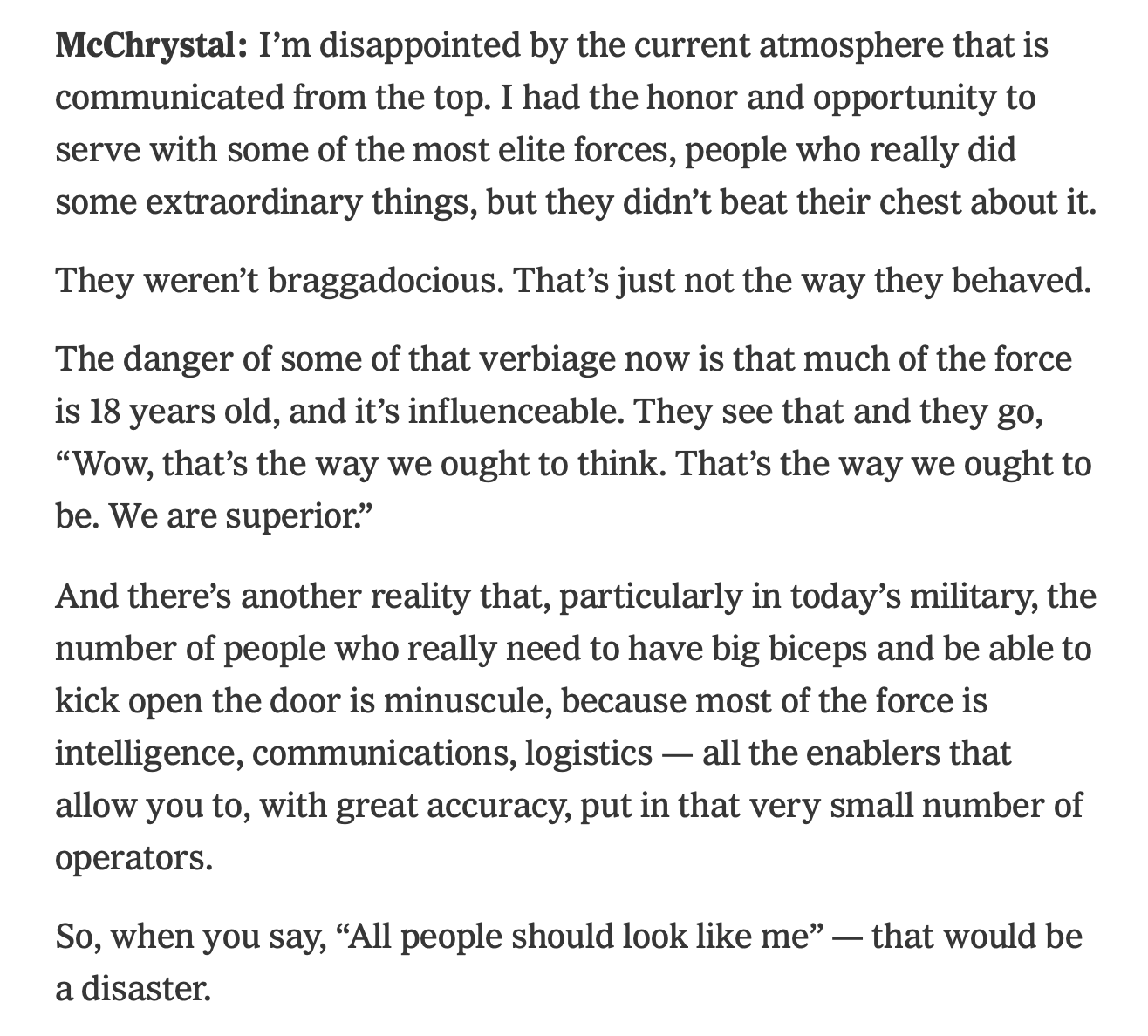
What is your objective here General @StanMcChrystal ?
I will forever be confused about your character arc. I remember you. I never met you, but I remember what it was like under you in 2010.
Trying to engage Taliban in Zhari, Kandahar. Your "courageous restraint" approach in full effect. It really stings you know. Because we had such good ISR. It was so easy to spot enemies setting up for attacks.
But unless the boys were in contact, every engagement had to be weighed and deliberated. To strike first meant going back and forth with commanders and JAG. In truth, you're the one I should've been mad at all these years, not the JAGs interpreting your policy.
I remember having to meticulously set up a response to a Taliban attack hear Highway 1 so we wouldn't get grief for engaging first.
We saw their weapons on ISR. Knew they were going to start shooting our convoy. Just like they did dozens of times before from the same spot. But we weren't allowed to harm structures or engage first without hostile intent, whatever that means.
So we had to set up this janky ass plan where mortars were laid in on the backside of their attack site. So we could try and hit them on the way out when they mounted their bikes. It was all just so dumb. We didn't kill sh*t. Because how do you hit dudes on motorcycles with mortars?
Whether or not you meant the ROE to work out that way, that's how it was perceived at our level. So when I saw you got fired, I breathed a sigh of relief. We all did.
Say what you want about GEN Petraeus but at least he let us shoot back when he took over.
You say "I had the honor and opportunity to serve with some of the most elite forces...". Man, that hits deep. Because I remember thinking that before I hit ground in Afghanistan. I was like "Yea! This man won't let us suffer like we did in Iraq a year prior, he's gonna let us take the gloves off. He's an operator."
We expected wildcat and all we got was a beached whale. The SOF dude turned into a sheep. I remember sitting around a burn barrel one night a couple months in talking to some folks. All of us asking how a SOF guy could be so weak. We got talked off so many fights up to that point.
You failed General. Like it or not, you failed. And I don't recall you admitting that once. If you were humble about it, maybe I could respect you.
But here you are smearing our Secretary like you and your retired cohort do all day every day. It's really sad honestly.
Your sycophants on here always go in my comments sticking up for you, saying people like Hegseth are the war criminal and you're the savior.
Say what you want about the man. At least he lets us throw a punch. Working for you with two arms held behind my back will forever be stuck in my mind. And you're just making it worse by saying dumb things in interviews.
Mike Venerable retweeted

Using focused ultrasound (FUS) in the lab we wanted to mimic what GLP-1 drugs do — without the weekly injections. Using a machine found in every hospital (and every submarine) we stimulated the vagus nerve in obese mice and they lost weight. And they had less inflammation. Does a new future with fewer drugs await?

ALT https://www.nature.com/articles/s41598-021-84330-6
Mike Venerable retweeted

U.S. Central Command has announced the first combat use of Low-cost Unmanned Combat Attack System (LUCAS) one way attack drones from Task Force Scorpion Strike in the attack on Iran today. Task Force Scorpion Strike was formed within CENTCOM last December with the assistance of the Rapid Employment Joint Task Force. At the announcement in December, CENTCOM stated that one squadron was active at an undisclosed location within the CENTCOM area of responsibility. The LUCAS is based on the Iranian Shahed one way attack drone.
