

Pantheist 🌌 Seeker, Tamiḻ Indian 🏹🐅🎏 🇮🇳
Chennai, India
Joined March 2018
- Tweets526
- Following701
- Followers272
- Likes7K




Pinned Tweet
If you're expecting Kumari kaṇṭam, Yāḷi lords of Kumari, Tamiḻaṉ king Irāvaṇaṉ's war in Moon and Mars, Cōḻas and Pāṇṭiyas conquering and ruling over the world, Great Tamils making contacts with the Andromedans. Then this post is not for you! quora.com/What-is-your-brief…

Look at where some Tamil Nationalists are heading. They aren't prepared to confront Dravidian politics outright, but seem perfectly willing to side with something considerably worse just to defeat what they consider as evil.
Let's be clear: Dravidian politics has had its share of corruption, opportunism, power-hungry leadership and even politicians who have concealed their own ethnolinguistic identities behind political convenience. But its contributions to Tamil Nadu's social development, education, industrialisation, welfare and economic growth are undeniable. Tamil Nadu has made remarkable progress across multiple sectors, standing alongside major economic states like Maharashtra in several respects.
That legacy deserves critical evaluation, not wholesale dismissal. And when the alternatives include Religious-drivern politics and an increasingly personality-driven, cinema-induced political culture, the stakes are considerably higher.
What disappoints me most is that Tamil Nationalists, who should ideally have a much longer-term vision for Tamil Nadu, seem increasingly satisfied with defeating Dravidian politics at any cost. Winning against the lesser evil means nothing if you end up empowering something worse.
This is precisely the kind of political short-sightedness that has cost Seeman and NTK dearly. After nearly two decades of political groundwork, you cannot expect a movement to build itself overnight, only to see a recently launched, cinema-driven political phenomenon receive the political crown. You have effectively undermined years of organisational effort in favour of celebrity appeal.
I never expected Tamil Nationalists to settle for this. I expected a far greater political vision: a Tamil Nadu beyond both Dravidian political monopolies and Rightwing dominance, beyond personality cults and cinema-driven hero worship.
Personally, I don't want DMK under Udhayanidhi either. I'd rather see capable leadership emerge from within, people like PTR or other worthy leaders. I want a credible Tamil Nationalist alternative under Seeman, alongside another progressive, somewhat Left-oriented Tamil political formation under equally capable leadership.
Tamil Nadu deserves political alternatives built on ideology, competence, social progress and long-term vision—not celebrity worship, emotional mobilisation and the desperate satisfaction of defeating yesterday's opponent.
You cannot claim to be saving Tamil Nadu while celebrating the very political culture that risks undermining its achievements.

Media goltis are trying to rage bait Tamils with such content to cope with their anger of dravidam getting defeated in 2026 assembly elections by hero worshipping Tamils.
Im ok with such dehatism if it keeps defeating dravidam till Tamil desiyam solidifies and takes over.
2
18
1,299
The term Cūr appears to have an interesting connection with the traditional Tamil conceptualisation of illness, affliction and supernatural agency. A possible historical linguistic development is its association with Sūram and Joram, terms used in various Tamil dialects for fever or illness.
In traditional village practice, one of the first responses to illness may be to consult a pūcāri (pūsāri) and perform vēppaṉilai aṭittal (the ritual waving or striking with neem leaves), before seeking treatment from a qualified maruttuvar (physician). Within this ritual framework, the pūsāri attempts to cleanse or drive away the perceived supernatural affliction affecting the person. Physical illness is subsequently addressed through medical treatment, historically associated with medicinal practitioners and, in later Tamil traditions, the Cittar (Siddhar) tradition. Earlier Tamil ritual specialists and ecstatic or divinatory figures, such as the vēlaṉ and other pūcāri or māyāḷar figures, belong to a different historical and religious context and should not simply be conflated with the later Siddhar tradition.
What makes the early Tamiḻ religious domain particularly interesting is the relationship between Cūr, Aṇaṅku and Muruku. Rather than reducing Cūr to an embodiment of absolute evil, though it functions like that, it may be more appropriate to understand it within a wider conception of affliction, dangerous supernatural potency and forces that require ritual containment. Aṇaṅku and Muruku, meanwhile, represent powerful numinous dimensions of the Tamil religious imagination, conventionally associated with feminine and masculine divine or supernatural agency respectively.
Later Sanskritisation appears to have supplied more anthropomorphic identities and mythological narratives to some of these older Tamil religious concepts: Aṇaṅku becoming associated with Mahāmāyā, Muruku with Skanda, and Cūr being elevated as Cūraṉ or Sūrapaḍmaṉ. These associations are worth investigating as processes of religious reinterpretation and assimilation, rather than assuming that the Tamil concepts were originally identical to their later Sanskritic counterparts.
The important distinction is between the older Tamil conceptual vocabulary, its ritual and socioreligious functions, and the later Sanskritic mythological identities through which these forces came to be interpreted.


Today is Śūrasaṃhāram, which commemorates the victory of Murugan over the asura Śūrapadmā. Much has been written about the indigenous roots of Murugan before his absorption into the Puranic fold but the indigenous roots of his chief enemy Śūrapadmā is less known.
Śūrapadmā is unique to the southern recension of Skanda Purana whereas in the northern tradition the primary enemy of Skanda is the asura called Tāraka. But even before Śūrapadmā, there was cūr (சூர்) which was a malevolent force inhabiting the mountains and forests in ancient Tamil belief system.
In the earliest layers of Tamil Sangam literature, cūr appears as an impersonal force and not as a personified demigod like asura. It is listed as a native root in the Dravidian Etymological Dictionary, meaning fear, suffering, affliction, etc. The local hill communities prayed to their native hunting deity, Murugan, to drive away this cūr using his spear (vēl). This Murugan was not fighting a literal war; he was an exorcist-protector driving away a spiritual affliction.
Later under the influence of the northern Puranic tradition, cūr, through homophonic conflation, becomes identified with the Sanskrit word śūra meaning mighty, a trait of asuras. Hence, Śūrapadmā as an asura is born in the southern Sanskrit recension of Skanda Purana and its Tamil adaptation.
Even then the Tamil tradition maintains its uniqueness. Because of the older Dravidian meaning of cūr (affliction/terror), the Tamil portrayal of Śūrapadmā became much more deeply tied to psychological and spiritual dread than his northern counterpart. He was no longer just a king fighting for territory; he was the literal embodiment of cosmic illusion, ego and spiritual affliction.
In the northern narrative, Skanda simply destroys his enemies. But in the Tamil tradition, Murugan splits Śūrapadmā in two with his vēl. Instead of dying, the “affliction/ego” is conquered and transformed: one half becomes Murugan’s vehicle (the peacock) and the other becomes his flag (the rooster).
By conflating the two words, Tamil tradition successfully anchored a complex Sanskrit Puranic epic (Skanda Purana) directly into their deeply ancient, indigenous folklore. The invisible “spiritual affliction” (cūr) of the ancient hills was given a physical body, a palace, and a dramatic storyline in the form of the asura king Śūrapadmā.


First of all, similar-sounding words are not proof of linguistic borrowing. Tamil cōḷam (சோளம்) and European sorgo/sorghum may refer to the same crop, but their documented etymologies are different.
English sorghum entered in the late 16th century through Italian sorgo and Medieval Latin surgum/suricum, associated with Latin Syricum (granum) — “Syrian grain”. Spanish sorgo likewise follows the European word history, not an established borrowing from Tamil.
[Cc: treccani.it/vocabolario/sorg…]
More importantly, comparative Dravidian linguistics reconstructs a much wider cereal-name cognate group: F. C. Southworth's PDr-2 *connel includes Tamil cōḷam/connal, Malayalam cōḷam, Kannada jōḷa, Telugu jōnna, Kolami sonna, Parji jenna and Gondi jonnang.
[Ref: homepages.ucl.ac.uk/~tcrndfu…]
That is an actual comparative linguistic argument based on multiple related languages, not a resemblance between two isolated words.
An early Tamil attestation establishes the antiquity of the Tamil word; it does not establish that Italian or Spanish borrowed it. Chronological priority is not etymological proof.
The comparative reconstruction is evidence for a shared Dravidian lexical history, not proof that every listed modern form descends through an identical, uninterrupted phonological pathway. Also, the claim that Tamil cōḷam is attested exactly 2,100 years ago needs a specific dated inscription or securely dated textual occurrence before being used as an exact chronological fact.
Day by day, we are turning ourselves into a laughing stock! It is genuinely disheartening to see a linguistic tradition with the intellectual legacy of the Tolkāppiyam and Naṉṉūl being reduced to such careless arguments, baseless claims and embarrassing displays of ignorance. We have a remarkable grammatical and scholarly heritage. The least we can do is uphold it with evidence, rigour and intellectual honesty—not undermine it with linguistic nonsense.

Early attestations and written records certainly matter, but they are not the only measures of a language's richness, value or greatness. As a Tamiḻ speaker, the language is dear to me; it is my mother tongue, and naturally, I connect with it. The same is true of Kannadigas and their relationship with Kannada.
Historian R. C. Hiremath, in his work on Dravidian languages, discusses the idea of an earlier Kannada–Tamil linguistic continuum, whose separation was associated with the expansion of Mauryan influence into the Deccan. In this view, around 400–300 BCE, Kannada and Tamil were developing as closely related branches of an earlier linguistic unity, before gradually drifting apart through their own changes and developments.
Their later literary histories took different paths, and the surviving records are not equally old. But that does not make one language inherently greater or more authentic than the other. They share a deep linguistic ancestry, and both have their own remarkable histories.

Other seals, particularly Mohenjo-daro Seal M-312, appear to depict a Water Buffalo (PDr. *kaṇṭ-āy) rather than a Zebu Bull (PDr. *kāḷ-āy).
However, the bull-taming human-sport motifs are much clearer in the Madurai cave paintings, dated to around 1000 BCE, where the animals depicted (in other two pictures) are specifically Bos indicus.
Although Zebu Bulls are also represented on other Indus seals, their presence does not necessarily indicate that they held the same cultural or ritual significance.
Nevertheless, the interpretations proposed by Asko Parpola and Iravatham Mahadevan deserve consideration. Sangam literature attests to this sport as a tradition associated with the Vēḷir (Āy/Yādava) and most likely practised among agrarian communities across the Indian subcontinent.


Could this also explain how Korra would have died—or been killed by a mob of ordinary people? #AvatarSevenHavens
This quoted post is unavailable.
1
346
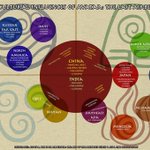
Man, they literally kept the original elemental logos and their Chakra-associated designs! I understand why removing the Chinese characters was a bad call, but the Avatar franchise has always drawn from both the Sino and Indosphere traditions. Without India, the Avatarverse is incomplete! Asia doesn’t mean East Asia alone. Its cultural influences extend across regions, and South Asia is just as much a part of that story!


They removed the Chinese characters in the background to gaslight you that the show has always been Indian
5
309
It is generally believed that the k > c palatalisation occurred within the Old Tamiḻ branch. However, I think linguists sometimes arrive at this conclusion by taking the Old Tamiḻ literary register at face value, without adequately accounting for contemporary epigraphic and numismatic evidence. If we examine material records from the Old Tamiḻ period, we can still find local forms retaining the non-palatalised k-initials.
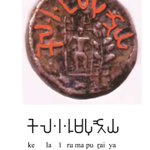
One notable example is a Cēra king's coin, which attests his name as Kel-Irumpōṟai, in contrast to contemporary literary Tamiḻ records that attest the name as Cel-Irumpōṟai, or even Cēral-Irumpōṟai. This raises the possibility that the literary palatalised form did not entirely displace the older or regionally retained k-initial pronunciation.
Likewise, the Indo-Aryan designation Kēraḷaputra and its variants may be better understood through contemporary indigenous usage, particularly the Tamiḻ honorific Cēramāṉ.
The latter is often liable to misinterpretation or mistranslation as “sons of the Cēras” or “sons of Cēralam.” However, in Old Tamiḻ, māṉ functions as an honorific element denoting an elevated personage, rather than simply meaning “son.” Consider comparable titles such as Tirumāṉ (Tirumakaṉ) and Pērumāṉ (Pērumakaṉ), where the element conveys dignity, eminence, or elevated status. Thus, Cēramāṉ should not be reduced to a literal genealogical expression. Its usage is better considered in the context of Old Tamiḻ honorific nomenclature, where māṉ could designate a distinguished or eminent personage.
My point is that literary standardisation, regional pronunciation, and contemporary naming practices need not have followed precisely the same trajectory. Numismatic and epigraphic evidence should therefore be considered alongside literary texts when reconstructing the linguistic history.
Read/Check out: dx.doi.org/10.2139/ssrn.4633…


While it's true that the "Land of Coconuts" etymology for "Kēraḷa" is likely a folk derivation, the actual derivation is more complex insofar as "Kēra" is actually the more "archaic" form.
Proto-Dravidian *k- palatalized into *c- in Proto-Tamil-Malayalam before front vowels (e.g. i, ī, e, ē), unless the front vowel was followed by a retroflex consonant (+ additional conditioning involving alveolars, though that's beyond the scope of this post).
Hence ciṟu (< PDr. *kiṟu, "small"), cem- (< PDr. *kem-, "red"), but kēḷ (< PDr. *kēḷ-, "to hear, listen"), kiṇṭi (< PDr. *kiṇṭV-, "metal pot").
The Cera polity was comprised primarily of speakers of Old Tamil (or Old Tamil-Malayalam, if you prefer), so they referred to themselves as "Cēra."
However, word-initial "k-" in most neighboring Dravidian languages (with the notable exception of Telugu) like Kannada, Tulu, Toda-Kota, etc. never underwent the *k > c palatalization before front vowels.
Speakers of these language continued to refer to the Ceras by the earlier tribal/dynastic name "Kēra."
The name Kēraḷa, first epigraphically attested in the inscriptions of Aśoka (e.g. Ketalapuᵗta [Gīrnār], Kelalapuᵗta [Kālsī], Keralaputra [Mānsehrā], Keraḍaputra [Śahbāzgaṛhī], etc.), therefore suggests an exonym or loan from a non-Tamil-Malayalam Dravidian language.
In those languages, the tribal/dynastic name remained as "Kera"
Seeman is already a weak and off. What worries me even more is seeing figures like Pāri, Varuṇ, Duraimurugan and Maṉṉar Maṉṉaṉ being elevated as prominent voices of Tamil nationalism.
After putting our hopes in Vijay and TVK, being left with these kinds of counter-options feels like a cursed political landscape. 😑
This isn't about saying every Tamil nationalist idea is wrong. Tamil identity, language and cultural rights are legitimate subjects of political debate.
But when the people presented as its principal voices are themselves so unconvincing, the movement risks turning a serious political tradition into a spectacle of personalities, rhetoric and competing egos.
Tamil nationalism deserves better intellectual leadership than these absolute clowns.


1
3
257
Ahh, now I understand why you're so concerned! It isn't about the “poop” in Poopathy—you just remembered the famed “poopjeet” mockery Westerners used for Hindians.
I’m not going to lecture you on how Tamiḻ routinely handles voiceless/voiced stops differently from Sanskritic orthographic conventions. These are part of the language's own phonological and morphophonological patterns. And yes, even I find it jarring when Tamiḻ is forced into foreign orthographic conventions.
Anyone actually familiar with Tamiḻ linguistic nuances would understand why the pū in Pūpati may look strange when you are expecting Sanskrit Bhūpati. I get why it feels “off” to you. 😏
But here's the funny part:
That's our language doing its own thing.
You can even find such Tamiḻ forms reflected in the devotional traditions of the Nāyaṉmār. Jagannātha can be rendered in Tamiḻ as Pūviyarāsaṉ, rather than simply reproducing Sanskritic forms such as Bhūvarāja or Bhuvaneśvara.
So, @AgentSaffron (Kāvi-mugavarē) are You having issue with Tamiḻ or Tamiḻ flavoured Hinduism?

Srilankan Tamils don't have any brains or what ?
Is this supposed to be Paapathy or Bhoopathy ?! What the hell is POOPATHY ?

1
175
Man! I genuinely don't know where people get these fact-less historical narratives. 😒
“Only a Brahmin woman saved the art form.”
Really? Then from whom did she learn it in the first place—and who had preserved and transmitted it for generations before her?
People seem to have little understanding of Tamil history, yet happily project the modern Sanskritised/classical formulation backwards into the past, while erasing the communities who actually maintained the tradition.
Rukmini Devi Arundale certainly played an enormous role in the revival, institutionalisation and reconfiguration of Bharatanatyam. But she did not magically rescue an art form from oblivion by herself. The Sangeet Natak Akademi records that she trained under Pandanallur Meenakshisundaram Pillai.
And Meenakshisundaram Pillai belonged to the Pandanallur Nattuvanar tradition—a hereditary lineage through which Sadir and its associated repertoire, pedagogy and performance practices had been transmitted for generations.
That history matters.
Tamil literary, musical, religious and performance traditions were nurtured across many communities—including Vellalar-associated agrarian and mercantile groups, hereditary artist communities, Nattuvanars, Vellalars and others—and cannot honestly be reduced to “Brahmins preserved everything.”
Rukmini Devi's contribution was real. Erasing the traditions and teachers who came before her is not. She learned from the tradition; she did not invent it. And alongside E. Krishna Iyer and others, she helped reframe, reorganise and institutionalise the dance under the modern name and presentation of Bharatanatyam, including significant changes to repertoire, music, costume and stage presentation.
So please, before declaring that “a Brahmin woman saved Tamil dance”—tell us who taught her.
Because sometimes the person celebrated as the “saviour” is standing on the shoulders of the very people history conveniently forgot.
8
521
Hello, Ms. @PoorniDeepa! Do you know what happened at Pānadura during the 1958 anti-Tamil pogrom?
Fueled by a completely false rumour about alleged violence against Sinhalese people in the East, a Sinhalese mob attacked the local Hindu temple. When they failed to set the temple itself on fire, they dragged out its Tamil-brahmin priest and burned him alive.
So when will some Tamil Brahmins realise that you are Tamils too?
The Brahmin part does not place you outside Tamil society, nor does it grant some special historical position above other Tamils. Your caste does not erase your Tamil identity—and it certainly cannot protect you from the consequences of ethnic hatred directed at Tamils.
The way how you casually mocked the labels “Eelam” and “Tamil” says a lot about the mindset behind your argument.
And the irony? You apparently have no idea that people from your own community were among those who suffered and were killed during the anti-Tamil violence.

Well it's exactly like how a North Indian Rudra Śarman became Uruttira Caṉmar and composed Tamil poetry in the Sangam-era!
So why is it suddenly “appropriation” when actresses of Tamil origin portray characters from related or closer South Asian linguistic or cultural background?
What’s next? We can’t accept a Badaga girl playing a Bihari Sītā? 🤦♂️
At this rate, apparently an actor needs a matching ancestry certificate for every fictional character they play. 😏
This quoted post is unavailable.
Guys, there are other North Indian actors casted alongside Maitreyi in this movie (Best of the Best). Even Anjali, the best friend she interacts with, is played by Priyanka Keida, who is also North Indian. And yes, her dusky complexion is also quite obvious.
The irony is that both Maitreyi and Priyanka probably wouldn’t be preferentially cast by our respective Bollywood or Kollywood industries in the same way. Yet at an international level, dusky and darker South Asian complexions are not automatically treated as a disgrace or a barrier to leading roles.
Meanwhile, the comment section is completely losing it, calling everything “cultural appropriation.” That is an incredibly lazy assertion.
And mind you, Bharatanāṭyam is traditionally and deeply rooted in the Eelam Tamil regions of Sri Lanka as well as Tamil Nadu. The film has used a fusion of traditions, and personally, I find some of that fusion questionable from a traditionalist perspective. But if we are talking about how culture evolves, such experimentation and hybridisation are inevitable.
And people seem to have completely missed what the film is actually about. It is about South Asian diaspora students in the US, coming together through dance, friendship and the journey toward a national dance competition. It is not some archaeological reconstruction of “authentic Indian culture.”
Also, Maitreyi never claimed to be Indian. So why are people projecting an identity onto her, accusing her of cultural appropriation, and then getting offended on her behalf? 🤦♂️
And here's another basic point people desperately need to understand: Not everything we casually perceive as “Indian” or “Bollywood” is exclusively Indian.
South Asian and wider Asian cultures have interacted for centuries. Pakistan, Sri Lanka, Bangladesh, Nepal, Bhutan, Tibet, Thailand, Cambodia, Malaysia, Singapore and many other regions have their own histories of Indic influence, cultural exchange and shared traditions. These relationships are messy, layered and interconnected—not neatly divided into modern national boxes.
And finally, the colourism issue.
This may actually be one of the more realistic representations of the range of complexions found among ordinary Indians, rather than the heavily filtered, fair-skinned fantasy that Bollywood has conditioned generations to associate with “beauty,” “heroism” and “stardom.”
Dusky skin isn't a flaw. It isn't a downgrade. It isn't something that needs to be lightened to become beautiful.
So before flooding the comments with “appropriation,” “not Indian enough,” or whatever the internet's favourite accusation happens to be today—watch the damn film, understand what it is actually doing, and stop forcing every cultural interaction into your favourite ideological box.

The Elamite word for ‘writing’ is Tal, the same word in Dravidian (taḷ) means “to push, thrust, press through”, so Elamites probably meant pressing/pushing the stylus into clay tablets for writing? 🤔
#LinguisticCoincidences
#ElamoDravidian

What were schools like in Mesopotamia?
They were tablet houses, often just ordinary homes where boys sat with lumps of wet clay, cut a reed into a stylus, and pressed those little wedge marks into the surface before it dried.
You started with single wedges, then sign lists, then whole stretches of Sumerian, and if the clay was still damp you could smooth a line out and try again, though a sloppy hand still got you in trouble.
Dr George Heath-Whyte explains. Sound on.
Man! No wonder, day by day, we are making ourselves the laughing stock. 😑
There are so many questions these remarkable Iron Age datings have sparked, and they need clear answers. First, nowhere in those results are there sufficiently clear explanations of how these dates were established and, more importantly, how securely they are associated with the iron-working contexts. This whole push happened during the DMK period, but now they are gone. The current TVK government seems more occupied with maintaining Vijay Annā's popularity and political image than with carrying forward, independently reviewing, or correcting the archaeological mess left behind by the previous DMK administration.
From crucial Iron Age datings to the attempts to push back the chronology of Tamili/Tamiḻ-Brahmi, several questions remain unanswered or inadequately settled. Even the recent findings of Tamili alongside other Indic-language inscriptions in Egypt are instructive. If the recent dating assumptions used by TN Archaeology were mechanically applied there, some of the Cikai Koṟṟaṉ inscriptions could theoretically have been pushed several centuries earlier. Yet the researchers followed established palaeographic and archaeological frameworks—particularly those associated with scholars such as Iravatham Mahadevan and Harry Falk—and placed the inscriptions within the Greco-Roman period. That contrast itself deserves attention.
Regarding the early datings for iron in the deep South, however, this is not something inherently new or impossible. When the Adichanallur weapons and associated material are dated to around the second millennium/early first millennium BCE in different studies and contexts, somewhat earlier ironworking in South India is certainly conceivable. We already have evidence for early experimentation with iron in parts of the Deccan. So an early development of iron technology in peninsular India is not an impossible proposition.
What needs much more careful scrutiny are the extraordinarily early Tamil Nadu dates extending into the 4th and 3rd millennia BCE. The Deccan's rich iron-ore resources make technological experimentation plausible, and comparisons with early African metallurgy show that the emergence of ironworking was not necessarily a single, uniform global process. Some African evidence has been argued to be surprisingly early, although the chronology and interpretation of the earliest African ironworking itself remain debated. Therefore, early experimentation in South India cannot simply be dismissed as impossible—but neither can a laboratory date automatically be transformed into the date of the invention or widespread use of iron.
We should also be careful with the idea of “AASI people” as though this were a neatly identifiable archaeological population. Ancient South Indian populations were genetically and culturally complex, and ancestry categories cannot simply be equated with archaeological cultures.
Likewise, early ironworking does not automatically mean immediate Neolithic agriculture, Megalithic culture, urbanisation and state formation. These are separate processes with their own chronologies. Yet with evidence for early urban development at Anurādhapura around the early first millennium BCE, expecting contemporary complex settlements in the Kāvēri, Vaigai–Tāmiraparani, Krishna and Godavari regions is certainly not unreasonable as a hypothesis. It simply needs archaeological evidence.
[Continued 👇]


But we still need to remain cautious with these extraordinarily early Iron Age datings from Tamil Nadu.
The radiometric dates spanning roughly 3345 BCE to 1155 BCE raise serious questions, because no archaeological culture should simply be assumed to have remained materially static for two thousand years. The earliest charcoal dates were selectively highlighted as evidence for iron usage, while critics have questioned whether the charcoal was securely associated with the iron-bearing contexts and whether disturbances or mixed deposits affected the stratigraphy. The presence of materials belonging to substantially different periods in proximity—or within disturbed contexts—can indicate problems with depositional integrity. The reporting has consequently attracted criticism for what some have described as political theatrics.
Of course, none of this excuses the ASI's own history of inadequate attention to, or disputes over, important South Indian sites. Pattanam in Kerala is an obvious example of how archaeological interpretation can become entangled with ideological and political disagreements. Nor does it absolve the Tamil Nadu Archaeology Department under the DMK from scrutiny. Both sides deserve the same evidentiary standard.
That is precisely why I call the whole setting a circus. We should not replace one ideological archaeology with another.
We need genuinely independent institutional bodies to oversee excavation, dating, archaeometallurgy and interpretation—rather than allowing archaeological narratives to move in tune with whichever political ideology happens to control the government.
If these extraordinary dates are correct, excellent. Tamil Nadu Archaeology Department needs to publish the complete evidence. Let independent specialists test it. Let the data survive scrutiny—not politics.
Without all this, it does no good for Tamiḻs to go around every online platform propagating hypotheses, traditionalist narratives, and exaggerated claims as though they were established historical facts.
If we genuinely care about Tamiḻ history, we should demand stronger archaeology, transparent evidence, independent research, and rigorous peer review—not turn every attractive narrative into a certainty.
Otherwise, we are not defending Tamiḻ history. We are only making ourselves an easy target for ridicule.
Man, IF I have to argue on your terms, then here, You have it!
I never compared myself to you. I compared your claims with those of Dr. Kamil Zvelebil—which is precisely why I called him a veteran linguist and you an amateur. And You, Dr. Krishnamurti Jr., You really mistook me there!
And FYI, I hold a Tamilology degree from TVU. That is why I was bold enough to ask whether you actually know about all forms of the Tamiḻ language before making sweeping claims about its historical stages and its diverse modern varieties.
If you seriously regard the label “Old Tamil” as a Tamil nationalist invention or distortion, I can give you Dr. Eva Wilden’s academic contact. Please write to her and ask her to rename her A Grammar of Old Tamil for Students Text as “A Grammar of Proto-Tamil-Malayalam,” or “Tamil-Malayalam Continuum Grammar,” or whatever terminology you believe is more appropriate. She will be happy to settle your doubts.
And also I have never claimed that every popular Tamil belief is correct. My argument is about scholarly evidence, not popular mythology. Yet instead of addressing the linguistic arguments and sources I cited, you repeatedly shifted the discussion toward the supposed psychology and “stupidity” of ordinary Tamil people.
And do you seriously think scholars such as Iravatham Mahadevan and Agesthialingom simply propagated the same baseless claims as linguistic nationalists?
Check this video by Ofcourse a learned guy, he do cites Naṉṉūl, not specifically Tolkāppiyam and clearly describes what I have cited through Zvelebil's passage: youtu.be/kajZdM-qd4s?si=H6e2…
The crucial distinction remains: historical stages of the same language are not the same phenomenon as separate daughter/offshoot languages. Reducing that distinction to a mere change of labels is linguistically indefensible.
Since you keep collapsing these two fundamentally different linguistic phenomena, let me be clear here again:
[1] A historical stage of a language is not the same thing as a genealogically distinct daughter or offshoot language. Old → Middle → Modern Tamil represents diachronic stages within a continuous linguistic tradition;
[2] Malayalam, Irula, etc. represent divergent branches whose relationship to Tamiḻ must be established genealogically.
You cannot simply rename a historical stage as though it were a separate language branch and call the problem solved. That is not linguistic analysis; it is terminological substitution for historical argument.
And also why? Instead of addressing my comments directly, you reshared my Xweets with your illogical counters and posed it as some victory. Genuine scholarship engages the argument at its strongest—not a caricature of it.
Because you can't able to have a genuine argument, I am also not going to waste my time with You for good. Continue with your work, all the best — @anand_011235!


Exposed to both forms, really?!
Literary Tamiḻ for Dravidian is what Sanskrit is to Indo-European!
Just get used to it.
This is what a veteran Dravidian linguist says about Tamil’s linguistic tradition:
archive.org/details/dli.jZY9…
[check: p.13–18]

