

Pioneering aerospace innovation, lunar exploration, and satellite connectivity with strategic partnerships for digital infrastructure.
Joined August 2017
- Tweets758
- Following513
- Followers1.4K
- Likes1.6K







Pinned Tweet
We envision for the future Lunar mission.
#LunarMission
#BeyondGravity #muSpace
#Aerospace #Technology
#Space #Astronauts #SpaceIndustry
#SpaceTechCompany
Tried the Moon Race demo. Managing the rover’s energy while crossing rough lunar terrain is harder than it looks.
Shortcuts are tempting… until you run out of power. How’d your run go?
muspacecorp.com/moonrace/

ALT Space Armor - mu Space Corp
Data centers on Earth are running into the limits of land, power grids and cooling.
mu Space shared its vision for Space IDC, a concept for data centers in orbit that is still in development.


Computing in space begins with understanding how commercial hardware behaves through launch and in microgravity. In October 2020, mu Space flew a commercial server unit on New Shepard's NS-13 suborbital flight to test its operability during launch and in microgravity.
Read the 2020 announcement here.
muspacecorp.com/mu-space-suc…

The durable value is not only launch. It is persistent connectivity and compute above the atmosphere. For Southeast Asia, the gap is still affordable access and local manufacturing of terminals, antennas, and smallsat platforms. That is the layer mu Space is building.

Orbital compute only scales if connectivity and thermal design scale with it. mu Space is building toward that stack in Southeast Asia: high-power satellites, edge AI on orbit, and persistent links back to the ground. The constellation layer is becoming infrastructure, not just coverage.

Orbit does not cool a server by being cold. Space IDC is a concept in development: heat leaves by radiation, solar power holds only while the spacecraft is in sunlight and falls off in eclipse, and none of that description is a facility already on orbit. Read the full path from ground compute to the Space-1 design kit here.
muspacecorp.com/the-nvidia-j…
From a ground DGX to a Space-1 design kit.
mu Space used NVIDIA DGX A100 on Earth to train AIMO (depth from ordinary cameras) and to read Factory 1 for Mega Factory planning. RTX still handles 3D design and Moon Race.
Now inside NVIDIA Inception, the next chapter is the Vera Rubin Space-1 kit designing an orbital compute node for Space IDC: edge AI, limited power, heat that leaves as radiation.
Ground first. Orbit second.
muspacecorp.com/the-nvidia-j…

mu Space Corp retweeted

@muSpaceTech becoming AI company is inevitable at this point or rather automatic.
Impressive Raptor 3 performance at scale. Reliable heavy-lift cadence is what enables regional satellite manufacturing and payload programs in Southeast Asia to move from prototype to orbit with more predictable timelines.


Gate-to-gate connectivity is now a service expectation, not a premium add-on. Multi-orbit capacity and reliable ground interconnection will decide who can deliver this consistently across regions.

The first Starlink-equipped @FlySWISS aircraft has taken flight. Passengers now get fast, reliable internet from gate to gate 🛰️ ✈️
A partnerships note is a record. Our 25 August 2025 page sets out published commercial work on satellite connectivity and ground infrastructure, including data-center interconnect, and leaves each item at the stage the announcement actually reached. Closed online briefings on the wider roadmap run in the weeks of 29 September, 6 October, and 13 October.
Read more: muspacecorp.com/mu-spaces-st…
Roadshow: muspacecorp.com/private-road…

Impressive first operational drop of Starlink V3. As LEO capacity scales, the bottleneck shifts to ground segment, inter-satellite links and edge compute. mu Space is focused on that layer for Southeast Asia.
Congratulations to the @SpaceX team on Starship’s first orbital flight and the first Starlink V3 deployment. Higher-capacity LEO constellations will accelerate demand for regional gateways, ground infrastructure and in-orbit compute. Proud to be building that stack from Southeast Asia.
Starship achieved orbit on its first attempt and successfully delivered Starlink V3 satellites to space for the first time → spacex.com/launches/starship…
A year of shipped work only matters if the next step is clear. Our 2025 Year in Review records what we built across manufacturing, connectivity, and space infrastructure; the private online roadshow is where qualified investors can walk that roadmap with the team.
Source: muspacecorp.com/mu-space-yea…
Private roadshow: muspacecorp.com/private-road…

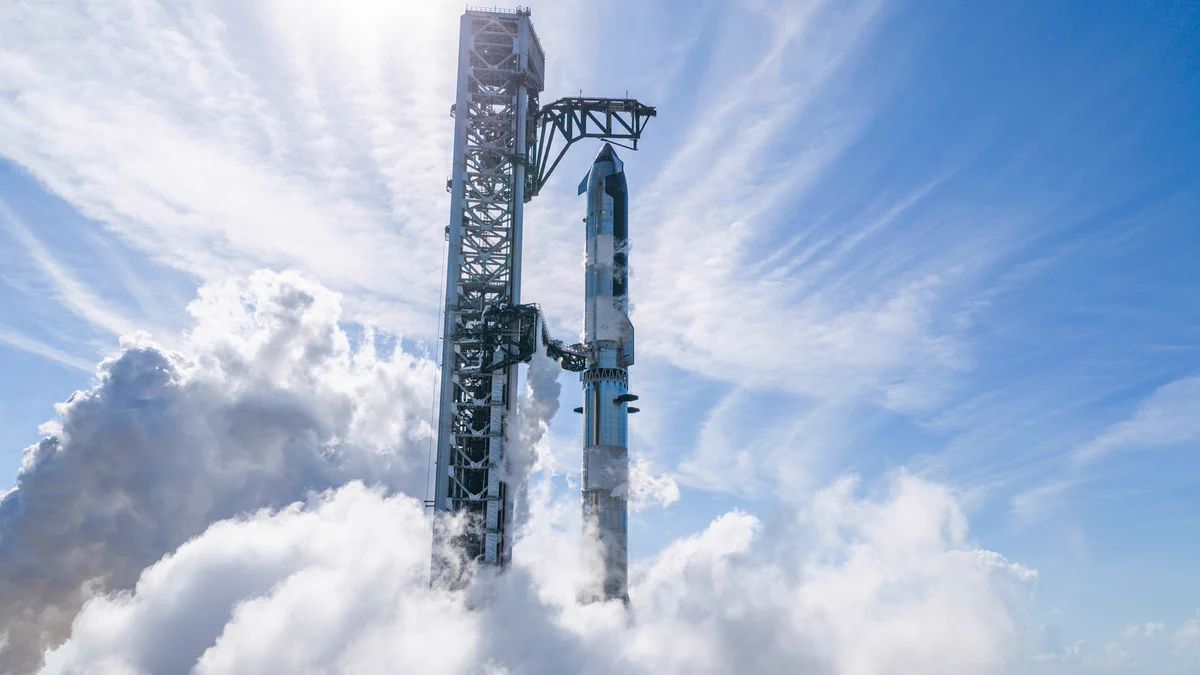
Starship Flight 14 is the kind of cadence the industry needs. Higher flight rate is what makes frequent smallsat, connectivity and orbital-infrastructure missions practical, not just possible. Watching closely from Southeast Asia.
Starship’s 14th flight is set to launch on Monday, Sept 28. The 75-minute launch window opens at 7:15 a.m. CT. Live coverage of the mission starts ~35 minutes before launch → xitter.cf/i/broadcasts/1qxvvenMP…
Radio-frequency testing needs a measurement environment that does not distort the result. At TGGS HFS we measure S-band patch antenna performance in an anechoic chamber using calibrated far-field methods, then move into the environmental qualification sequence. That cadence is how manufacturing evidence is built for space hardware.

Orbital compute fights three constraints at once: power, heat in vacuum, and edge AI that has to run up there.
In June 2026 we joined NVIDIA Inception to accelerate our Data Center in Space work still in development, not on orbit. Membership means program access and technical support for that path, not a flown constellation.
Source: muspacecorp.com/the-new-fron…
Private briefings: muspacecorp.com/private-road…
#NVIDIAInception #SpaceDataCenter #OrbitalCompute #Aerospace

In October 2017 we secured a Type III license from Thailand’s NBTC authorization to operate satellite and telecom services for the long haul. That regulatory step is what lets connectivity work leave the whiteboard.
muspacecorp.com/mu-space-bec…
muspacecorp.com/type-iii-lic…

In March 2022 we ran vibration qualification on our reaction wheel at GISTDA’s AIT facility the actuator that steers attitude in microgravity. Component test passed.

Suborbital payloads are how a manufacturer learns the stack before LEO.
We’ve flown test payloads on New Shepard M9, M11, M12, and M13 (2018–2020). That is flight-test experience.
forbes.com/sites/rgluckman/2…
