

Law professor @sjquinney, teaching criminal law and procedure, cyberlaw, AI, privacy. Views are my own. My writing is here: https://xitter.cf/t.co/ZYC0XOtLsd
Joined September 2009
- Tweets1.9K
- Following969
- Followers1.9K
- Likes7.2K




Pinned Tweet
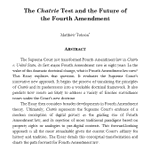
What is Fourth Amendment law now? My new essay, forthcoming in @NotreDameLRev, tries to answer that question.
papers.ssrn.com/sol3/papers.…

Matthew Tokson retweeted
It is a basic principle of American democracy that the government can’t selectively target individuals simply because of their political beliefs or what they say. But that’s exactly what the Trump Administration is doing to Congresswoman Ilhan Omar of Minnesota.
To understand why this is so appalling, it’s important to know the facts. Congresswoman Omar came to this country with her father when she was 12 years old. Five years later, her father became a naturalized citizen. If Ilhan had been 18 at the time, she would have had to apply for citizenship separately. But because she was 17, she became a naturalized citizen automatically.
Congresswoman Omar went on to graduate from college, work as a community organizer, become the first Somali-American legislator elected to public office in the U.S., and win a seat in Congress. There, she has been one of the Trump Administration’s fiercest critics, which has led the president to repeatedly single her out as someone who he believes does not belong in this country.
Now the Administration is actively trying to deport Congresswoman Omar, seemingly based solely on the unsubstantiated theory that she was actually 18 when her father was naturalized, and therefore is not a citizen. Federal agents have raided her home, confiscated personal records, and seized her phone — all to try and uncover a nonexistent smoking gun from 20 years ago that will somehow make their case.
Think about that. The full weight of the federal government is being brought down on a law-abiding elected official because she has dared to criticize the president. And it’s not the first time this has happened. Under President Trump, the Justice Department has repeatedly gone after those he considers his political enemies — from the Attorney General of New York, to the former head of the FBI, to members of the Federal Reserve.
In those cases, the prosecutions either stalled or were dismissed for having no basis in law, and the same is likely to happen in this case. But not before Congresswoman Omar’s life has been turned upside down, her legal bills have piled up, and she’s been forced to spend time fighting unsubstantiated charges instead of serving the people of Minnesota.
The fact that any president, or any administration, is willing to engage in such transparent efforts to intimidate someone should outrage all Americans, regardless of how they feel about Congresswoman Omar’s political views. Because if this becomes the new normal, there’s no reason to believe it will stop with her — or that future presidents, in either party, won’t do the same.
Matthew Tokson retweeted

Scaling Laws' most recent episode was our second live recording of our Scaling Laws Roadshow. Matt Tokson (@mtokson) joined Kevin to discuss AI, the Fourth Amendment, and the promise of near-perfect surveillance:
shows.acast.com/arbiters-of-…

Honored to win the University of Utah's 2026 Faculty Research Excellence in Responsible AI Award. Stay tuned for more scholarship on AI & privacy and AI safety to come.

Matthew Tokson retweeted

We were honored to host @KevinTFrazier and @mtokson for the @scaling_laws podcast at the University of Nebraska! Great conversation on AI and civil liberties.

A federal district judge just declared that Flock camera systems violate the Fourth Amendment! Applying Chatrie, the court concludes that extensive camera networks engage in unlawful "indiscriminate mass surveillance." A major ruling. storage.courtlistener.com/re…


I was honored to give the Keynote Address at the Nebraska Law Review's annual symposium last week. I spoke about the future of surveillance and law enforcement, and I'll post my keynote article sometime later this fall.
It was a great event and I enjoyed it so much.

Matthew Tokson retweeted
@mtokson questions the possibility of "near perfect" law enforcement through AI. What is the socially optimal level of law enforcement? Which crimes and which people do we prosecute? What are the costs in privacy? Fascinating and sobering talk at the @UNLCollegeofLaw symposium.

The idea that the AI race isn't real is starting to catch on


Treasury Secretary Scott Bessent recently warned that “there is no day after tomorrow” if China pulls ahead in artificial intelligence; Americans receive this message from political leaders and from tech innovators. Yet, the first to cross the finish line is not always the one who wins a tech race. Take, for example, the long line of British inventors who helped bring electricity to the world in the 1800s. A betting man, at the cusp of the 20th century, would have been hard pressed to deny Britain its place in the future. But that’s not how the story goes. By 1912, America had become the world’s leading industrial power, and was producing five times more electricity, per person, than Britain. This logic—that it’s not always who is first who ends up cornering the market—may apply to A.I. today. Chang Che explores this way of thinking: newyorkermag.visitlink.me/NM…

My new paper forthcoming in the Notre Dame Law Review explains, among other things, how Flock cameras should be analyzed under Chatrie v. US.
Basically, it’s going to depend on how many cameras there are.
papers.ssrn.com/sol3/papers.…


Matthew Tokson retweeted

Here's why we should be worried about AI leiterreports.com/2026/09/17…

Matthew Tokson retweeted
I was encouraged this week to see the leaders of the frontier labs agree on the need for them to slow down the pace of AI development. Given the stakes, it’s a good and necessary first step.
But I’m even more encouraged by the growing recognition that how this powerful new technology develops should be at the center of our public debate.
I’ve been watching the progress on AI for over a decade now, and one thing that’s clear to me is that the potential impact of this technology is not overhyped. It’s also moving at lightning speed – and even faster than those who are engineering it can keep up with.
I’m not an AI accelerationist who believes it will lead to some techno-utopia, and I’m not a doomer who thinks it will inevitably lead to humanity’s destruction.
But whether this technology results in amazing breakthroughs in medicine, energy and education or unleashes huge economic disruptions, greater inequality, and potential catastrophe will depend on the choices that we make right now – choices that should be made not just by the companies involved, but by all of us.
Matthew Tokson retweeted

Scoop: Obama implored Democratic leaders to move A.I. oversight to the center of the party's agenda, warning during a private fundraiser this past week that the technology could be “dangerous” if they do not get on top of it. nytimes.com/2026/09/13/us/po…

Matthew Tokson retweeted

Strong presumption against creating any new regulatory agency, but for AI right now, the presumption is overcome. In support of a new AI regulatory agency. @alexolegimas @DAcemogluMIT
casssunstein.substack.com/p/…
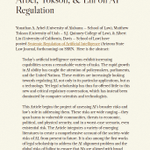
Honored to have my essay on AI and the lessons of history featured today in Luiza Jarovsky's great AI newsletter!

🚨 Can past technological developments provide a definitive answer about how AI will impact society? Should we base AI policy and regulation on specific historical examples?
Some people dismiss AI regulation as counterproductive by citing historical examples in which concerns were overblown.
Others are optimistic about AI and point to previous technological waves that some thought were exceedingly dangerous but ultimately led to societal prosperity.
In his paper “AI and the Lessons of History,” @mtokson paints a more nuanced picture: no one person has the full picture or the final word on how a technology like AI will unfold, and multiple perspectives from different fields are necessary to inform responsible policies and effective regulation.
The paper also reminds us that even geniuses make mistakes:
- In 1934, world-famous, Nobel Prize-winning theoretical physicist Albert Einstein said that “there is not the slightest indication that nuclear energy will ever be obtainable.”
- In 1998, Nobel Prize-winning economist Paul Krugman predicted that “the Internet’s impact on the economy would be no greater than the fax machine’s.”
Both were wrong.
As AI accelerates, we must invest time and effort to understand its unique risks and benefits and act fast, as AI governance and regulation cannot wait, and global coordination will be necessary.
The paper offers a detailed historical perspective to inform AI governance, ethics, and policy discussions and is a great weekend read.
👉 Learn more about the paper, read my recommendations, and join my newsletter's 100,300+ subscribers below.

Matthew Tokson retweeted

🚨 Can past technological developments provide a definitive answer about how AI will impact society? Should we base AI policy and regulation on specific historical examples?
Some people dismiss AI regulation as counterproductive by citing historical examples in which concerns were overblown.
Others are optimistic about AI and point to previous technological waves that some thought were exceedingly dangerous but ultimately led to societal prosperity.
In his paper “AI and the Lessons of History,” @mtokson paints a more nuanced picture: no one person has the full picture or the final word on how a technology like AI will unfold, and multiple perspectives from different fields are necessary to inform responsible policies and effective regulation.
The paper also reminds us that even geniuses make mistakes:
- In 1934, world-famous, Nobel Prize-winning theoretical physicist Albert Einstein said that “there is not the slightest indication that nuclear energy will ever be obtainable.”
- In 1998, Nobel Prize-winning economist Paul Krugman predicted that “the Internet’s impact on the economy would be no greater than the fax machine’s.”
Both were wrong.
As AI accelerates, we must invest time and effort to understand its unique risks and benefits and act fast, as AI governance and regulation cannot wait, and global coordination will be necessary.
The paper offers a detailed historical perspective to inform AI governance, ethics, and policy discussions and is a great weekend read.
👉 Learn more about the paper, read my recommendations, and join my newsletter's 100,300+ subscribers below.
Matthew Tokson retweeted

Now is a good time to note our paper on "AI and Existential Risk"
We ask: given that there is true uncertainty about both the risk and benefit profile of AI, what should the law do?
w/ @mtokson

Matthew Tokson retweeted

The truth is for too long, too many of us did not give enough weight to the warnings of AI safety activists, thinking the extreme scenarios were science fiction.
I was one of those many, and I was wrong. Although I always supported a robust federal AI agency for safety, I should have in retrospect supported @Scott_Wiener SB 1047 which would have established state liability. The bulk of the California delegation was mistaken in writing a letter opposing that bill. I say this as someone who has endorsed Scott's opponent, Connie Chan, for Congress. On this issue, he was right.
As I've studied this problem, and listened to the AI safety experts, I believe we not only need the federal approach I outlined above but also a robust state approach and mandatory insurance.
I have always believed in transparency when I get a call wrong. I hope more lawmakers tackle this issue with the seriousness it deserves.
I'm glad to see lots of law profs posting about AI and existential risk this week. Here are some law review articles we wrote about it and how the law might address it.
AI and Existential Risk - papers.ssrn.com/sol3/papers.…
Systemic Regulation of AI -
papers.ssrn.com/sol3/papers.…
Matthew Tokson retweeted

The #MLR Book Review Issue is live online! This final Vol. 124 issue features authors from across the legal landscape as they review a slew of recently published books—and revisit a beloved classic. Make sure to check out these incredible reviews!
READ: michiganlawreview.org/volume…

