Rio de Janeiro, Brazil
Joined March 2009
You pay $1 for a coffee with a stablecoin. Your barista can see you hold $100,000 and earn $12,500 a month. If the café uses one address, so can anyone who buys a coffee there. And see when you come in: Mon, Wed and Fri, around 9 am. That's blockchain forensics. Here's how. 🧵
3
11
4
23
2,114
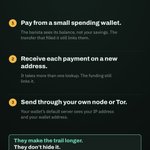
If you pay on a public chain: 1. Pay from a small spending wallet, not your savings. 2. Receive each payment on a new address. 3. Send through your own node or Tor, not your wallet's default server. The catch: each address has to be funded on its own, and bringing funds back together costs fees and links them again. It takes discipline. They make the trail longer. They don't hide it.
1
3
6
123
With a credit card, the café sees the last four digits; your bank and the card network see the rest. On a public chain, anyone sees every amount and every address. If the café uses one address, mapping its regulars costs a stranger $1: buy a coffee, open that address, list who pays and when. Researchers already link Ethereum addresses by the hours they are active (arxiv.org/abs/2005.14051). Criminals already target crypto holders in person: 86 logged attacks in 2025 (list by @lopp: github.com/jlopp/physical-bi…). No public case says a victim was found through the chain. A public ledger hands anyone the list for $1. Next: Bitcoin has no accounts, only coins (UTXOs). So how do analysts find yours? Then, which fixes actually work.
4
6
117
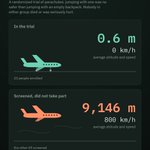
In 2018 the BMJ published a randomized trial of parachutes. Jumping from a plane with one was no safer than jumping with an empty backpack. The trial was careful and correct. The planes were parked. Many blockchain speed records are set the same way. Here's how to tell. 🧵 Average altitude 0.6 m. Average speed 0 km/h. Nobody in either group died or was seriously hurt. The trial ran in the BMJ's Christmas issue, and its lesson is serious. The point: a test can be done right and still say nothing about the hard part, if it runs where the hard part can't happen. Tempo's published benchmark is one example. Its methodology page: "two local validators in consensus on a dedicated bare-metal server."
3
7
1
21
1,510
Five questions to ask any blockchain benchmark: 1. On chain or off chain? 2. A short peak, or did it last? 3. How much work does each transaction do? 4. How many validators, and where? 5. How long until a payment is final? For Tempo: on chain; 90 seconds across regions; transfers use token code built into the node, not a contract; 2 validators on one server or 10 across three continents; time to finality not on the benchmark dashboard. How high did the plane fly, and for how long? Tempo has started to answer. We will publish ours against the same five questions. Which benchmark should I put through the five questions next?
1
2
8
103
Another lens on benchmarks, the spherical cow: xitter.cf/msbrogli/status/210827…
The blockchain industry loves big TPS numbers. 10K. 100K. 1M. Now Sui's 40M. A nerd joke: a farmer asks a physicist how to make his cows give more milk. The physicist finds a perfect solution. There's just one catch: it only works for spherical cows in a vacuum. Many TPS numbers are like that. They are true, but only under conditions that real networks don't have. The joke is about simplifying a real problem so much that the answer only works on paper. 🧵
1
5
68
Magicians hand you the box to inspect. The box is real. That's the trick. The Ledger implant in the news this week works the same way. Genuine Check passes, because the chip it checks really is genuine. The theft happens on three wires right next to it. 🧵
1
3
14
445
If you hold your own keys: 1. Buy from the maker. "Authorized reseller" was not enough here. 2. Let the device make your 24 words. Never use words that came in the box. 3. Words shown on a doubtful device are leaked. Make new ones on a trusted device and move the funds. 4. A small test deposit proves nothing. A thief can wait. 5. Airplane mode doesn't stop a radio you didn't install. 6. Use multisig across devices from different makers, so one leaked device is one key, not your funds.
1
2
54
Credit to Joe Grand and Tibane Labs for the teardowns, and to Ledger's Donjon team for being open about what it found. Same lesson as reading a TPS number: a test tells you only what it measures. xitter.cf/msbrogli/status/210827… Tibane Labs: tibane.net/research/ledger-n… Joe Grand: grandideastudio.com/portfoli…
The blockchain industry loves big TPS numbers. 10K. 100K. 1M. Now Sui's 40M. A nerd joke: a farmer asks a physicist how to make his cows give more milk. The physicist finds a perfect solution. There's just one catch: it only works for spherical cows in a vacuum. Many TPS numbers are like that. They are true, but only under conditions that real networks don't have. The joke is about simplifying a real problem so much that the answer only works on paper. 🧵
1
42
The blockchain industry loves big TPS numbers. 10K. 100K. 1M. Now Sui's 40M. A nerd joke: a farmer asks a physicist how to make his cows give more milk. The physicist finds a perfect solution. There's just one catch: it only works for spherical cows in a vacuum. Many TPS numbers are like that. They are true, but only under conditions that real networks don't have. The joke is about simplifying a real problem so much that the answer only works on paper. 🧵
6
11
3
31
2,571
The spherical cow in a vacuum: the same two people pay each other many times. For a one-time payment, a tunnel is waste: two on-chain transactions, open and close, instead of one. The chain never saw the 40M. Off chain ≠ on-chain.
1
1
8
168
Tunnels are a good tool for two parties who pay each other many times. But in a payment network anyone may pay anyone, and tunnels alone are not enough for that. Tunnels and chains are both useful. They just measure different things. This is the first post of a series. I'll read more TPS numbers with the same five questions, including ours.
1
11
148