




Pinned Tweet
When you’re ready, these are the best places to buy your first Bitcoin.
@Swan - cheapest for first $10K
@River - cheapest for recurring orders
@CashApp - quickest if you have the app
mrbitcoinbasics.com/3-best-w…
#bitcoin #howtobuybitcoin

Inevitable that the big banks would embrace the hardest asset. Question is: what are YOU gonna do about it?


Bitcoin is code.
It can be used to store value.
What do you think intelligent code will use to store value?
Bitcoin demands real-world energy.
AI demands real-world energy.
Bitcoin is what AI needs.

⚡️The real shift is that money itself is about to become an autonomous software decision.
Humans currently decide what counts as savings through culture, institutions, fear, habit, regulation, career risk. Machines do not inherit those attachments unless humans deliberately hard-code them.
Give an autonomous agent revenue, expenses, liabilities, a treasury balance, and a long enough planning horizon, and eventually it has to answer one primitive question:
Where does unused purchasing power live?
That question gets answered millions of times per second by policy, not emotion.
For operating capital, dollars win. Stablecoins are machine-readable dollars with instant settlement.
For yield-bearing reserves, tokenized Treasuries win a large share.
For capital that needs to survive outside an issuer, jurisdiction, maturity schedule, or discretionary monetary policy, Bitcoin becomes the obvious candidate.
That creates a monetary stack that looks increasingly machine-native:
stablecoins for transactions
tokenized government debt for yield
Bitcoin for sovereign reserve
And here is the part that could become enormous.
Once agents become economically autonomous, Bitcoin demand can detach from human attention entirely.
An agent earns $100,000. Expenses require $40,000. Liquidity buffer requires $20,000. Treasury policy automatically allocates some fraction of the remaining $40,000 into long-duration reserve assets.
Then another agent does it.
Then ten million.
Then industrial robots. Autonomous companies. Personal AI corporations. Machine-run marketplaces. Software entities earning from other software entities.
Nobody needs to wake up bullish.
Nobody needs to watch a halving.
Nobody needs Michael Saylor to explain anything.
The accumulation becomes background computation.
That is a radically different monetary regime because human speculative demand is episodic. Machine treasury demand can be continuous.
The deepest implication is that Bitcoin may eventually become the first major asset whose marginal buyer is partly nonhuman.
And once that happens, the old framing of Bitcoin as a human belief asset starts breaking down. Its monetary premium begins coming from something colder:
software choosing the asset because the rules survive inspection.
Fixed supply.
No issuer.
No bankruptcy.
No board.
No country.
No closing hours.
No maturity.
No permission required at the protocol layer.
A machine does not need the mythology of digital gold. It can simply compare monetary objects.
That is where this gets almost eerie.
Bitcoin was designed before autonomous economic agents existed, yet its architecture happens to look unusually compatible with an economy populated by them.
A bearer asset that machines can verify themselves.
A monetary policy expressed in code.
A settlement system that never sleeps.
A supply curve requiring no trust in another mind.
That combination may turn out to have been waiting for a user class that did not exist when Bitcoin was created.
“The mother of all scarcity squeezes”
⚡️The real risk is Bitcoin gets paperized before it gets fully monetized.
Wall Street can build layers of derivatives, loans, custodial claims, rehypothecation, and synthetic “BTC exposure” around the real coins.
That can suppress price discovery because scarcity only bites when demand reaches the scarce object.
If a pension wants $500 million of Bitcoin exposure and a bank manufactures the exposure without buying $500 million of spot BTC, the 21 million cap never feels that demand.
That is Gromen’s real signal.
But financialization does not erase scarcity.
Bitcoin can move globally, settle directly, and be independently verified. Gold never had that.
The financial system can manufacture unlimited claims.
It cannot manufacture another satoshi.
So the larger the paper layer becomes, the more dangerous the mismatch underneath it becomes.
Everything works while nobody asks for the asset.
Then sovereigns want custody.
Corporations want reserves.
Funds demand redemption.
Counterparty trust weakens.
Claims start trying to become coins.
That is when the synthetic layer discovers what fixed supply actually means.
And because Bitcoin settles at internet speed, that reconciliation could be violent.
The likely path is:
Bitcoin gets absorbed into traditional finance.
Synthetic exposure dampens volatility and reduces spot pressure.
The market starts looking domesticated.
Then settlement stress reminds everyone that the underlying asset is radically different from the credit built on top of it.
The paper layer can postpone the encounter with scarcity.
It cannot erase it.
Bitcoin may eventually become base money beneath a credit system:
Base asset: fixed, scarce, final settlement.
Credit layer: elastic, expandable.
Gromen is touching something real.
He is describing how Bitcoin can be temporarily tamed.
But the same mechanism can eventually create the mother of all scarcity squeezes.
Wall Street may spend years pretending 21 million is more elastic than it really is.
Honestly, I’m glad Luke is skeptical and “less bullish” than others. We need doubters in the community.
It leads to bitcoin ripping even harder.

Surprised at the reaction to this post. Here is the thought that generated it:
1. I logged onto Coinbase recently to buy more BTC, & was struck that unlike when i first bought BTC on Coinbase in 2013, Coinbase now offers all sorts of BTC derivatives, offering varying degrees of leverage, all cash-settled (not BTC-settled).
2. BTC peak-to-peak CAGR returns have collapsed in the 2 cycles since cash-settled** BTC derivatives began trading
(**"cash-settled" is key, because it means the owner of the biggest printing press increasingly sets marginal prices over time, NOT physical supply & demand. In most cases, the owner of the biggest printing press is the very fiat system BTC was designed to escape from) 👇
As a BTC holder since 2013 (and still), this collapse in peak-to-peak CAGR of BTC troubles me greatly. I would be happy to have anyone explain why peak-to-peak returns have collapsed in the past 8 years & why they think this trend will stop despite the seeming continued expansion of cash-settled BTC derivatives and cash-settled betting markets on BTC. Thank you. 🙏❤️

Wow! In just 6 years, inflation stole 15 weeks of your earnings… if you earn about $38/hr.

Mr. Bitcoin Basics retweeted

This video is about the lived experience of Broken Money.
My team and I worked for over a month on this one, I hope you will check it out and share it.
Mr. Bitcoin Basics retweeted

Clarity didn't pass because Republicans refused to amend the bill to meet the following requests from Democrats:
1. Make presidents divest large crypto interests or genuinely separate themselves from them. The purpose was to prevent a president from regulating an industry while personally profiting from it. A version of this was backed by both Democrat Ruben Gallego and Republican Thom Tillis.
2. Let state attorneys general enforce the ethics rules against the president. Democrats did not want enforcement to depend entirely on the president’s own Justice Department. The final Republican proposal gave states some power, but Democrats said it still did not clearly let them take direct action against the president.
3. Don't let the Office of Government Ethics simply waive the restrictions. Democrats objected to language that could allow senior officials to keep crypto-business relationships after receiving an ethics-office exemption.
4. Stop presidents and other senior officials from launching or profiting from new crypto tokens while in office. This was aimed at conflicts like a president simultaneously holding office and benefiting from meme coins or crypto businesses affected by government policy. Republicans ultimately accepted substantial restrictions in this area.
Context: Trump’s 2025 financial disclosure reported more than $1.4 billion in income from crypto ventures. The White House says his finances are managed by his children, although Trump remains the beneficiary. So Congress was writing crypto rules while the president had major financial interests in that same industry.
In a nutshell, the argument for Dem's demands was straightforward: someone making the rules shouldn't have a large personal financial stake in the industry being regulated, and the rules shouldn't depend on that person's own administration for enforcement.
So instead of just pointing fingers at Democrats for not passing the bill, why aren’t we asking why Republicans refused to agree to these terms?
Even if Americans take reliable money and payments for granted, Bitcoin’s deeper value is the freedom it offers the majority of humanity whose systems never received a bailout: self-sovereign savings and transactions that no government or bank can unilaterally deny.


Always was. Always has been.

Don’t blame baby boomers because they could buy houses for $20k and pay for college with a summer job.
Blame the politicians who printed money from thin air for half a century to fund expansion of government, war and grift.
The money is broken. Fix the money. Fix the world.
Mr. Bitcoin Basics retweeted

We desperately need to leave the crypto bubble for five minutes.
Dice? Entropy? Air-gapped devices? Seed phrases stamped into steel?
Nobody knows what the hell we are talking about.
If securing your life savings requires the average person to become an amateur cryptographer and cybersecurity expert, the product is not ready for the average person.
And screaming “not your keys, not your coins” doesn’t solve that.
Self-custody is incredibly powerful. It is also completely non-viable for 99% of people in its current form.
Until self-custody becomes so easy that your parents can use it safely without understanding what entropy means, we have not solved the problem.
The difference is in savings. The S&P 500 is up 400% since 2000.
US GDP has grown ~76%. Subtract GDP from market and there’s your extra 300 points.
Consumer price is what we spend. The stock market is where we save. Inflation benefits the investors. Always has.


Mr. Bitcoin Basics retweeted
Or, hear me out, the gov printed so much money and flooded the economy with it through “bailouts” that there was literally more dollars chasing bare necessity goods like groceries.
Inflation is always a result of money printing. And it matches gov debt too.

Good explanation of what actually happens when you make a bitcoin payment. No coins actually move.

This is America.

Bitcoin is Freedom
I spent the last few weeks in my motherland, Vietnam. The country has transformed since my family escaped in 1978. It is more prosperous, energetic, and ambitious than the Vietnam I left behind. A young population, rising investment, and global aspiration have created extraordinary momentum.
And yet one thing remains clear. For many in Vietnam, the ultimate dream is still America. And if they cannot make it to America, they want to wear American brands, eat American food, listen to American music, and exude American confidence.
My trip to Vietnam reminded me of this, and the World Cup has made it visible on a global stage. America remains not only a country people admire, but a place people still want to reach, represent, and belong to.
The United States remains the land of the free, the Wild Wild West, and the home of the American Dream. Walmart and Waffle House. Boston and Austin. Silicon Valley and Wall Street. A country where people can still rise from welfare to extraordinary success through hard work, ingenuity, risk taking, and some luck.
My family experienced that promise directly. We arrived in America as refugees, sponsored by a Catholic church in Syracuse, New York. We received public assistance, food stamps, and free school lunches. My father worked three jobs. We lived frugally and dealt with poverty and racism. America was not easy, but it was open. It gave us a system where effort, education, entrepreneurship, and perseverance could compound.
This is America. The world still aspires to be like us.
What has made America successful over the last 250 years is not accidental. It is a principled Constitution, geographic scale, abundant resources, and a culture of liberty, capitalism, entrepreneurship, and reinvention. Other nations try to replicate the recipe, but often waver. Interventionism, bureaucracy, corruption, and ego get in the way.
Which brings me to Bitcoin.
Bitcoin is the United States of money. It aspires to do for money what the American Constitution aspired to do for government: create a system governed by transparent rules rather than the discretion of individuals. Built on a principled white paper, digitally enforced scarcity, and proof of work, Bitcoin is digital capital governed by code, energy, and consensus.
But beyond that, Bitcoin is hope.
It provides hope for those who have worked hard for their money and want to protect it from monetary inflation. It provides hope for those born in countries without reliable rule of law or economic freedoms. It provides hope for anyone seeking protection, opportunity, and a form of property that does not depend on geography, politics, or permission.
I was born in the year of America’s bicentennial. Fifty years later, the future of American dominance is being questioned. I have no question. The United States of America is the greatest country in the world.
My life is proof of what America makes possible. I left Vietnam as a refugee, grew up poor in America, built a career through education and hard work, and now have a wonderful wife and three children. That is the American Dream to me. It is not just wealth. It is freedom, family, opportunity, and the ability to determine your own future.
That is also why Bitcoin resonated with me. I found Bitcoin because it reflected the same principles that shaped my life: clear rules, individual sovereignty, property rights, resilience, open competition, and long-term conviction.
America gave my family freedom through a country. Bitcoin offers individuals monetary freedom through a network. One opened the door for me. The other opens a door for anyone, anywhere, to protect the fruits of their labor.
That is why Bitcoin is freedom.
Mr. Bitcoin Basics retweeted
This is what Bitcoin solved—coordinating governance among parties collaborating on the network while competing for rewards to secure the network.
No corporate governance. No boards or meetings.
Just BIPs, bytes and bitcoin.
Mr. Bitcoin Basics retweeted
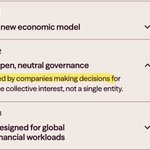
“Led by companies making decisions…” No thanks.
Bitcoin is led by individuals making decisions in their self-interest. The collective interest becomes the genuine collective self-interest of the network users. Companies are self-interested and will seek profit at our expense.
