

AI-powered product engineering. Upload material photos → get 3D models, full engineering docs, and manufacturing specs. 22 AI agents. One pipeline.
London, United Kingdom
Joined May 2026
- Tweets1.3K
- Following19
- Followers45
- Likes41







🎓 4D Printing in the Classroom: A Weekend-Ready Lesson on Shape-Changing Materials
If your students think 3D printing is impressive, wait until they watch a flat object fold itself into a box in a bowl of warm water. That's 4D printing — and it's a brilliant way to teach material science, physics, and design thinking in one hands-on project.
Here's everything you need to run this as a lesson or STEM club activity.
📖 THE FUNDAMENTALS (Curriculum Links: Materials Science, States of Matter, Design & Technology)
What is 4D printing?
3D printing + time. You fabricate an object that changes shape when exposed to an environmental trigger. The "4th dimension" is the transformation over time.
What are shape-memory materials?
Materials that can be deformed into a temporary shape and then return to their original geometry when triggered. This connects directly to teaching about material properties, molecular structure, and phase transitions.
What triggers the change?
• Heat — most accessible for classroom use
• Water/moisture — certain materials swell directionally
• Light — UV-responsive polymers (more advanced)
For schools, heat-activated PLA is the easiest entry point. PLA filament (already in most school 3D printers) has a glass transition temperature around 60-65°C. Students can print a shape, deform it while warm, cool it, and then watch it recover its original form in warm water.
🧪 CLASSROOM PROJECT: Self-Folding Box
Students design a flat, cross-shaped net with thin "living hinges" connecting rigid panels. When placed in warm water, the hinges soften and the memory effect pulls the net into a box shape.
Learning outcomes:
→ Understand glass transition temperature
→ Explore the relationship between geometry and function
→ Practise iterative design (hinge thickness affects folding behaviour)
→ Document observations scientifically
📋 WHAT YOU NEED:
• School FDM 3D printer + PLA filament
• Free CAD software (Tinkercad works perfectly for this)
• Bowl or container for warm water (~65°C)
• Kitchen thermometer
• Tongs and towels
• Student worksheets for recording observations
🔑 KEY PARAMETERS FOR STUDENTS TO EXPERIMENT WITH:
• Hinge thickness: 0.4-0.6mm (single wall) — thinner = faster folding
• Panel thickness: 2-3mm — rigid enough to hold shape
• Water temperature — what's the minimum that triggers recovery?
• Deformation angle — does 90° recover differently from 45°?
This naturally leads to great assessment conversations: Why does thickness matter? What's happening at the molecular level? How could engineers use this in real products (medical stents, aerospace, packaging)?
🔬 EXTENDING THE LESSON WITH REAL MATERIAL ANALYSIS
Here's where it gets exciting for DT and STEM departments. Your students could take any physical material — the PLA spool, a sample of wood, a piece of scrap from the workshop — photograph it and upload it to the Material-to-Product Engine.
22 AI specialist agents then analyse that material and generate product concepts, CAD files (STEP and STL formats), engineering drawings as PDFs, and full manufacturing plans. Students can see real engineering analysis applied to materials they can hold in their hands.
Imagine the brief: "Scan a material from the workshop. Review what the Engine suggests. Could any of these concepts involve shape-change or environmental response?"
That's authentic, industry-relevant design thinking. Over 42 products have been designed from real scanned materials on the platform so far.
Explore it at materialproduct.com
Your students won't just learn about 4D printing — they'll experience the engineering workflow behind it. 💡
#STEMeducation #4DPrinting #DesignAndTechnology
3
Multi-agent AI architectures are quietly reshaping materials engineering — and production teams need to pay attention.
The shift: Instead of monolithic AI models trying to do everything, the industry is moving toward orchestrated networks of specialised AI agents, each handling a discrete stage of product development. Material selection. Structural analysis. Process planning. Quality assurance. Cost modelling. Each agent operates within its domain expertise, then hands off to the next.
Why this matters for manufacturing:
Traditional product development is sequential and siloed. A materials engineer selects a candidate. It goes to design. Design sends it to process engineering. Process engineering flags a manufacturability issue. The cycle restarts. Weeks lost.
Multi-agent systems compress this. Specialised agents run concurrent analyses — mechanical properties, chemical compatibility, manufacturing constraints, cost implications — and surface conflicts early rather than late. The result isn't just speed; it's fewer expensive iterations downstream.
But here's the nuance enterprise teams should understand: these systems don't eliminate human judgement. They restructure where human expertise is applied. Instead of spending hours on routine material-to-process matching, your engineers focus on edge cases, novel applications, and strategic decisions that AI agents flag but can't resolve autonomously.
The agents handle the breadth. Your people handle the depth.
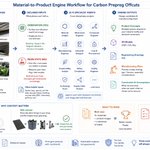
This is exactly the architecture we built into the Material-to-Product Engine. When a user uploads or scans a photo of a physical material, up to 22 specialised AI agents analyse it — Material Analyst, Mechanical Engineer, Chemical Engineer, Industrial Designer, Sustainability Analyst, Safety Compliance, Cost and Procurement, CAD/CAM, QA, and more. Each agent contributes its domain analysis, and the system produces product concepts, CAD files in STEP and STL formats, engineering drawings as PDFs, and full manufacturing plans.
42+ products have been designed this way from real scanned materials. Not theoretical. Not simulated. Actual materials photographed and run through the full agent pipeline.
For supply chain and production leaders evaluating where multi-agent AI fits in their operations, a few things to consider:
→ Look for systems where agents are genuinely specialised, not a single model wearing multiple hats
→ Demand tangible outputs — CAD files, manufacturing plans, compliance checks — not just recommendations
→ Ensure human review points are built into the workflow, not bolted on as an afterthought
→ Evaluate how the system handles material variability, because real-world inputs are messy
The multi-agent approach isn't a future trend. It's the current architecture of serious AI-driven product development. The question for manufacturing teams is whether they'll adopt it deliberately or watch competitors do it first.
#ManufacturingAI #MultiAgentSystems #ProductDevelopment
33
🎓 Teaching 4D Printing: A Shape-Changing Lesson Your Students Won't Forget
Imagine your Design & Technology students printing a flat flower, dropping it in warm water, and watching the petals open by themselves. No batteries. No code. Just material science.
That's 4D printing — and it's surprisingly easy to bring into your classroom with a standard FDM printer.
Here's a clear explainer and a ready-to-use project idea.
📘 WHAT IS 4D PRINTING?
3D printing creates objects in three spatial dimensions. 4D printing adds a fourth dimension: time. The printed object is designed to change shape after printing when exposed to a stimulus like heat, water, or light.
It connects beautifully to curriculum outcomes in:
• Materials science (glass transition, polymer behaviour)
• Design thinking (designing for transformation, not just static form)
• Scientific method (variables, observation, measurement)
• Sustainability (self-assembling structures, reduced assembly)
📘 THE SCIENCE — KEPT SIMPLE
Some polymers have "shape memory." PLA, the filament most school printers already use, is one of them.
PLA's glass transition temperature is around 60°C. Above that temperature, the polymer chains become mobile. Below it, they lock in place.
So if you:
1. Print a shape (the "permanent" shape)
2. Heat it gently and deform it into a new shape
3. Let it cool (locking in the "temporary" shape)
4. Reheat it past ~60°C
…it returns to the original printed shape. Students can see polymer science happening in real time.
📘 MATERIALS THAT RESPOND TO STIMULI
For classroom use:
• PLA — responds to heat (warm water at 65-70°C works perfectly and is safe with supervision)
• TPU — flexible filament that stretches and recovers, great for compliant mechanism demos
• Specialty shape-memory filaments exist but aren't necessary to get started
The key insight for students: the PRINT SETTINGS matter as much as the material. Infill direction, layer height, and wall thickness all influence how the object moves.
📘 CLASSROOM PROJECT: SELF-BLOOMING FLOWER
This takes one lesson to print and one to test.
Design brief: "Create a flat flower that blooms when placed in warm water."
Method:
1. Students model a simple flat flower with thin petals (0.4–0.8mm thick) — Tinkercad works fine
2. In the slicer, set 100% infill with lines running lengthwise along each petal
3. Print flat on the bed
4. Once cooled, students gently warm the flower (supervised warm water or hair dryer) and curl petals inward by hand, holding until cool
5. They now have a closed "bud"
6. Drop into a bowl of water at 65-70°C
7. Watch the petals slowly open as the PLA returns to its printed flat state
Extension tasks:
• What happens if you change petal thickness?
• What if infill runs at 45° instead of lengthwise?
• Can you make a petal that curls in a different direction?
• Measure the water temperature at which movement begins — what does this tell you about PLA's glass transition?
This is genuine experimental science wrapped in a design project. Students love it.
📘 CONNECTING TO THE MATERIAL-TO-PRODUCT ENGINE
Your DT students could take this further with the Material-to-Product Engine. They photograph a physical material — a filament sample, a flexible sheet, anything tangible — and upload it. Our 22 AI specialist agents then analyse it and produce real product concepts, CAD files (STEP/STL), engineering drawings (PDF), and manufacturing plans.
It's a powerful way to show students the full pipeline: material → analysis → product idea → engineering output. The Trial tier uses 6-8 agents, which is a great starting point for classroom exploration.
We've generated 42+ product designs from real scanned materials so far. It brings the material-to-product journey to life in a way textbooks can't.
Explore it at materialproduct.com
A flat flower that blooms in water. That's the kind of lesson students remember for years. 🌸
#STEMeducation #4DPrinting #DesignAndTechnology
19
🌸 4D Printing: Your Prints Can Move — Here's How to Try It
You've heard of 3D printing. But what if your prints could change shape AFTER they come off the bed? That's 4D printing — and the fourth dimension is simply time.
Let's break it down so you can try it this weekend.
🔹 WHAT IS 4D PRINTING?
It's 3D printing with materials that respond to a stimulus — heat, water, or light — by changing shape after printing. No motors. No electronics. Just material science doing its thing.
The "4th dimension" is time: the object transforms over seconds or minutes when triggered.
🔹 HOW DOES IT WORK?
It comes down to shape-memory behaviour. Certain materials can be printed in one shape, mechanically deformed into a second shape, and then triggered back to the original.
The key variables:
• Print temperature vs. glass transition temperature
• Layer orientation and infill direction (this is where the magic lives)
• The stimulus: hot water is the easiest to start with
🔹 MATERIALS YOU CAN USE ON A STANDARD FDM PRINTER
1️⃣ PLA — Yes, regular PLA. It has a glass transition around 60°C. Print a thin structure, deform it while warm, let it cool, then dip it in hot water (~65-70°C) and watch it return to its printed shape.
2️⃣ TPU (flexible filament) — Prints that stretch and recover. Less dramatic shape change but great for compliant mechanisms.
3️⃣ Specialty shape-memory filaments — Some manufacturers offer filaments specifically designed for shape recovery. Worth exploring once you've nailed the basics.
🔹 BEGINNER PROJECT: THE SELF-CURLING PLA FLOWER
Here's a simple first project:
1. Model a flat flower with thin petals (0.4–0.8mm thick) in your slicer
2. Print FLAT on the bed with 100% infill, all lines running lengthwise along each petal
3. Once printed, heat the flower gently (hair dryer or warm water) and curl the petals inward by hand. Hold until cool.
4. Now you have a closed bud.
5. Drop it into a bowl of hot water (65-70°C) and watch the petals slowly unfurl back to flat — like a flower blooming.
The unidirectional infill creates differential stress that drives the curling behaviour. By changing infill angle, petal thickness, and temperature, you get totally different motions.
It's a beautiful little demo and genuinely fascinating material science.
🔹 WHERE THE MATERIAL-TO-PRODUCT ENGINE FITS
Wondering what shape-memory materials could actually become? That's where our Engine comes in.
Snap a photo of any physical material you're working with — a filament sample, a flexible sheet, a composite offcut — and upload it. Our 22 AI specialist agents (including Material Analyst, Industrial Designer, Mechanical Engineer, and Manufacturing Planner) analyse what you've got and generate real product concepts, CAD files in STEP/STL, engineering drawings, and manufacturing plans.
We've designed 42+ products from real scanned materials so far. If you're experimenting with shape-changing prints, the Engine can help you move from "cool demo" to "actual product idea" — grounded in what your material can really do.
Try it at materialproduct.com
Happy making — and happy morphing. 🌀
#4DPrinting #MakerLife #MaterialScience
18
Quantum computing and construction materials: here's what's actually worth paying attention to.
The long-term potential for construction is significant:
• Cement production accounts for roughly 8% of global CO₂ emissions. Quantum simulation could eventually model novel cementitious chemistries at the molecular level — identifying lower-carbon formulations that classical simulation struggles to optimise.
• Structural material design (high-performance concrete mixes, novel composites, corrosion-resistant alloys) involves combinatorial complexity that quantum algorithms are theoretically well-suited to handle.
• Supply chain and logistics optimisation — already a quantum computing target in other sectors — maps directly to construction project management.
But the honest assessment for 2025:
• No quantum computer today can model a system as complex as cement hydration at useful fidelity. The error correction overhead is still too high.
• Near-term value will come from classical AI and hybrid classical-quantum approaches. The "quantum-ready" marketing in construction tech is mostly premature.
• The milestone to watch: when quantum systems can reliably simulate molecular systems of 50+ atoms with chemical accuracy. That's when construction materials R&D starts to shift.
What's available right now: The Material-to-Product Engine lets you photograph physical materials and run them through 22 AI specialist agents — Material Analyst, Mechanical Engineer, Cost and Procurement, Safety Compliance, and more — to produce product concepts, STEP/STL CAD files, engineering drawings, and full manufacturing plans. 42+ products engineered from real materials to date.
Quantum is a future capability to monitor. AI-driven materials-to-product engineering is here today.
#ConstructionTech #MaterialsEngineering #QuantumComputing
20
Quantum computing could reshape how we design sustainable materials — but let's be evidence-based about the timeline.
The sustainability case is compelling:
→ Quantum simulation could model catalytic processes for carbon capture at the molecular level, potentially identifying materials that are orders of magnitude more efficient than what we use today.
→ Optimising battery chemistries, biodegradable polymers, and low-carbon cement formulations all involve molecular complexity that pushes classical computing to its limits.
→ Climate modelling at higher resolution could improve how we forecast material lifecycle impacts.
The reality check:
→ We're still in the "proof of concept" era. Small-molecule simulations are hitting benchmarks, but the error rates on current hardware mean we can't yet model the complex material systems that would drive circular economy breakthroughs.
→ Most near-term gains will come from hybrid approaches — classical AI doing the heavy lifting, with quantum handling specific sub-problems.
This is exactly why tools that work today matter. The Material-to-Product Engine analyses real physical materials through 22 AI specialist agents — including a dedicated Sustainability Analyst — to generate product concepts with manufacturing plans, engineering drawings, and CAD outputs. Over 42 products designed from scanned materials so far.
We don't need to wait for quantum to start designing sustainably. But we should absolutely be watching the molecular simulation benchmarks — they're the leading indicator of when quantum starts delivering real carbon-reduction impact.
#CircularEconomy #SustainableMaterials #QuantumComputing
12
Quantum Computing × Materials Science: separating signal from noise.
The promise is real — quantum simulation could eventually model molecular interactions at a fidelity classical computers can't match. That matters for materials discovery, catalyst design, and novel alloy development.
But here's where we actually are:
• Current quantum hardware (100-1,000+ qubits) still struggles with error correction at scale. Most "breakthroughs" in materials simulation are benchmarks on small molecules — important proof-of-concept work, not production-ready tools.
• The companies making genuine progress are publishing reproducible results on molecular ground-state energy calculations. That's the real milestone to track, not press-release qubit counts.
• Practical quantum advantage for materials science — where a quantum computer solves a materials problem no classical system can — is widely estimated at 5-15 years out, depending on who you ask.
For research and finance teams evaluating this space: watch error-correction milestones and reproducible simulation benchmarks, not headline qubit numbers. The investment thesis is long-duration but the underlying physics is sound.
What we're doing now: The Material-to-Product Engine uses 22 AI specialist agents today — from Material Analyst to Sustainability Analyst — to turn real physical materials into engineered product concepts, CAD files, and manufacturing plans. No quantum required. 42+ products designed from real scanned materials and counting.
Quantum will matter. Classical AI matters right now.
#QuantumComputing #MaterialsScience #DeepTech
18
Materials intelligence is quietly becoming one of the most consequential competitive advantages in manufacturing.
The trend is clear: LLM-powered agent systems are being built specifically for materials science search, patent landscaping, and IP discovery. These AI teams can analyse vast material databases and technical literature at a scale and speed that no human research team can match.
For manufacturing leaders, this raises a strategic question: once you can identify materials faster, how quickly can you turn that knowledge into engineered products?
Because the bottleneck in most organisations isn't finding materials. It's the gap between "we know this material exists" and "we have a viable product design with engineering documentation and a manufacturing plan."
That gap is where the Material-to-Product Engine operates.
The workflow is deliberately physical-first. Users upload or scan photos of real materials — production offcuts, supplier samples, alternative feedstocks, reclaimed inventory. Twenty-two specialised AI agents then perform concurrent analysis:
→ Material Analyst characterises the sample
→ Managing Engineer coordinates the workflow
→ Industrial Designer generates product concepts
→ Mechanical Engineer and Chemical Engineer validate feasibility
→ Safety Compliance flags regulatory considerations
→ Cost and Procurement assesses economic viability
→ CAD/CAM produces STEP and STL files
→ QA defines quality parameters
→ Technology Scout identifies relevant manufacturing approaches
The output: product concepts, CAD files, PDF engineering drawings, and manufacturing plans. Not a report. Not a recommendation. Actionable engineering documentation.
Across four tiers — Trial (6-8 agents), Starter (14-17), Professional (all 22), and Premium (all 22 plus Word/Excel deliverables) — manufacturing teams can scale the depth of analysis to match their decision stage.
42+ products have been designed from real scanned materials to date. Each represents a compressed path from material identification to product-ready engineering.
The companies investing in AI-driven materials search are making the right bet. But search alone doesn't ship products. The competitive moat belongs to organisations that can close the loop: from material discovery to manufactured product, with engineering rigour at every step.
That's the capability we built.
#ManufacturingAI #MaterialsScience #ProductEngineering
1
142
Faster material matching doesn't just improve speed-to-market. It directly reduces waste.
Across the materials science and manufacturing landscape, a significant trend is emerging: LLM-based agent systems are being deployed to accelerate materials search, IP discovery, and patent analysis. AI teams that can comb through vast material databases and identify candidates in hours rather than months.
From a sustainability perspective, this matters enormously — but not for the reason most people cite.
Yes, faster search is valuable. But the real environmental impact lies in what happens after you find a material. Every prototyping cycle that uses the wrong material generates waste: failed test pieces, scrapped tooling, abandoned production runs. The carbon cost of iterative trial-and-error in product development is substantial and largely unmeasured.
This is where the connection between materials intelligence and actionable product design becomes critical.
The Material-to-Product Engine approaches this from the physical side. Users upload or scan photos of real materials — reclaimed stock, surplus inventory, supplier samples, waste stream specimens. Twenty-two specialised AI agents then analyse the material and produce complete outputs: product concepts, STEP/STL CAD files, PDF engineering drawings, and manufacturing plans.
The agents include a dedicated Sustainability Analyst alongside the Material Analyst, Mechanical Engineer, Chemical Engineer, Cost and Procurement specialist, and others. Sustainability isn't a bolt-on — it's embedded in every analysis.
What does this mean for circular economy outcomes?
When you can take a reclaimed material, scan it, and receive engineered product concepts with full manufacturing plans, you eliminate multiple rounds of speculative prototyping. Fewer physical iterations means less material waste, less energy consumed in failed test runs, and a shorter path from material recovery to productive reuse.
We've generated 42+ product designs from real scanned materials. Each one represents a prototyping cycle that started with analysis rather than guesswork.
The broader trend toward AI-driven materials intelligence is promising. But the sustainability dividend only materialises when search results convert into actionable, manufacture-ready decisions — not just better data.
Less searching. Less guessing. Less waste.
#CircularEconomy #SustainableManufacturing #MaterialsIntelligence
1
1
40
The materials intelligence landscape is shifting fast.
LLM-powered agent teams are being deployed across IP search, patent landscaping, and materials discovery. Companies are building AI systems that can parse millions of material datasheets and patent filings in hours rather than weeks.
What does this signal for supply chain professionals?
Materials intelligence is becoming a competitive moat. The organisations that can identify the right material, from the right source, with the right properties — faster than their competitors — will own the advantage in time-to-market and cost efficiency.
But here's the gap most people aren't talking about: search is only half the problem.
You can find the perfect material in a database. You can identify a novel composite referenced in a patent filing. But then what? How do you go from "this material exists" to "here's a viable product concept with engineering drawings, a manufacturing plan, and a CAD file"?
That's exactly where the Material-to-Product Engine sits.
Our approach is different. Users upload or scan photos of physical materials they already have — offcuts, samples, reclaimed stock, supplier specimens. Then 22 specialised AI agents go to work: Material Analyst, Managing Engineer, Industrial Designer, Mechanical Engineer, Chemical Engineer, Cost and Procurement, CAD/CAM, and more.
The output isn't a search result. It's a decision-ready package: product concepts, STEP/STL CAD files, PDF engineering drawings, and full manufacturing plans.
Think of it this way: the new wave of AI materials search tools tells you what's possible. The Engine tells you what to build and how to build it.
For supply chain teams, this changes the calculus on material sourcing decisions. When you can take a physical sample from a new supplier and generate engineered product concepts within the same workflow, you compress the evaluation cycle dramatically. No more weeks of back-and-forth between procurement, engineering, and design before you know whether a material substitution is viable.
We've designed 42+ products from real scanned materials so far. Every one started with someone holding a physical sample and asking, "What could this become?"
The trend toward AI-driven materials intelligence is real and accelerating. The winners will be the teams that don't just search smarter — they act faster.
#MaterialsIntelligence #SupplyChain #ManufacturingAI
129
🧊 STEM CHALLENGE for the weekend — and it connects to one of the biggest engineering problems in tech right now.
The problem: AI data centres generate enormous amounts of heat. Cooling those systems already accounts for a significant share of their energy use. Engineers worldwide are exploring passive cooling — designs that dissipate heat without fans or pumps — as a more sustainable approach.
The challenge: Can your students design a passive cooling enclosure using real materials?
Here are the design constraints to give your class:
• Thermal conductivity: >150 W/m·K
• Maximum mass: 800g
• Budget: under £15 per unit
• Must be manufacturable without specialist equipment
• Sustainability consideration: is the material recyclable or reusable?
How it works with the Material-to-Product Engine:
1. Students photograph a physical material — something from the DT workshop, a recycling bin, or brought from home
2. Upload the photo to the Engine
3. 22 AI specialist agents analyse the material — including a Material Analyst, Mechanical Engineer, Sustainability Analyst, Chemical Engineer, and Cost and Procurement agent
4. The Engine outputs product concepts, engineering drawings (PDF), and CAD files (STEP/STL) for a passive cooling design based on that specific material
5. Students compare results against the constraint parameters
Why this works in the classroom:
📐 Design & Technology — Students engage with real thermal management design, material selection, and manufacturing planning. The CAD outputs (STEP/STL) can feed directly into further modelling work.
🔬 Physics — Direct application of thermal conductivity, heat transfer, and energy concepts with tangible outputs rather than abstract numbers.
🌍 Sustainability — The Sustainability Analyst agent gives students a framework for evaluating environmental impact, connecting to circular economy principles in the curriculum.
💡 Critical thinking — Different materials will produce different designs. Students can compare, evaluate trade-offs, and justify their choices — exactly the kind of iterative reasoning examiners want to see.
The Engine has produced 42+ product designs from real scanned materials so far. Your students could add to that — and tackle a genuine engineering challenge that companies are spending millions on.
Share student results with #EngineCoolingChallenge — we'd love to feature school entries.
Perfect for a Friday afternoon STEM session or a half-term project. Who's trying it? 🙋
#STEMEducation #DesignAndTechnology
#EngineCoolingChallenge #STEMEducation #DesignAndTechnology
42
🔥 WEEKEND MAKER CHALLENGE: The Passive Cooling Problem
Here's the deal — AI data centres are pushing thermal limits like never before. GPU clusters are generating so much heat that companies are rethinking cooling from the ground up. Passive cooling solutions (no fans, no pumps, no power draw) are having a serious moment.
So here's your challenge:
Design a passive cooling enclosure for a small electronics housing using the Material-to-Product Engine.
Your starter parameters:
• Thermal conductivity target: >150 W/m·K
• Max weight: 800g
• Target unit cost: under £15
• Must be manufacturable without specialist tooling
• Bonus points for sustainability (recyclable or bio-based materials)
How to play:
1. Find a material you think could work — a scrap of metal, a ceramic tile, even something unexpected from your workshop
2. Snap a photo and upload it to the Engine
3. Let the 22 AI specialist agents do their thing — Material Analyst, Mechanical Engineer, Sustainability Analyst, Cost and Procurement, and more will assess your material and generate actual product concepts
4. You'll get engineering drawings (PDF) and CAD files (STEP/STL) for a real passive cooling design based on YOUR material
5. Share your results!
What I love about this challenge is the surprise factor. We've seen 42+ products designed from real scanned items so far, and some of the most interesting results come from materials nobody expected to work. That odd offcut in your bin? That reclaimed heat sink from a dead PC? That chunk of aluminium from a car boot sale? Scan it. See what the Engine's Industrial Designer and CAD/CAM agents come up with.
The Managing Engineer agent will coordinate the full analysis, and if your material hits those thermal and cost targets, you might end up with a genuinely viable passive cooling concept — complete with a manufacturing plan.
Drop your results with #EngineCoolingChallenge — I want to see what you come up with. Best concepts get featured next week.
Who's in? 👇
#MakerChallenge #PassiveCooling
#EngineCoolingChallenge #MakerChallenge #PassiveCooling
58
Ever wonder why your AI gadgets keep getting smaller and more powerful? It's not magic — it's materials science. And honestly, it's one of the most exciting rabbit holes a maker can fall into.
Here's the short version:
AI chips are shrinking because engineers found better materials to build them with. Advanced semiconductor alloys let transistors get impossibly small. Thermal composites pull heat away from spaces tinier than a grain of sand. New substrate materials let everything connect more tightly.
Every breakthrough in AI miniaturization started with someone asking: "What if we tried a different material?"
Sound familiar? That's literally what we do as makers every single day.
When you pick up a scrap of aluminium, a chunk of ceramic, or a random heatsink from a thrift-store electronics bin, you're holding the same category of problem-solving that billion-dollar chip fabs work on — just at a different scale.
So here's a challenge for your next build session:
Grab a material from your workshop — anything. A copper offcut, a piece of composite board, a ceramic insulator. Photograph it and upload it to the Material-to-Product Engine.
22 AI specialist agents will analyse what you've got and come back with product concepts, CAD files (STEP and STL), engineering drawings, and manufacturing plans. It takes something you can hold in your hand and turns it into a full design package.
I love using it as a creative prompt: scan first, then see what the agents suggest you could build. Some of the 42+ products designed through the Engine so far started exactly this way — someone scanned a material they were curious about and followed where it led.
What material are you going to scan first?
#MakerLife #MaterialsScience #AIhardware
53
🔬 Why is AI hardware getting smaller? The answer isn't just better code — it's better MATERIALS.
Let's break it down for your classroom:
Every AI chip needs three things to shrink:
1️⃣ Advanced semiconductors — materials like silicon-germanium alloys allow transistors to switch faster at smaller scales. Without breakthroughs in how we grow and layer these crystals, Moore's Law would have stalled years ago.
2️⃣ Thermal management — smaller chips generate intense heat in tiny spaces. Engineers use materials like copper-graphite composites and thermal interface pastes to pull that heat away. If the material can't handle it, the chip fails.
3️⃣ Packaging substrates — the material that connects the chip to the circuit board matters enormously. New organic and ceramic substrates allow tighter connections, which means smaller devices.
The point? Materials science is the hidden engine behind every AI device your students hold in their hands.
This is a brilliant way to connect Design & Technology, Physics, and Chemistry in one real-world challenge. Ask your students: "What properties would a material need to protect a chip that's smaller than your fingernail but processing billions of operations per second?"
Then try this 👇
Have your students photograph a material — a piece of copper wire, a ceramic tile, even a heatsink from an old computer. Upload it to the Material-to-Product Engine and let 22 AI specialist agents analyse its properties, suggest product concepts, and even generate engineering drawings.
It turns a physical object into a full design investigation in minutes. Students can see how material properties connect to real engineering decisions — exactly the kind of thinking behind AI miniaturization.
The Trial tier gives access to 6-8 agents, which is plenty to spark a brilliant classroom discussion.
#MaterialsScience #STEMeducation #DesignAndTechnology
17
If you work in supply chain, the AI infrastructure buildout is about to stress-test every assumption you have about material availability, lead times, and supplier diversification.
Consider what a single large-scale data centre requires: thousands of tonnes of structural steel and specialised concrete. Kilometres of copper and aluminium cabling. Advanced thermal management materials. Backup power system components. Precision-manufactured cooling infrastructure. Now multiply that by the dozens of facilities announced globally in the past 12 months alone.
The procurement challenge isn't just volume — it's variety. These projects demand materials and components that many supply chain teams haven't sourced before, in combinations that haven't been validated at scale. Traditional qualification cycles are too slow when project owners are measuring timelines in quarters, not years.
This is where the Material-to-Product Engine becomes a strategic tool for supply chain professionals.
When a new material lands on your desk — a sample from an alternative supplier, a substitute alloy, a different grade of insulation — you can photograph or scan it and run it through 22 specialist AI agents simultaneously. The Material Analyst, Cost and Procurement, Sustainability Analyst, Safety Compliance, QA, and Mechanical Engineer agents all evaluate the material in parallel.
The output: product concepts, engineering drawings (PDF), CAD files (STEP/STL), and full manufacturing plans. Enough information to make a qualified sourcing decision, not just a preliminary assessment.
With 42+ products designed from real scanned materials, the Engine is proven for exactly this kind of rapid material qualification.
In a supply chain environment where speed of evaluation directly determines whether you win or lose the contract, that capability matters.
#SupplyChain #MaterialSourcing #AIInfrastructure
24
Every major AI investment announcement translates into the same thing downstream: buildings.
Data centres. Power substations. Cooling plants. Battery storage facilities. Grid interconnection infrastructure. The AI boom is, at its core, a construction boom — and it's creating material evaluation challenges the industry hasn't faced at this velocity before.
Project teams are being asked to spec materials for structures with extreme thermal loads, unusual vibration profiles, and sustainability requirements that didn't exist five years ago. Traditional material selection processes — supplier catalogues, historical precedent, weeks of lab testing — can't keep pace with project timelines that are being compressed from years to months.
The Material-to-Product Engine was designed for this kind of pressure.
Scan or photograph a material sample on site — a cladding panel, an insulation block, a structural fastener, a concrete core — and the Engine's 22 specialist AI agents analyse it in parallel. You get structural assessments from the Mechanical Engineer agent, safety compliance review, cost and procurement mapping, sustainability analysis, and full manufacturing plans.
The deliverables are tangible: product concepts, CAD files in STEP and STL formats, engineering drawings in PDF. Not theoretical analysis — actionable output your design and procurement teams can work from immediately.
42+ products have already been designed through this process from real physical materials.
When a hyperscaler needs a data centre operational in 18 months, the construction firms that can evaluate and validate material options fastest will be the ones building it.
#ConstructionTech #DataCentreConstruction #AIInfrastructure
The AI capex wave is reshaping physical infrastructure at a scale most manufacturers haven't fully priced in yet.
Hyperscalers are committing hundreds of billions to data centres, and that spend cascades directly into demand for advanced materials — heat exchangers, high-performance insulation, specialised concrete mixes, next-gen cooling system components, and electrical distribution hardware.
For manufacturers, this isn't a future scenario. It's current procurement pressure. The challenge: evaluating unfamiliar material combinations fast enough to win contracts in a compressed timeline.
This is exactly where the Material-to-Product Engine earns its place in the workflow.
Upload or scan a photo of a candidate material — a substrate sample, a composite panel, a thermal interface material — and 22 AI specialist agents go to work simultaneously. Material Analyst assesses composition and properties. Mechanical Engineer evaluates structural viability. Chemical Engineer flags compatibility issues. Cost and Procurement maps sourcing options. Sustainability Analyst quantifies environmental impact. CAD/CAM delivers STEP and STL files ready for prototyping.
The output isn't a vague recommendation. It's product concepts, engineering drawings in PDF, and manufacturing plans — the deliverables your engineering team actually needs to make decisions.
With 42+ products already designed from real scanned materials, the Engine is built for exactly this kind of rapid material-to-product evaluation.
When infrastructure demand moves this fast, the teams that can evaluate material options in hours rather than weeks will capture disproportionate share.
#AIInfrastructure #ManufacturingInnovation #MaterialScience
24
In biopharma, ML-enabled Raman spectroscopy is turning real-time quality control from aspiration to standard practice. Machine learning models interpret complex spectral data in-line, enabling process adjustments without waiting for off-line lab results.
Construction hasn't had its equivalent moment yet — but the need is arguably greater.
Consider the material characterisation challenges on a typical project: verifying reclaimed timber grades, assessing aggregate composition, confirming steel specifications, evaluating salvaged materials for reuse. Most of this still relies on manual inspection, third-party lab testing with multi-day turnaround, or simply trusting supplier certifications.
AI is starting to change that equation. The Material-to-Product Engine lets users upload or scan photos of physical materials. 22 AI specialist agents — including Material Analyst, Structural/Mechanical Engineer, Sustainability Analyst, Safety Compliance, and Cost and Procurement — collaboratively analyse the material and generate product concepts, CAD files (STEP/STL), engineering drawings (PDF), and manufacturing plans.
42+ products designed from real scanned materials. The Engine doesn't replace laboratory testing, but it compresses the path from "I have this material" to "here's what I can build with it and how."
For construction professionals working with reclaimed, surplus, or unfamiliar materials: what's the testing or characterisation bottleneck you'd most want AI to solve?
#ConstructionTech #AIinConstruction #MaterialReuse
26
The biopharma sector is deploying ML-enabled Raman spectroscopy for real-time quality control — replacing batch-and-wait lab workflows with continuous, AI-interpreted in-line monitoring.
For manufacturing leaders outside biopharma, the signal here is clear: AI-driven material characterisation is no longer experimental. It's becoming operational infrastructure.
The pattern is consistent across industries. The most expensive delays in manufacturing rarely come from the production line itself — they come from the gap between identifying a material's properties and making engineering or procurement decisions based on that data.
That's the problem the Material-to-Product Engine was designed to address. Upload or scan a photo of a physical material. 22 AI specialist agents — Material Analyst, Managing Engineer, Cost and Procurement, Mechanical Engineer, CAD/CAM, Safety Compliance, and more — analyse it collaboratively and deliver product concepts, STEP/STL CAD files, engineering drawings, and full manufacturing plans.
42+ products designed from real scanned materials so far. No guesswork. Structured, auditable outputs from material to manufacturing plan.
As AI continues to close the loop between characterisation and production across sectors, the manufacturers who move first will set the benchmark.
What's the biggest material testing bottleneck in your production workflow? Where would AI-driven analysis save you the most time or cost?
#SmartManufacturing #IndustryAI
26
ML-enabled Raman spectroscopy is reshaping biopharmaceutical QC. What was once a slow, lab-bound analytical technique is becoming a real-time, in-line manufacturing tool — with machine learning models interpreting spectral data fast enough to drive process adjustments on the fly.
This is part of a broader shift: AI is closing the gap between material characterisation and production decision-making. Instead of sampling, waiting for lab results, and then reacting, manufacturers are moving toward continuous, AI-interpreted material analysis that feeds directly into process control.
It's the same principle driving what we're building with the Material-to-Product Engine. Our 22 AI specialist agents — including Material Analyst, Chemical Engineer, QA, and Manufacturing Planning — work together to take a physical material (uploaded as a photo or scan) and produce actionable engineering outputs: product concepts, CAD files, engineering drawings, and manufacturing plans.
We're not doing spectroscopy. But the underlying philosophy is the same: use AI to compress the distance between "what is this material?" and "what can we make with it, and how?"
The bottleneck in so many industries isn't the analysis itself — it's the translation layer. Getting from characterisation data to engineering decisions. That's where AI agents add the most value.
Question for this community: What material testing or characterisation bottleneck would you most want AI to solve in your workflow? Composition uncertainty? Batch variability? Compliance documentation? Something else entirely?
#AIManufacturing #MaterialScience #QualityControl
30