

Monitoring the demographic transformation of Poland. Documenting the reality of mass immigration. Demographics is destiny. 🇵🇱
Warszawa
Joined April 2026
- Tweets307
- Following1
- Followers2.4K
- Likes3.1K


Pinned Tweet
Introducing monitorimigracji.pl
We mapped 886,253 businesses from the Polish KRS registry by owner origin. The data confirms what you see on the streets: over 23,000 are now foreign-owned.
The share of new registrations going to non-European owners has doubled in four years—from 2.8% in 2020 to 5.5% in 2024.
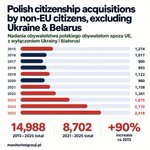
Polish citizenship acquisitions by non-EU citizens have risen sharply.
The largest non-white nationalities acquiring Polish citizenship in 2024 were:
🇻🇳 Vietnam — 371
🇦🇲 Armenia — 147
🇹🇷 Turkey — 95
🇪🇬 Egypt — 49
🇰🇿 Kazakhstan — 47
🇮🇳 India — 40
🇹🇳 Tunisia — 32

A glimpse into a dark future when migration from non-White countries continues unchecked, and the government, instead of prioritizing its own native population, just bleeds it dry via taxation to provide welfare for the invading hordes. This dark future must not be allowed to materialize.

As a Belgian, I completely agree.
This country is beyond fucked.
Native Flemish people work their asses off, pay some of the highest taxes in the world, and watch their money fund mass immigration while the social fabric around them erodes at an insane pace.
Never in human history have people willingly given away their own country, abandoned their culture and identity, and actively supported policies that will make their own people disappear in the next 50 years.
It’s complete insanity.
You don’t see this happening anywhere else in the world either. Yet it’s happening all across Europe, right in front of us, and barely anyone seems willing to stop it.
Belgium is one of the worst. Every time I come back here I'm completely shocked, every single time. But people living in it every single day don't see how bad it actually is and how fast it is eroding.
Monitor Imigracji retweeted
Warto przeczytać ten wątek:
xitter.cf/monitorimigr/status/20…

Poland’s Muslim population is now estimated at 40-76k, with recent growth driven largely by labour migration. Halal production is already integrated into major poultry/beef exporters, so domestic demand is expanding on top of an established export infrastructure.


Legal non-European immigration is not the neutral “skilled labour” story often sold. Much of it flows into low-protection, non-essential roles that Poles largely avoid. The real question is how large this channel has grown and how firmly it is already embedding. Here are the facts:

Poland tightened foreign-work rules from June 2025 and student/visa routes from July. Permit issuance subsequently slowed sharply. Yet the foreign-worker population remained around 7% above year-earlier levels in early 2026. Restricting new entry does not erase the recruitment networks, employers and legal pathways already created.
That is the point usually blurred in the legal-immigration debate: legal does not mean essential. The evidence shows rapid growth, unusually heavy reliance on flexible contracts, lower contribution bases and increasing regional concentration. What the state still does not publish is evidence showing that most of these non-EU inflows fill indispensable shortages that Poland could not reasonably meet domestically.
As investigators of demographic change, Instagram’s algorithm now constantly serves us ads featuring White Polish women with African migrant men. We don't need to even search for this anymore.
This is a glimpse into the algorithm itself, and into how globalist social engineering and propaganda work. None of this is natural.
What is being pushed onto impressionable women is also being pushed onto the rest of us. It has brainwashed them to such an extent that many now act against their own people, ancestry, culture, and nation, while believing it is normal.
Here are 4 more recent examples.
An Uber Eats driver refused to deliver pork in Kielce, Poland.
Religious rules > job duties.
This is what mass immigration from incompatible cultures looks like in practice.


40% of Poles eat kebabs.
Poles ordered over 5 million via Glovo (a company responsible for increasing demand for migrant labour).
The kebab market is worth 2.5B złoty.
~25,000 kebab locations operate nationwide.
Let’s examine how this leads to health and demographic risks 🧵


Take a look at our Zahir Kebab investigation to understand how kebabs become an immigration pipeline.
The network operates roughly 130–200 locations and supplies industrial halal production to 12,000+ retail points, including Żabka. Job ads offered free accommodation for foreign workers and stated Polish language was not required.
Zahir has even received state investment support (special economic zone relief and BGK loan guarantees) and sponsored major Indian cultural events tied to student-visa recruitment.
Bangladeshi work permits rose from 680 in 2011 to nearly 28,000 in 2023.


