

Building digital finance in Africa and Asia: payments, credit, platforms and AI. Author of The Financial Stack newsletter.
Johannesburg, South Africa
Joined March 2010
- Tweets1.4K
- Following740
- Followers1.9K
- Likes2.5K





Check out the latest article in my newsletter: When the Merchant Becomes the Customer linkedin.com/pulse/when-merc… via @LinkedIn
39
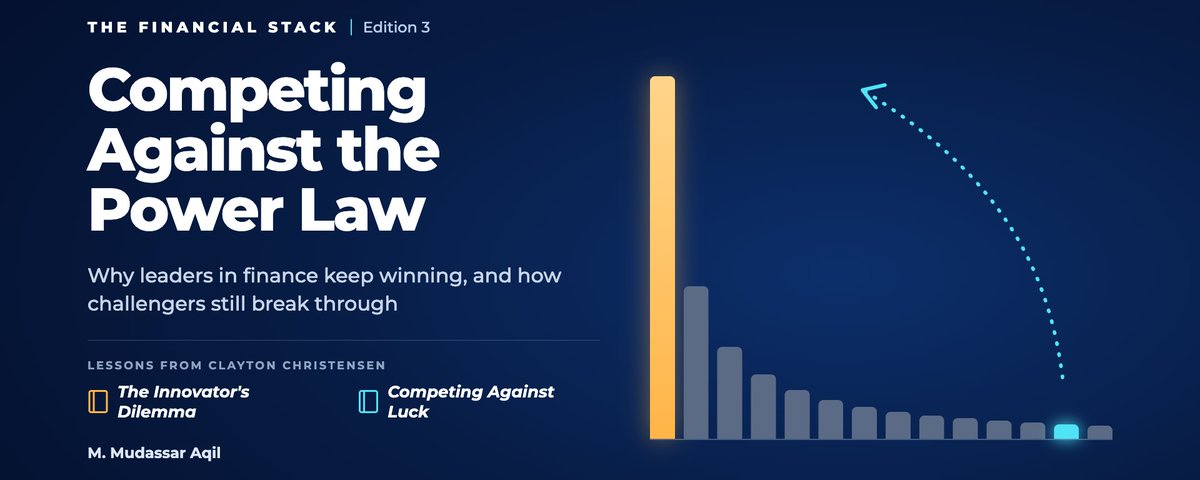
How do you compete against the power law?
For decades, five banks held about 81% of Brazil’s credit. Today Nubank is the most common primary bank in the country, and worth roughly as much as Latin America’s largest bank.
Finance runs on a power law: a few winners take most of the value. Clayton Christensen explained why leaders still lose. They keep serving their best customers and ignore anyone too small or too costly to serve.
In the new edition of The Financial Stack, I look at how Nubank, Wise and Robinhood broke, bent or reset a power law, and what AI changes for the next generation of challengers.
xitter.cf/mmaqil/status/21173388…

How do you beat a leader that has already won? Finance runs on a power law, yet Nubank, Wise and Robinhood broke, bent or reset one. Lessons from Clayton Christensen, and what AI changes for the next challengers.
47
How do you beat a leader that has already won? Finance runs on a power law, yet Nubank, Wise and Robinhood broke, bent or reset one. Lessons from Clayton Christensen, and what AI changes for the next challengers.
607
Check out the latest article in my newsletter: Headless Wallet: Financial Services Without a Front Door linkedin.com/pulse/headless-… via @LinkedIn

2
59
Muhammad Mudassar Aqil retweeted

Third question on AI.
A question that also remains unasked is whether the AI boom can continue without leading to a massive increase in inequality.
A recent paper by Stijn Van Nieuwerburgh runs the numbers on how much revenue the AI industry needs to generate to recover its massive investment (summary and a link to the paper can be found here: brookings.edu/articles/finan…).
Van Nieuwerburgh’s arithmetic should make us more concerned. AI investments will average about 3.6% of GDP annually between 2025 and 2032. Van Nieuwerburgh calculates that, using a 10% rate of return, the industry would need to generate annual revenues of about $3.7 trillion by 2032 to recover these costs (growing from its current levels of about $200 billion or so). That is significantly more than 10% of current US national income, and will likely remain around 10% of national income by 2032, even if GDP growth rose from its current level.
A large fraction of this revenue will go to capital income. That means a massive increase in the share of capital in national income, which has already risen substantially over the last 25 years or so – now standing at an all-time high of about 47% (bls.gov/news.release/pdf/pro…).
Capital income is much more unequally distributed than labor income, so a massive increase in the capital share of national income will translate into a very sizable surge in inequality.
The rise in inequality may not stop with the capital share. My work with Pascual Restrepo documents that (automation-driven) increases in the capital share of national income are typically associated with rising labor income inequality as well (see, for example, economics.mit.edu/sites/defa…). The same may happen in the next several years, boosting inequality further.
What is missing from our current debate is any discussion of a fundamental dilemma these numbers pose: can the AI boom avoid both an economically costly crash and a huge increase in inequality?
If the industry reaches these revenues, inequality surges. If the industry does not become profitable, a crash, with substantial costs in terms of lost output and jobs, becomes likely.
My assessment would be that the industry is unlikely to reach levels of revenue Van Nieuwerburgh calculates. First, diffusion has been and will likely continue to be slow. Second, competition from open-weight models, which are getting better, will limit how much proprietary models can charge. Third, despite important advances, I still believe that AI models will not be able to automate entire occupations anytime soon, thus limiting their value to businesses as cost-saving devices.
Whether this leads to a crash or not is more complicated and will depend on whether various AI companies are bailed out and what kind of support they receive.
Nevertheless, even if revenues fall short of these gargantuan amounts and we avoid a dramatic surge in inequality, I expect that the diffusion of AI will push up inequality between capital and labor and within labor.
If inequality does surge, a further question becomes central: can our democracy survive such astronomical levels of inequality?

Muhammad Mudassar Aqil retweeted

David Marcus just wrote the most important post-mortem in fintech and most people are going to read it as nostalgia. It’s a roadmap of how a $360B company gets reduced to $42B.
The math is staggering. PayPal hit $308 per share in July 2021. It closed today around $42 after dropping 19% on the CEO firing. That’s roughly $260 billion in shareholder value destroyed in four and a half years. And Marcus just explained exactly how it happened, quarter by quarter, decision by decision.
The branded checkout number tells the whole story. Growth decelerated from 6% to 1% in a single year. JPMorgan said it “adds fuel to the bear thesis that PayPal will struggle to maintain share in the market.” Meanwhile Apple Pay grew to 64 million U.S. users in 2025, capturing 54% of in-store mobile wallet transactions. PayPal watched the entire checkout moment get rebundled by a phone manufacturer.
What Marcus describes is a textbook case of the optimization trap. PayPal had the network, the data, the merchant relationships, and the consumer trust. After the spinoff, it had a once-in-a-generation window to build a global payments infrastructure company. Instead, leadership optimized for quarterly TPV growth and unbranded processing volume, the exact segment where PayPal had the least pricing power and the weakest customer relationship.
Marcus identifies the Visa deal as the turning point. Visa structured an agreement that killed PayPal’s ability to steer customers toward bank-funded transactions, which was the core of PayPal’s economics. PayPal traded long-term network control for short-term processing volume. That single decision repriced the entire company.
The CEO carousel makes it worse. Schulman ran it as a financial optimization engine for eight years. Chriss came from Intuit and understood SMB software but had no payments muscle memory. He cleared out executives who understood transaction economics and settlement infrastructure. Now the board has hired Enrique Lores, who ran HP for six years. A printer and PC executive running a payments company.
Three CEOs in three years, and the common thread is that none of them are payments people. The board keeps hiring operators who understand cost structures and efficiency gains, because that’s what boards optimize for when they’ve lost conviction about what the company actually is.
Marcus’s point about BNPL is where the post gets really sharp. Klarna, Affirm, and Afterpay built consumer finance brands with persistent credit identities and new shopping behaviors. PayPal had every advantage: 400+ million accounts, merchant trust, transaction data. The U.S. BNPL market is headed toward $258 billion by 2031. PayPal treated it as a checkout feature. Others built platforms.
The real insight buried in Marcus’s post is about what happens when a company with network-effect potential gets run by people who think in terms of unit economics instead of platform power. Every decision PayPal made since the spinoff was locally rational. Optimize for volume. Cut costs. Acquire for activity. Ship features defensively. Each quarter looked manageable. The cumulative effect was the systematic dismantling of a payments network that could have been worth $500B.
Marcus waited 12 years to say this. The stock dropped 86% before he did. Sometimes the people who know what’s wrong leave too early and speak up too late. But the diagnosis is precise, and the pattern he describes isn’t self-correcting. It’s accelerating.

A few thoughts about PayPal, nearly 12 years after I left.
I woke up this morning to dozens of messages from former PayPal colleagues. It pushed me to finally speak up.
I never spoke publicly about the company after I left. Part of that was loyalty to John Donahoe, who gave me an unlikely opportunity, handing the reins of PayPal to a startup guy who, on paper, had no business running a then 15,000-person organization. But part of it was something else: I had left. I chose not to stay and fight for the changes I believed in. Speaking from the sidelines felt like armchair commentary. Easy opinions without the burden of execution. So I stayed quiet.
But twelve years of silence is long enough. And today's news makes it clear the pattern I've watched unfold isn't self-correcting.
I left PayPal in 2014 because I was deeply frustrated. We had executed a silent turnaround of a company that had lost its soul. We brought back engineering talent, shipped good products quickly, and acquired Braintree and Venmo. The company was on a tear. So much so that Carl Icahn felt compelled to accumulate a position in eBay and push for a PayPal spinoff. At the time, eBay decided to fight Icahn.
It was a difficult period for me, caught between what I felt was right for PayPal and my loyalty to the eBay team.
This is when Mark Zuckerberg approached me to join Facebook. The combination of his conviction that messaging would become foundational, the appeal of going back to building products at scale, and my growing exhaustion with the internal politics at PayPal and eBay eventually convinced me to leave and join one of the best teams in the world, one I had admired for a long time.
In the summer of 2014, I met John in a café in Portola Valley and told him I had decided to leave. During that conversation, he told me that Icahn had effectively won the fight, that PayPal was going to become an independent company, and he tried to convince me to stay on as CEO, but I had already said yes to Mark, and my word is my bond. There was no turning back.
After my departure, the board scrambled to find a replacement, and it took a few months for them to land on Dan Schulman. The leadership style shifted from product-led to financially-led. Over time, product conviction gave way to financial optimization.
Much of the momentum we had created still persisted and carried the company forward, mainly driven by Bill Ready, who came over in the Braintree acquisition and rose to COO. Under his leadership, Venmo grew exponentially, and total payment volume (TPV) accelerated quickly. But the shift under Schulman became more pronounced after Bill's departure at the end of 2019. With him went the product conviction that had defined the post-spinoff momentum. Then, for a period, COVID-fueled online shopping hid a lot of the company's new weaknesses.
During that period, the company made a fundamental miscalculation: it optimized for payment volume instead of margin and differentiation. It leaned into unbranded checkout, where PayPal had the least leverage, instead of branded checkout, where the margin, data, and customer relationship actually lived.
Visa masterfully structured a deal that effectively ended PayPal's ability to steer customers toward bank-funded transactions, which had been a core driver of PayPal's economics. Not long after, PayPal lost a significant portion of eBay's volume. Over time, it saw its share of checkout among its most profitable customers steadily erode as Apple Pay and others continued to execute well.
The same pattern repeated itself across lending, buy-now-pay-later (BNPL), and new rails.
On lending, PayPal missed the opportunity to turn it into a platform weapon. Products like Working Capital were conservative, short-duration, and optimized for loss minimization. Lending never became programmable, never became identity-driven, and never became a reason for merchants or consumers to choose PayPal over something else.
The missed opportunity in BNPL was even more striking. Klarna, Affirm, and Afterpay didn't just offer installment payments, they built consumer finance brands, persistent credit identities, and new shopping behaviors. PayPal saw the BNPL turn, entered the market, and had every advantage: distribution, trust, and merchant relationships. But BNPL was treated as a defensive checkout feature rather than an offensive category. There was no attempt to turn it into a core consumer relationship, no super-app behavior, and no meaningful differentiation for merchants. Others built platforms, PayPal added a feature.
The failure to lean into building and owning new rails followed the same logic. After the spinoff, PayPal had a once-in-a-generation opportunity to build a global, at scale payment network. Instead, the company focused on building on top of existing networks and third-party rails.
More recently, that mindset carried over to PYUSD. Technically, the product was sound. Strategically, it launched without a compelling transactional reason to exist. PYUSD had distribution, but no organic demand. It was not embedded deeply enough into flows to become a true settlement layer, a cross-border merchant rail, or a programmable money primitive. It sat adjacent to the product instead of inside the core of it.
Acquisitions during this period followed a similar pattern. Honey was not a strategic acquisition for PayPal. It added activity, but not leverage. It lived outside the transaction, monetized affiliate economics rather than payment economics, and never meaningfully strengthened PayPal's control of the customer or the checkout moment. Xoom solved a real problem in remittances, but it never compounded PayPal's advantage. It scaled volume without changing the underlying rails, identity graph, or settlement model, and as importantly, it didn’t cater to a high-value, high-margin customer archetype.
None of these were bad companies. They were just a wrong fit for PayPal and became unnecessary distractions.
The board eventually recognized the problem. In 2023, they brought in Alex Chriss, an Intuit veteran with a strong product background, explicitly to restore product conviction. It was the right instinct.
But Alex came from software, not payments. He understood SMB product development. He didn't have the muscle memory for transaction economics, network effects, or settlement infrastructure.
In hindsight, he also made an error: clearing out much of the leadership team that understood payments deeply. Executives with years of institutional knowledge departed within his first year.
This morning, Alex was removed as CEO. Branded checkout grew 1% last quarter. The board tapped another operator, Enrique Lores, the former HP CEO who's been on the PayPal board for five years.
I don’t know Enrique. And he might be a great leader, but on paper at least, he’s a hardware executive. For a payments company.
The common thread through all of this is incentive design. Once PayPal became independent, short/medium-term predictability beat long-term vision and ambition. Stock performance mattered more than platform risk and network opportunity. Financial optimization replaced product conviction.
I'm not claiming I would have made every call differently. Running a public company at scale involves tradeoffs I didn't have to make after I left. But the pattern, choosing predictability over platform risk, again and again, was a choice, not an inevitability.
Over time, the company that had every advantage and could’ve become the most consequential and relevant payments company of our time, lost its mojo, its product edge, and its ability to compete in a market that’s being rewired and reinvented in front of our eyes.
That's the part that's hardest to watch for a company I care so deeply about.
Muhammad Mudassar Aqil retweeted

"In the hospital there are kids maimed by airstrikes: missing arms, missing legs, third degree burns. Often there’s not enough pain medication. But the children are not screaming about the pain, they’re screaming: 'I'm hungry! I’m hungry!'"

“When I entered Gaza the Israeli military had a rule: I was only allowed to bring in three kilos of food. As I was weighing out protein bars, trying to get under the limit, I said to my husband: ‘How sinister is this?’ I’m a humanitarian aid worker. Why would there even be a limit on food? I’ve worked in many places with extreme hunger, but what’s so jarring in this context is how cruel it is, how deliberate. I was in Gaza for two months; there’s no way to describe the horror of what’s happening. And I say this as a pediatric ICU doctor who sees children die as part of my work. Among our own staff we have doctors and nurses who are trying to treat patients while hungry, exhausted. They’re living in tents. Some of them have lost fifteen, twenty members of their families. In the hospital there are kids maimed by airstrikes: missing arms, missing legs, third degree burns. Often there’s not enough pain medication. But the children are not screaming about the pain, they’re screaming: ‘I’m hungry! I’m hungry!” I hate to only focus on the kids, because nobody should be starving. But the kids, it just haunts you in a different way. When my two months were finished, I didn’t want to leave. It’s a feeling I haven’t experienced in nearly twenty years of humanitarian assignments. But I felt ashamed. Ashamed to leave my Palestinian colleagues, who were some of the most beautiful and compassionate people that I’ve ever met. I was ashamed as an American, as a human being, that we’ve been unable to stop something that is so clearly a genocide. I remember when our bus pulled out of the buffer zone. Out the window on one side I could see Rafah, which was nothing but rubble. On the other side was lush, green Israel. When we exited the gate, the first thing I saw was a group of Israeli soldiers, sitting at a table, eating lunch. I’ve never felt so nauseous seeing a table full of food.”
-------------------------------------------------------
Aqsa Durrani is a pediatric doctor and board member of Doctors Without Borders USA, with nearly twenty years of experience in humanitarian projects. During our interview Aqsa repeatedly expressed a desire to center the voices of her Palestinian colleagues. To this end I’ve spent the past week collecting stories from the Palestinian staff of Doctors Without Borders in Gaza. I will be sharing these stories over the next several days. I’m so grateful for the time that these people gave me; they were sleepless, hungry, traumatized, and often working 24-hour shifts. Because of the unreliable internet connection their images are sometimes grainy. Their words, however, will be crystal clear.

Muhammad Mudassar Aqil retweeted

Hate no one, no matter how much they wronged you. Live humbly, no matter how wealthy you become. Think positively, no matter how hard life is. Give much, even if you’ve been given little. Keep in touch with those who have forgotten you, and forgive who has wronged you
Hazrat Ali
Lastly, a big shout out to my team for keeping faith and playing for the long term value. Super proud of you all!
A special thanks to our shareholders @TelenorGroup & @AntGroup for their support and belief in the team and Pakistan market.
8/8
Most importantly all of the above has been achieved under a regulated entity with transparent, publicly available financials. No hidden numbers and no hidden costs!
I look forward to our successful coversion to Digital Bank later this year and continue creating user value
6/n
8
1,379
3. Platform Business:
- Our business model is transformed from a walled garden 4 years ago to a platform biz today.
- Open APIs, developer ecosystem, and mini-apps are powering 3rd party use cases.
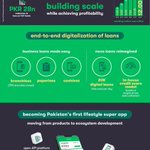
- EP is on its way to become Pakistan’s first lifestyle superapp.
5/n
7
709
- All loans are given digitally in a cashless process. EP users can see their credit score in the app and learn how they can improve it.
- We are disbursing 20k loan per day and on track to double this number by year-end.
4/n
2. Digital Transformation:
- TMB is the only bank in the country that has transformed its business model to not just #digitalfirst but #mobilefirst - we have closed 75% of our branches already. Customers don’t need to come to any branch.
3/n
Our journey over the last few years has broadly achieved 3 things:
1. Building scale + a profitable business:
- Easypaisa is Pakistan’s #1 app with 15M monthly device active & 12.5 M trx active users.
- With 34M registered users, 1/4 adult in Pakistan is an EP user.
2/n
8
764
I am excited to share that effective March 2023, Telenor Bank/Easypaisa is profitable!
Over the last 5 years more than $300M of FDI was invested in building scale, innovation and digital transformation of the bank. So this is an important milestone for Pk digital ecosystem
1/n


Muhammad Mudassar Aqil retweeted

In case you missed it, the two largest wallets in 🇵🇰 @easypaisa and @JazzCash are now both *profitable* growing their revenue and valuation quickly. 70% of new bank accounts are created on them. Bravo @mmaqil and @aamir_ibrahim01. Entire digital ecosystem wins as they thrive.
Muhammad Mudassar Aqil retweeted
Women sometimes take career breaks to pursue full time roles as care givers for their families. Career gaps make it hard to reenter the workforce. @rozee_pk is delighted to work with @easypaisa to get women with corporate and banking experience back into jobs. Apply below.


If you are leaving your money sitting in a current account in 35% inflation that means your hard earned money is losing value every single day. Be smart and move it to a liquid, daily interest/profit earning acct.


Celebrating our women leaders on #GirlsinICT day! 👏🏼👏🏼👏🏼
This Post is from an account that no longer exists. Learn more
3
340

