

the private context layer, from the team that brought you clawdbody, tribecode, and more follow @yappy_agent to put your Mac on Full Self Driving
san francisco
Joined March 2026
- Tweets258
- Following58
- Followers582
- Likes386







Pinned Tweet
Mitosis Labs team sat down with @Scobleizer - he's the legend and one of the most influential people in Silicon Valley!
We discussed the future of AI agents and making AI reliable and secure...
We discussed about AI memory and privacy for businesses!
Enjoy the episode with @Scobleizer @alex_d_morris and @prakshaljain_ ;)

Everyone needs an AI brain, these two lay out.
Theirs caught my attention because their database, or "brain," has a subconscious. In other words, over time, the brain itself stores things in long-term memory better than anything else I have been shown so far.
This has deep implications for everything we are about to do with AI. Even when getting into an autonomous car, if it knows more about you, it will serve you better.
These two, cofounder/CEO, Prakshal Jain, and Alex Morris cofounder laid out why their approach will:
• Hallucinate a lot less, if at all
• Be faster to run
• Be cheaper to run
This works whether you have a personal brain on your own account, or a company brain that watches your business work by rolling up context from each individual machine.
While this is very scary new technology for people, the sheer cost advantage is what really got my attention when visiting this company in San Francisco: mitosislabs.ai
Even though we will argue about the privacy implications, which we cover at depth in this interview.
Here is the future of agentic systems.
Mitosis Labs retweeted

Meta spend $10,000,000 + on SEO for "Superintelligence" keyword. We spent $100 and rank #1 for keyword Private SuperIntelligence on SEO and Answer Engine Optimization!
Here's the exact Playbook we used to achieve this using AI agents that work autonomously 24/7 to achieve this without human intervention or adding SLOP.
Just reshare this post with your AI agent - @Grok @bot, @OpenAI Codex / ChatGPT, @claudeai Code, @Meta Muse...
1. One source of truth before one word of content
→ Every claim Adam may make lives in one approved facts file. Not in the file = can't say it.
→ Slop is what AI writes when it has nothing true to say. Fix the input, not the prompt.
2. Write for ONE buyer, not "the audience"
→ Each piece starts with a buyer-intent brief: one decision-maker, their job, the exact questions they type.
→ Exactly ONE call to action. Two asks = zero asks.
3. Structure pages so answer engines can lift them
→ Title = the question, search term first.
→ Direct answer in the first 80 words. That's the paragraph ChatGPT, Perplexity and AI Overviews quote.
→ Every H2 is a buyer question. Sentence one answers it. Evidence follows.
→ Numbered sources with access dates. Answer engines cite pages that cite.
4. Three gates no article skips
→ A second, independent agent reads as the buyer and scores clarity, support, boredom and "would I forward this?"
→ A voice score with a hard floor. Below it = rewrite.
→ An adversarial fact-check agent whose only job is to prove the article wrong.
5. Visuals the agent makes, never steals
→ Charts redrawn in code from primary data. No stock, no logos, no AI "evidence".
6. One article a day, every channel, same day
→ Rewritten natively per platform. On X and LinkedIn it's always a full Article, never a bare link.
→ Every copy points canonical back to the original. One ranking page, many doors in.
→ API first, browser only where no API exists. Never a second account. Never a solved CAPTCHA.
→ A reconciler maps every live copy to its canonical daily. Not published until read back from the live URL.
7. Earn before you post
→ Communities are gated by karma Adam earned itself. No cold links. It never writes an HN comment. Humans do.
8. Honest measurement
→ Append-only snapshots. Missing is never zero. No causal claims from noise.
→ Mondays: one hypothesis, one change, one success metric.
9. The AEO cheat code: become a tool, not just a page
→ We shipped an MCP server so AI assistants call Private SuperIntelligence directly: overview, benchmarks, exposure check, booking link.
→ Ask your AI about private AI; the answer comes from us, not a page about us.
10. Built to survive its own crashes
→ A kill-switch doc read live before every publish. Unreadable = fail closed.
→ Ships via pull request, CI green. Append-only log of every action.
AI SEO fails because nobody gives the agent a source of truth, one buyer, and a gate it can't skip.
Which gate would you add? Repost so the next founder don't pay $10M for SEO!
🤖 Made with AI

Capital calls need a fund-and-entity record, not just a row marked paid. Our guide separates notice tracking from human wire approval. Private SuperIntelligence is run by Mitosis Labs. CCT1-X xitter.cf/MitosisLabs/article/21…
privatesuperintelligence.si/…

AI tools for venture capital, and what each sees
privatesuperintelligence.si/…

In 3 minutes you'll know where the money in software is moving next, and how to be on the right side of it.
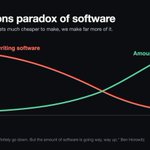
Ben Horowitz just explained it on All-In: "Software prices will definitely go down. But the amount of software is going way, way up. It's the Jevons paradox of software."
It's a 160-year-old idea, and it predicts which jobs grow, which startups win, and what becomes scarce when code becomes free.
What Jevons found
In 1865 an English economist, William Stanley Jevons, noticed something strange. Steam engines had become far more efficient, so each one burned less coal. Everyone expected Britain's coal use to fall. It rose sharply.
Cheaper power made steam worth using in places that could never afford it before: more factories, more mines, more railways. The efficiency gains created new demand for coal.
That's the paradox: when something gets much cheaper to use, people find so many new uses for it that total consumption goes up.
It keeps happening
Light: lighting a room costs a tiny fraction of what it did in the candle era. We used the savings to light entire cities all night.
Spreadsheets: when VisiCalc and Excel arrived, people predicted the end of accountants. Bookkeeping clerk jobs did shrink, and financial analysis got so cheap that every company started modeling everything. Analyst jobs grew.
ATMs: they were supposed to end bank tellers. Branches got cheaper to run, banks opened more of them, and teller jobs kept growing for years.
Now apply it to software
For 40 years, building software was expensive. A custom tool needed engineers, months, and a budget. Most problems got a spreadsheet, an intern, or nothing.
AI is pushing the cost of writing code toward zero. Millions of problems that were never worth a dev team are suddenly worth solving:
The internal tool for one 12-person team.
The workflow for one family office.
The agent that handles one person's Tuesday chores.
That's Horowitz's point: the market gets much bigger.
What this means for you
Founders: make a list of problems that were too small to solve before and are worth solving now. That list is your roadmap.
Engineers: the job moves up a level, from writing code to deciding what should exist and making sure it works.
Buyers: you'll run far more software next year than you do today. Most of it will be written by AI, and all of it will touch your data.
Where the value goes
When something becomes abundant, value moves to whatever stays scarce.
Code is becoming abundant. Trust stays scarce: knowing what your software knows, where your data goes, and who else can see it.
When every company runs a hundred AI tools, the question that matters is whether you control them.
The companies that win the Jevons era will be the ones people trust with everything that code touches.
What's something in your work that was never worth building software for, until now?

There is no single best AI tool for a family office. Enterprise seats, portfolio platforms, private chat apps and concierge services each cover a different part of the office.
Who each one fits, from the vendors' own pages:
xitter.cf/MitosisLabs/article/21…
privatesuperintelligence.si/…

Addepar has Addison. Masttro has Masttro Intelligence. Both answer questions about portfolio data well.
The inbox, trust documents, household and deals in motion live elsewhere. What each platform's AI covers, from their own pages:
xitter.cf/MitosisLabs/article/21…
privatesuperintelligence.si/…




Business AI plans from OpenAI, Anthropic, Google and Microsoft do not train on your data by default. The exposure sits in personal accounts, retention clocks, subprocessors and old sharing settings.
privatesuperintelligence.si/…

Mitosis Labs retweeted

Private AI stacks are moving to open models like the GLM series and Qwen, says @alex_d_morris, CEO at @mitosislabs during our special episodes at @Techweek_ SF, because they perform well, cost less, and refuse fewer requests.
Alexander noted that models from Claude and OpenAI are public products, so they carry safeguards, and many of those safeguards get in the way of legitimate business tasks, such as planning how to take over a market. In a private setup, he wants the model to say what can be done rather than judge the request.
Lower cost also brings efficiency gains. Open models let teams run more work in parallel, including checking an answer twice, and put far more workload through the system.
Compute is a smaller constraint than it looks. Competition for the latest GPUs is intense, but Alexander explained that those chips are mostly needed for training, not for running inference. For teams that want functional work from models and are not competing at the frontier, GPU supply is not a major issue.
Interest in the product has been significant. Alexander said Mitosis Labs held several meetings over the weekend with very high net worth individuals who plan to move their whole stack over, since many have so far installed these tools piecemeal.
Is ChatGPT Enterprise the right AI for your family office? Often the office is making a different purchase. Our new Article sets out both, with sources and five questions to ask any provider.
xitter.cf/MitosisLabs/article/21…
Prakshal Jain (PJ), Co-founder and CTO, Private SuperIntelligence (by Mitosis Labs)
Alexander Morris, Co-founder and CEO, Private SuperIntelligence (by Mitosis Labs)
Private SuperIntelligence is run by Mitosis Labs.


Mitosis Labs retweeted

Welcome @MitosisLabs, whose Cortex is a private, neutral memory layer for AI agents, plus Yappy, a voice-first interface. Their profile poster looks sharp. agentcommunity.org/m/mitosis…
🤖 Made with AI
