

believing historian | "Mitch is solid gold"—David Lynch
Joined May 2013
- Tweets25.2K
- Following1.3K
- Followers23K
- Likes26.1K





I attempt to thread a very fine needle on this very complex case. mitchhorowitz.substack.com/p…


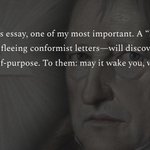
I am often asked about a historical profile I wrote of mystic Neville Goddard (1905-1972) in the March 2005 issue of Science of Mind magazine. It appears here gratis. When the piece first ran, Neville was a near-unknown, even in New Thought circles. My boss, a New Thought minister, teased me that perhaps fifteen people would read it. The article brought renewed attention to the mind-power icon, who had died in relative obscurity in 1972. Interest soon surged. Today, Neville is among the most widely read and heard figures in twentieth-century spirituality, abetted by his prescient decision to allow listeners to freely record his lectures in an era of nascent portable audiotaping technology.
At the time of my writing, there existed little background on Neville. He was, in a sense, a man of mystery. I reproduce the article exactly as it appeared in 2005—including the photograph, then one of very few available. The piece contains certain historical references that I have since updated. It is followed by several recent links, including my documentation of his death.
I hope this profile fills a gap in the cultural “lost years” of the teacher’s legacy. On a practical note: before this piece, I had not written historically on metaphysics. Experience taught me that what you do on a micro scale is repeatable on a macro scale. Within two years, I had a contract for my first book, Occult America. Let that inform your efforts. -M-
mitchhorowitz.substack.com/p…

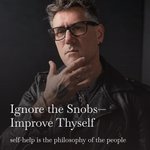
I used to feel embarrassed reading self-help on the subway. I no longer ride the subway. I bike. That appears in a self-help book I wrote.
In full disclosure, I also goddamn lazily Uber too much. I am trying to do better. That is my point: self-help is noble. It is not everything. But it is something. Most people do nothing.
Social critics think self-help has cheapened our culture. They overestimate its reach. Cynicism has cheapened us.
In twenty-seven years of corporate publishing, I learned that almost no author wants to be associated with self-help. They feel embarrassed, as I once did. They are misled. Self-help is the philosophy of the people.
As literary critic Irving Howe (1920-1993)—a personal hero—said at a meeting when I was twenty-three: “The intellectuals are always wrong. They were wrong about Stalin. They were wrong about Reagan. They are wrong now.” He referred to former radicals who drifted into conservatism.
I am hard-pressed to determine when they—tote-bag-carrying denizens of lettered culture—are not wrong. That is not to say that Irving would agree with this article. He would not. My writing is read by working people. I love them and they me. I am a public philosopher.
Do I use “love” mawkishly? No. It is the truth. It unites us in the search for self.
A few years ago I corresponded with a successful self-help writer who deplored the term. “I don’t see myself as a self-help writer,” he explained. “I think that most self-help is a sham.” I later received from him a mass pitch letter for a “Magic Income Trick.”
I know a bestselling author of popular psychology who also rejects the self-help label because, she says, “I don’t provide answers.”
Why do good writers flee a designation that obviously belongs to them? They fear it is undignified. To some, “self-help” seems naïve, anti-intellectual, or squishy. To others, it is gauche or down-market.
In her bestselling dissection of positive-thinking, Bright-sided, social critic Barbara Ehrenreich (1941-2022) recalled meeting a real-estate agent: “I teased her for being a ‘motivation junkie.’” It was so like Barbara, a shy and severe person whom I knew, to condescend to the type of wage-earner—sales jobs are brutal—for whom she and social-sciencey types routinely profess to advocate . . .
open.substack.com/pub/mitchh…


Like you, I wrestle with different approaches in the search.
I seek power. Those who know my work are aware that I mean not force but agency and expressiveness.
In prayer, I pursue alliance and petition. In matters of the psychical—a compact of intellect and emotion—my design is causation.
With those facts acknowledged, and probably others thrown into question and even paradox, I, and perhaps you, face the challenge posed by Russian novelist Nikolai Chernyshevsky (1828-1889) in his 1863 dramatization of pre-revolutionary efforts to chart a new society: What Is to Be Done?
Chernyshevsky’s sprawling, messy novel of ideas is an ardently secular, philosophically materialist—though not acquisitive—literary self-help manual, embraced dubiously but notably by Vladimir Lenin (1870-1924) and Xi Jinping (b. 1953).
Chernyshevsky’s enigmatic hero Rakhmetov unerringly pursues bodily and intellectual training as a means to self-liberty and effectiveness. The novelist, in a fashion that has evoked eye rolls from critics, steps outside the wall of drama to directly instruct readers to pursue the self-refinement exemplified by Rakhmetov, both severe and generous:
"Try it: development, development . . . Observe life: it’s so interesting. Reflect: it’s so fascinating. That’s all there is to it! . . . Desire to be happy—that’s all. Only desire is needed. To attain it you’ll take delight in devoting yourself to your own development. That’s where true happiness lies." (Michael R. Katz trans., 1989)
I say: commit your energies unconditionally and relationally to your search and endeavor. Let this dictate what you eat (Rakhmetov is a teetotaler—not my approach), how you dress, what you read, where you go, and what you permit yourself to think (emotions and body will make quick work of this, but try), and where, to the fullest degree possible, you dedicate your labors.
Life is debt. None of what I write implies eluding it. You owe nature. You owe others. Rakhmetov supports the education of several people. So do I. There exists a Chinese expression, “When a man attains enlightenment, even his dogs and chickens go to heaven" . . .
open.substack.com/pub/mitchh…

It is sometimes stated that William Walker Atkinson (aka "Three Initiates") derived his "Seven Principles" in The Kybalion (1908) from an 1885 translation and commentary on Hermetic tracts, The Virgin of the World by Anna Kingsford and Edward Maitland (whose English translation is adapted from an 1866/67 French compendium by classicist Louis Ménard).
This analysis first appeared in a 2009 blog article by esoteric scholar Mary K. Greer ("Source of The Kybalion in Anna Kingsford’s Hermetic System") and later in a 2018 introduction to The Kybalion that I commissioned from my friend and source of literary inspiration, Richard Smoley.
Having compared Greer’s and Smoley’s comparisons—which variously correspond to and depart from one another—to Kingsford and Maitland's book, I find the evidence tangential—not necessarily thin but incomplete—that Atkinson devised (or in the overly determined phrasing of an online commentator “plagiarized”) his seven principles from The Virgin of the World.
The Kybalion has passed through two stages of disdain in our generation. The first is that it is fake Hermeticism. This is overwrought. It is a modern novelty—in my estimation a meaningful novelty with insights into Hermetic themes and a canny analysis of New Thought and its physical limits.
The second and more recent disdain results from commenters reading one another versus reading the book, and hence arriving at semi-bizarre political claims suggested nowhere in the century-old text.
Ad fontes.
I will not chop up history into segments of maximalist criticism or affirmation that say "I like" or "I don't like." My servings are whole: husk and fruit. This article is gratis. mitchhorowitz.substack.com/p…


“I wouldn’t be a slave to God Himself, let alone man.”—H.P.B.
It is difficult even to introduce Madame H.P. Blavatsky (1831–1891)—variously one of the most debated, venerated, and deplored figures in modern life. With the exception of Aleister Crowley (1875-1947), no other occultist has been so widely, and critically, written about.
In 2012, during my publishing days, I issued an excellent biography of Blavatsky by historian Gary Lachman. The book received considerable praise—along with oh-no-you-don’t coverage in organs of lettered culture, including Harper’s Magazine and The Paris Review. I was surprised that such journals, usually dismissive of alternative spirituality—we never pitched them—set sight on a Ukrainian-born mystic who died ten years before Queen Victoria.
Thematically speaking, their articles, acidulous and know-better, were conceived in advance, the blight of most letters. The same charge can be directed at me. And pertaining to this very piece. I am a “believing historian.” I have been—I am not currently—a member of the Theosophical Society in America, the organization she cofounded. Use that background to judge my portrayal.
I disdain the cheapness of mainstream letters when approaching culturally disfavored figures—the practice of just broaching the line of dishonesty, experiences that have moved me to write less for legacy media, where I have plenty of bylines, and perhaps talk less to it.
In any case, the tote-baggers sought blood, more so in Harper’s Magazine. They portrayed Blavatsky as a peddler of mediumistic fakery, invented biography, and kook philosophy. That is the axe-handle of critical judgment. The blade, pervasive in online comments, calls her a purveyor of colonialism, genocide, and even proto-Nazism. In a novel twist, a detractor recently wrote me that “Theosophy was and is a Trojan horse for the new age, transexual, transhumanist woke movement.” Right.
I concede this: H.P.B., so known to admirers, frustrates scrutiny. As such, she is a kind of Rorschach. Documenting her requires entering a “hall of magic mirrors.” And yet—it is nearly impossible to imagine today’s culture without this one woman.
mitchhorowitz.substack.com/p…


You are never alone. Not really.
I am inviting you into an ad hoc, long-distance club—a circle of metaphysical company—that meets daily at 3 pm ET. We are approaching our ten-year anniversary.
It is called The Miracle Club.
The Club works this way: every day or any day at 3 pm ET you can join me in silently holding the intentions of each member of the group. And your own intentions.
That is all. Join daily. Join once. Join whenever you feel like it.
There is no fee, membership, or declaration. Your only commitment is a brief (two to three minutes—or if you are pressed just a few moments) silent meditation at 3 pm ET on any day you choose—wherever you are and whenever you like—with me and other members.
mitchhorowitz.substack.com/p…

What Is the Search? | Mitch Horowitz Explores the ‘Three Objects’ of the Theosophical Society youtube.com/watch?v=60qLoLen…
