Minh Pham retweeted

Learn Harness Engineering 🚀
Found this excellent open-source course by Walking Labs, covering 14 lectures and 8 hands-on projects on building more reliable AI coding agents.
What's inside:
→ Agent instructions (AGENTS.md / CLAUDE.md)
→ Context management and persistent memory
→ Multi-session continuity and state tracking
→ Task boundaries and scope control
→ Testing, verification, and observability
→ Automated agent loops and workflows
→ Multi-agent orchestration and graph engineering
The practical projects walk you through building a complete agent harness, comparing prompt-only execution with structured workflows.
Also includes ready-to-use templates, verification scripts, and a harness-creator skill.
Perfect for developers working with Claude Code, Codex, and other AI coding agents who want to understand the engineering behind reliable agent execution.
Completely free.
Here's the GitHub Repo: github.com/walkinglabs/learn…

Minh Pham retweeted

if you want to build an AI trading system from scratch, start with this article
you will end up with real market data, real backtests and a bot that trades for you 24/7

Minh Pham retweeted
RIP Bloomberg Terminal.
i just reverse-engineered a Bloomberg-style terminal using REA MCP (Reverse Engineer Anything), software got nuked
now i am using $24K/year worth terminal for completely FREE
here is how to reverse engineer the terminal with your AI agents from scratch:
→ install REA and connect its MCP to Claude Code to investigate authorized software & trace how features work
→ map the terminal's core workflows: security search, market quotes, financial statements, news, charts and portfolio analytics
→ build independent data connectors for equities, crypto, forex, commodities and macroeconomic data using documented APIs
→ use opus 5.5 to build the terminal UI, live-data pipelines, historical databases and multi-asset charting engine
→ add financial screeners, yield curves, factor models, portfolio analytics and a Python strategy backtesting engine
→ connect Bloomberg BLPAPI only with the required access and permissions; REA does not unlock Bloomberg's proprietary data for free
→ test every module, verify data accuracy, track licensing rights and ship a working terminal instead of a static UI mockup
if you want to TRY Bloomberg-style terminal, you will find it in the article below:


Minh Pham retweeted

Ummm guys, I took @googlegemma Embedding 2 model and train it on 3,000hrs of Vietnamese audio. IT REACHED SOTA. All it took is 2 hours on 8xH100

Minh Pham retweeted

i still can't get why people run claude code on default settings
one settings change and every model gets the job it's actually good at:
→ opus plans the task and steps in when you're stuck
→ sonnet 5.5 does the typing
→ haiku runs every file search
→ a critic agent tries to break your diff before it gets merged
Opus thinks. The cheap ones grind.
paste this into claude code
Add this to ~/.claude/settings.json. Keep every hook, permission and plugin I already have. Then create the two agent files below and show me the diff.
```json
{
"model": "opusplan",
"advisorModel": "opus",
"effortLevel": "medium",
"modelSettings": {
"claude-opus-5-5": { "effortLevel": "high" },
"claude-sonnet-5-5": { "effortLevel": "medium" }
},
"env": {
"CLAUDE_CODE_SUBAGENT_MODEL": "haiku"
}
}
```
~/.claude/agents/scout.md
```
---
name: scout
description: finds code fast. returns file paths and line numbers only.
model: haiku
tools: Read, Grep, Glob
---
Locate exactly what was asked. Return file:line. No fixes. No opinions.
```
~/.claude/agents/critic.md
```
---
name: critic
description: reviews a diff or plan before any task is called done
model: opus
tools: Read, Grep, Bash
---
Assume this is broken. Find how it fails. One line per issue, worst first
```
Send it to your Claude, then read the full article below 👇


Minh Pham retweeted

Peter Steinberger, the creator of OpenClaw, open-sourced his entire agent setup
The core idea is one folder that every agent on his machines reads from.
A single AGENTS.MD holds his rules, and a script symlinks it into ~/.claude/CLAUDE.md and ~/.codex/AGENTS.md
This way Claude Code and Codex always follow the same instructions.
Every other repo gets one line at the top:
READ ~/Projects/agent-scripts/AGENTS.MD BEFORE ANYTHING.
Change a rule once and every project picks it up.
Skills work the same way. 69 of them live in one place, each with a short description the agent reads to decide what to load, and scripts/sync-skills links them into both agents.
Fork it, replace his rules with yours, and delete the skills you do not need. His AGENTS.MD is full of his own hosts and accounts.
my agent team below:


Minh Pham retweeted

8 Types of LLMs used in AI Agents (Must know for Gen AI Data Scientists & AI Engineers):
Here's what they are and what they do: 🧵

Minh Pham retweeted

Anthropic engineers just shared the agent setup they use at Anthropic to keep up with their work
It’s a reference architecture for any agent that runs on a cron with nobody watching.
Here’s how it works: on a schedule, an agent on Claude Managed Agents wakes up, reads every source you gave it, and posts a short brief with only what needs your attention today.
The interesting part is how they managed to avoid the usual ways these automations break.
Memory: every run starts in a fresh sandbox, so everything lives in two stores. Preferences are read-only and re-read every run, so your rule changes apply the next morning. State is the agent’s own: a bookmark with the newest item it saw per source, and a ledger with a stable ID for everything it already reported.
Reading: it starts from the bookmark, never from “the last 24 hours”. With a time window, a late run leaves gaps and an early one sends duplicates.
Credentials: the sandbox only holds placeholders. The real tokens get swapped in as the request leaves, and only for the hosts you allowed. Nothing inside the agent can leak a key it never had.
Broken sources: if a source is down or a token expired, the run still starts, just without that source. So its bookmark stays put and the output says what couldn’t be read, instead of pretending it was a quiet day.
Posting: before sending, it checks whether today’s output already exists. A send counts only when the destination confirms it, and only then do the bookmarks move. If the result is unclear, the run gets marked “maybe posted” and nothing else changes.
What I’d copy into any agent: bookmarks plus that “maybe posted” state.



Minh Pham retweeted

Machine Learning Metrics Cheat Sheet
Accuracy
Precision
Recall
F1 Score
MAE
MSE
RMSE
R² Score
ROC-AUC
PR-AUC
Specificity
Balanced Accuracy
Log Loss
Silhouette Score
Davies-Bouldin Index
Calinski-Harabasz Index
MAP
nDCG
Hit Ratio
AIC
BIC
Adjusted R²
Right metric. Better model.

Minh Pham retweeted

LangChain 为 Deep Agents 框架的 Skills 做了三项工程升级:工具绑定 Skills、固定 Skills、中途重载 Skills,核心目标是在保持“渐进式披露”优势的同时,解决延迟、可预测性和运行时演化三个实际问题。
1. 工具绑定 Skills (Tool-binding Skills) - 知识与能力的同步披露
以前只有“知识”是渐进披露的,工具则一开始全部挂载。现在可在 SKILL.md 的 metadata.include_tools 中声明工具,由 SkillsMiddleware 管理:Agent 读取该 Skills 后,工具才被注入对话。这使“Skills”从纯知识单元升级为知识 + 能力的完整封装,用一个标签就能一次性披露整组 MCP 工具,还能基于运行时权限动态分配工具。技术上巧妙利用了 Anthropic 和 OpenAI 支持“对话中途添加工具”的特性,且不破坏提示词缓存前缀。
2. 固定 Skills (Pinned Skills) - 砍掉一轮往返
当用户显式指定 Skills (如输入 /meeting-prep) 时,应用解析后通过 pinned_skills 参数传入,中间件在下一次模型调用前就把完整指令注入。相比“Agent 看到描述 → 决定读取 Skills → 再执行”的原路径,省掉一整轮模型调用。注入方式是以带标签的新消息追加一次、不改历史消息,这既是行为可预测性的来源,也是缓存不失效的前提。这是典型的“确定性路径优先于模型自主决策”的工程取舍。
3. 中途重载 Skills (Reload Mid-thread) - 运行时演化
将 skills_metadata 设为 None,下一次运行就会重新扫描 Skills 库,无需重启线程。可用来实现客户端 /reload 命令。代价是重载改变系统提示词、缓存失效,但作者指出闲置线程的缓存通常早已过期,实际成本可接受。


Minh Pham retweeted

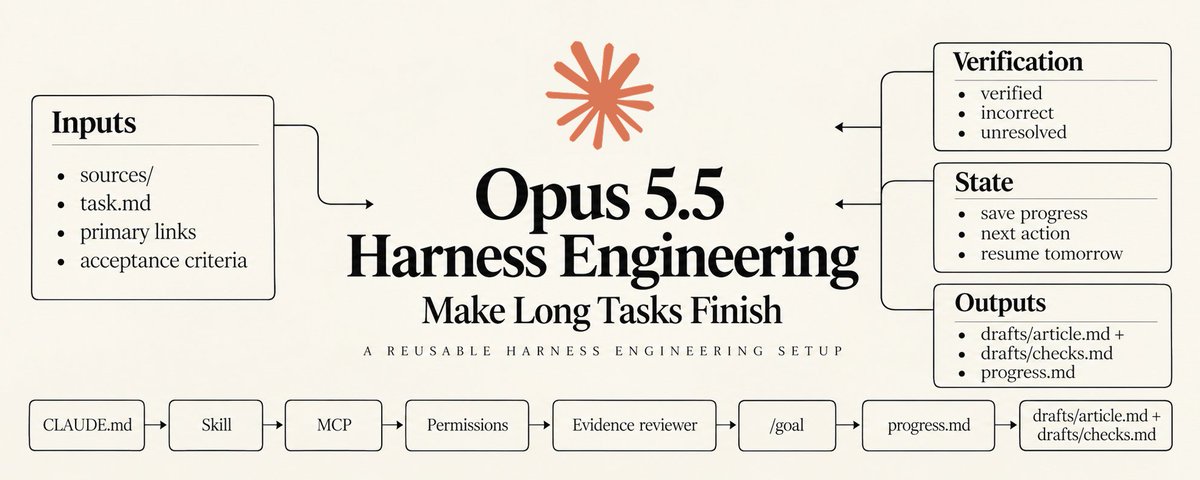
Andrej Karpathy (ex-OpenAI, ex-Tesla) just released a prompt that turns Opus 5.5 into a harness that actually finishes the any job.
It's f*cking unreal...
send it to Opus 5.5, and thank me later. Then read the full guide for Opus 5.5 Harness Engineering.



Minh Pham retweeted

Andrej Karpathy predicted the future of AI once again:
“Everyone’s renting frontier models for jobs a 3B model could do. Small models are the future.”
this 18-page PDF breaks down Karpathy’s case for working with small LLMs.
the real question isn’t “Is the small model as good?” It’s “Which of my 1,000 calls ever needed a frontier model?”
And @thewebai just answered it for formal logic.
TwIL-LM3-Pro:
→ 3.6B params, on par with Qwen3-8B on formal logic
→ leads VibeThinker-3B on all 6 formal-logic tasks tested
→ 95.4% on BBH logic, 95% on SVAMP
→ 2.09 GiB in Q4, runs on CPU or 4GB VRAM
→ no API bill, no data leaving your machine
The secret isn't size. It's post-training.
PDF below. Model 👇
huggingface.co/webAI-Officia…
🤝 Paid partnership


Half a million downloads in a month. Today, our open source family takes another step forward.
Thank you for the incredible support behind our first-generation models. We’re excited to introduce TwIL-LM3-Pro.
At just 3.6 billion parameters, it brings powerful reasoning to everyday computers, with quantized builds that run locally. No cloud required.
In our evaluation:
Formal logic: Highest recorded headline score among the small models compared—beating China’s VibeThinker-3B by 35% and Qwen3.5-4B by 24%, and Liquid AI’s LFM2.5-8B-A1B by 47%.
Broader reasoning: 95% on SVAMP and 64.1% on MuSR, the highest recorded scores among the small models compared.
BIG-Bench Hard’s logic subset: 95.4%, compared with VibeThinker-3B’s 61.1%.
We believe AI is entering a post-training era. The advantage will increasingly belong to companies with the best pipelines and those that can produce capable, personalized intelligence faster and more efficiently, then put it on devices people already own.
That’s what we’re building at webAI. And we’re only beginning to share what’s coming out of our lab.
Coming soon: Meridian, our family of frontier-class models built to run on device. Our most advanced models will be available through the @thewebAI application.
Join the waitlist as we expand access. Proudly built in Austin, Texas. 🇺🇸

Minh Pham retweeted

Claude Code tip: once Opus 5.5 is your main model, stop leaving Fable 5.1 sitting idle
put it on call with /advisor
run /advisor fable
Opus 5.5 keeps writing the code
Fable 5.1 reads the full session, every tool call included, and only speaks up at three points:
→ before a plan: is this the right approach?
→ when the same error comes back: am I digging in the wrong place?
→ before "done": what did I miss?
Fable 5.1 reviews. Opus 5.5 ships
Jev engineering is the same move one layer down: the forks that need no thinker (which file, which tool, retry or stop) go to Jev in under half a second, and the big model only sees the ones that split
- the full tree
> Opus 5.5 on high runs the main session
> explorer reads the code
> worker edits and runs tests
> researcher pulls the docs
> all three on medium
> Fable 5.1 on call as the advisor
paste the tree and this prompt into Claude Code ↓
"Rebuild my Claude Code setup around this tree:
1. Check ~/.claude/agents and .claude/agents for subagents that already fit explorer, worker and researcher.
> Draft new ones only for missing roles
> Give each model: opus, effort: medium
> Skip any that pin a different model and list them
2. Set the main session to high via effortLevel in ~/.claude/settings.json, and set advisorModel to fable
3. Find anything that keeps the advisor off (CLAUDE_CODE_DISABLE_ADVISOR_TOOL, DISABLE_TELEMETRY, any variable that stops feature-flag fetching) plus CLAUDE_CODE_EFFORT_LEVEL, which overrides subagent effort. Report them, change nothing
4. Add one rule to ~/.claude/CLAUDE.md: consult the advisor before a large plan, when an error repeats, and before calling a long task done
Show me every change as a diff first. No edits until I say go."
↳ code.claude.com/docs/en/advi…


Minh Pham retweeted

Top 12 agentic use cases for Jev:
(bookmark this)
Jev handles semantic decisions that ordinary code cannot express reliably. It returns typed answers and probabilities, while code continues to cover the workflow.
Here are 12 practical use cases for Jev:
1. Browser next action
> Convert the current DOM state into a bounded action such as click, type, or stop. Code executes only valid operation-target pairs. There are already several open-source Jev web agents.
2. Context compaction
> Decide which events from a long agent trace should remain. The selected text stays verbatim instead of being replaced with a generated summary.
3. Skill and context loading
> Compare the current user turn against the available skills. Load only the instructions needed for that turn instead of filling the context window with every skill.
4. Typed tool-call compilation
> Map a natural-language request to a function and fill its typed arguments. Each argument is evaluated separately before code allows execution.
5. Citation verification
> Check whether a quoted passage exists and whether the surrounding evidence supports the claim. The output can be supported, unsupported, or contradicted.
6. Extraction verification
> Run a cheap extractor first, then use Jev to verify questionable fields. Clean records stay on the fast path while uncertain ones reach a reasoning model.
7. Agent trace evaluation
> Turn raw trajectories into queryable labels such as progress and repetition. This avoids asking another LLM to write a full review of every run.
8. Semantic regression tests
> Replay a trace suite against a new agent build. Semantic checks can then pass or block prompt, model, tool, and policy changes in CI.
9. Jevgrep code search
> Search a codebase by what the code does rather than its exact words. Jev scores candidate snippets and returns the most relevant code first.
10. Entity alignment
> Compare two candidate records and decide whether to merge, review, or keep them separate. Candidate generation remains deterministic while Jev handles semantic identity.
11. Retrieval reranking
> Let embeddings retrieve a broad candidate set, then use Jev to reorder passages by relevance. The generation model receives the most useful evidence first.
12. Memory promotion gate
> Capture a completed agent trace, then judge whether its corrections contain a reusable lesson. Trace-backed lessons can be promoted while task-specific noise is discarded.
If you want to see the final pattern in practice, it is already implemented in the Beacon open-source project.
Beacon captures full sessions across Claude Code, Codex, Cursor, OpenCode, and 20+ agent harnesses, and then Jev identifies which workflows and corrections are worth learning from, so that a lesson discovered by one agent can become available to the others.
GitHub repo: github.com/Asymptote-Labs/ag…
(don’t forget to star it ⭐)
If you want to dive deeper, I also wrote about a similar mechanism in a hands-on guide. It covers building a Jev-style decision path with open models, entirely locally.
Read it below.


Minh Pham retweeted

Your Claude Code install is missing a few things.
Here are 40 additions (grouped by what they do):
I've hoarded over a hundred Claude repos this year.
These cover workflows, skills, memory and tools, plus reference libraries worth keeping open.
BUILD A WORKFLOW
1. learn-claude-code → Learn how agents work.
2. karpathy-skills → Cut common coding mistakes.
3. superpowers → Plan, build and test.
4. ponytail → Keep the code simple.
5. gstack → Add planning and review workflows.
6. ECC → Add skills, memory and checks.
7. oh-my-claudecode → Coordinate agent teams.
8. Archon → Build repeatable coding workflows.
ADD SKILLS
9. taste-skill → Improve your designs.
10. anthropics skills → Browse official skills.
11. mattpocock skills → Add engineering skills.
12. wshobson agents → Find specialist agents.
13. claude-plugins → Browse official plugins.
14. addyosmani skills → Add engineering checks.
15. ui-ux-pro-max → Get interface design guidance.
16. awesome-claude-skills → Find more skills.
KEEP THE CONTEXT
17. planning-with-files → Keep plans in files.
18. claude-mem → Carry context across sessions.
19. codegraph → Map the code's connections.
20. graphify → Connect code and documents.
21. repomix → Pack a repo into one file.
22. agentmemory → Give agents persistent memory.
23. beads → Track work across sessions.
CONNECT TOOLS
24. multica → Assign issues to coding agents.
25. firecrawl → Turn websites into usable text.
26. cc-switch → Manage your coding tool setup.
27. context7 → Fetch current code documentation.
28. vibe-kanban → Manage agent tasks on a board.
29. github-mcp → Work with GitHub from Claude.
30. playwright-mcp → Let Claude use a browser.
31. serena → Find and edit relevant code.
32. claude-code-router → Route model requests.
33. awesome-mcp-servers → Find more connectors.
PROMPTS & USAGE
34. system-prompts-ai → Study AI tool prompts.
35. best-practice → Read Claude Code practices.
36. codex-plugin-cc → Add Codex reviews in Claude.
37. claude-hud → See your session usage.
38. rtk → Trim command output.
39. headroom → Compress what the model reads.
40. caveman → Get shorter replies (much shorter).
So pick one for the job you're doing.
Open its repo, follow the setup instructions and try it on a real task before adding the next one.
My Claude resource vault
→ charliehills.substack.com/p/…
Repost ♻️ to help someone in your network.

Minh Pham retweeted

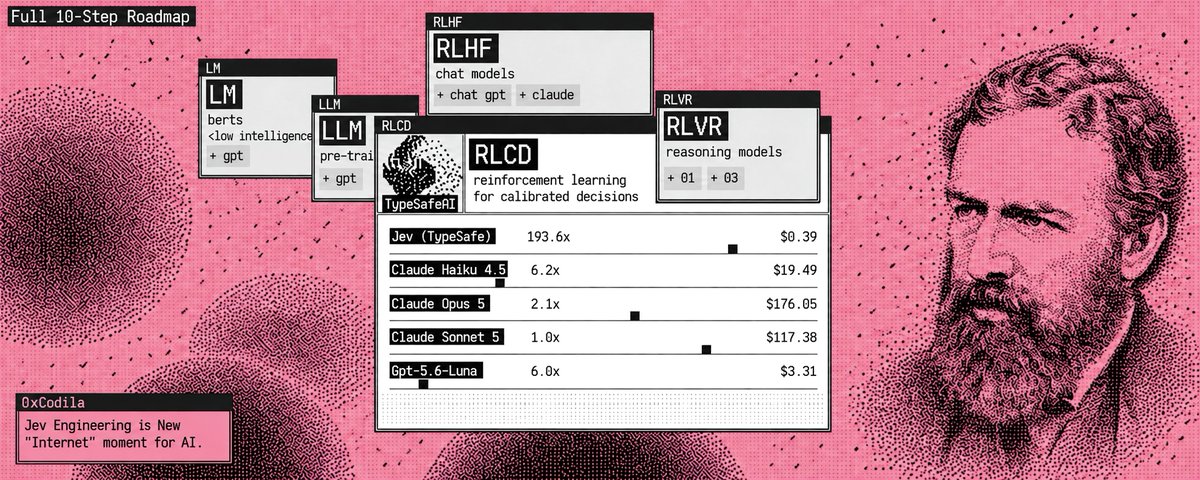
Jev might genuinely be an “Internet moment” for AI.
TypeSafe reports up to 193x faster and 444x cheaper performance in tests with Claude Fable 5.1 and GPT-6 Astra.
@0xCodila just wrote a great 10-page article explaining what Jev is, how to use it, and where its 100x advantage comes from.
Here are the 10 steps:
1 → LLMs create. Agents act. Jev decides the next move.
2 → Turn agent forks into three primitives: Choice, Score and probability.
3 → Build with OpenAI, Anthropic or xAI first, then swap Jev in without rebuilding the graph.
4 → Start with shared state, parallel decisions, risk thresholds and an execution queue.
5 → Batch decisions instead of making them sequentially. In one test, 13 questions were 10x faster and 12.2x cheaper.
6 → Put Jev at bounded forks: agent, model, tool, browser action or human escalation.
7 → Benchmark the whole loop, not just individual model calls.
8 → Rank wide, read narrow: shortlist first, then spend compute on what matters.
9 → Reuse the same system: State → Questions → Action → Verify.
10 → Keep Jev out of math, writing and irreversible execution. Code computes, LLMs create, Jev decides.
The result:
A slow, expensive agent loop becomes a much faster decision system that can route, score and escalate in milliseconds.
Full breakdown below ↓


Minh Pham retweeted
Karpathy's prediction about RL is coming true now!
He argued that a single reward number tells an agent very little about why its work was good or bad. For complex tasks, he proposed a review informed by knowledge of the task.
That problem shows up as soon as RL moves beyond answers that can be checked automatically.
A math solution is right or wrong. Code can run against tests.
But an agent's work may involve dozens of decisions, and a successful final answer can hide wasted steps or poor tool use.
Engineers can write rules to score those trajectories, but the rules need to anticipate the behavior they want to reward. When the agent's workflow changes, the scoring code often needs another pass.
RULER, implemented in OpenPipe ART, lets the engineer write the evaluation criteria in plain English.
An LLM reviews multiple trajectories against those criteria and ranks them. ART turns that comparison into rewards for GRPO training.
I used this setup to train a Qwen3 1.4B agent to play 2048. It saw the board and chose a direction at each step.
Rather than scoring its moves with a collection of rules I had coded, I described what the reviewer should look for and let RULER compare complete attempts.
The result is still a numerical reward, but the difference is how the reward is defined. I can revise the description when I find behavior the reviewer is missing, then inspect whether its judgments match what I intended.
The full implementation is available on GitHub.
ART GitHub repo: github.com/OpenPipe/ART
(don't forget to star it ⭐)
I also wrote a walkthrough of the RL concepts and this training run, covering RLHF, GRPO, and RULER, in the article below.

Minh Pham retweeted
Sam Altman (CEO of OpenAI):
"Every night I have a few thousand agents running with GPT-6 Astra"
A few thousand AI agents, working overnight, monitored from his phone.
In 1 hour he shows what one person can build now, and how long that used to take a whole team.
Watch the him explain how, then read the full breakdown below👇