Studying what GenAI bypasses in K–12 learning. District tech & innovation director. Pedagogical friction. https://xitter.cf/t.co/7BTjTd7bmc

Chicago
Joined August 2010
Were you in high school when AI writing tools showed up? A researcher wants to hear about it. I am Micah Miner, a doctoral candidate at National Louis University. I am talking with college students who were in grade 10, 11, or 12 during the 2022–2023 school year, which is when generative AI tools became widely available. I want to hear you describe the change in your own words. What did schoolwork feel like before, what shifted afterward, and what is coursework like for you now in college? This is one core interview session of about 40 to 55 minutes, by video call or in person. You may also be invited to complete a separate optional card sort of approximately 10 minutes within the same session, for an estimated total of 50 to 65 minutes. There is no compensation. I am not connected to your college or your old high school, I am not reporting anything to anyone, and I am not evaluating whether anything you did was allowed. Your name and your schools will not appear in the dissertation or in resulting publications or presentations. You are eligible if you are 18 or older, currently enrolled at a college or university, and were in grade 10, 11, or 12 during 2022–2023. If you are interested, email me at [email protected] and I will send you the consent form to read before you decide. Micah J. Miner, doctoral candidate, National Louis University. Committee Chair: Dr. Terry Jo Smith, [email protected].
17
Invitation: dissertation study on generative AI and K–12 teaching and learning Hello, My name is Micah Miner. I am a doctoral candidate at National Louis University, and I am looking for K–12 educators, building administrators, and district or system leaders who are willing to talk with me about generative AI and its effect on student learning. I am interested in the practical side of this. When does AI help students, when does it quietly do the work the assignment was meant to make them do, and what does your school or district actually give you to work with in the way of policy, assessment expectations, and professional learning? Taking part means one core interview session of about 50 to 65 minutes, at a time and in a format that works for you, by video conference or in person. Classroom-facing educators may also be invited to complete a separate optional card sort of approximately 10 minutes within the same session, for an estimated total of 60 to 75 minutes; building administrators and district or system leaders do not complete it. There is no compensation. No additional research session is required; transcript or results follow-up occurs only if you request it. Your name, school, and district will not appear in the dissertation or in resulting publications or presentations. You are eligible if you are 18 or older and currently work in one of the roles above. Employees of Beach Park Community Consolidated School District 3, where I work, are not eligible. If you are interested or want to see the consent form before deciding, reply to this message or email me at [email protected]. Thank you for considering it. Micah J. Miner, doctoral candidate, National Louis University Committee Chair: Dr. Terry Jo Smith, [email protected]
26
Were you in high school when AI writing tools showed up? A researcher wants to hear about it. I am Micah Miner, a doctoral candidate at National Louis University. I am talking with college students who were in grade 10, 11, or 12 during the 2022–2023 school year, which is when generative AI tools became widely available. I want to hear you describe the change in your own words. What did schoolwork feel like before, what shifted afterward, and what is coursework like for you now in college? This is one core interview session of about 40 to 55 minutes, by video call or in person. You may also be invited to complete a separate optional card sort of approximately 10 minutes within the same session, for an estimated total of 50 to 65 minutes. There is no compensation. I am not connected to your college or your old high school, I am not reporting anything to anyone, and I am not evaluating whether anything you did was allowed. Your name and your schools will not appear in the dissertation or in resulting publications or presentations. You are eligible if you are 18 or older, currently enrolled at a college or university, and were in grade 10, 11, or 12 during 2022–2023. If you are interested, email me at [email protected] and I will send you the consent form to read before you decide. Micah J. Miner, doctoral candidate, National Louis University. Committee Chair: Dr. Terry Jo Smith, [email protected].
38
Invitation: dissertation study on generative AI and K–12 teaching and learning Hello, My name is Micah Miner. I am a doctoral candidate at National Louis University, and I am looking for K–12 educators, building administrators, and district or system leaders who are willing to talk with me about generative AI and its effect on student learning. I am interested in the practical side of this. When does AI help students, when does it quietly do the work the assignment was meant to make them do, and what does your school or district actually give you to work with in the way of policy, assessment expectations, and professional learning? Taking part means one core interview session of about 50 to 65 minutes, at a time and in a format that works for you, by video conference or in person. Classroom-facing educators may also be invited to complete a separate optional card sort of approximately 10 minutes within the same session, for an estimated total of 60 to 75 minutes; building administrators and district or system leaders do not complete it. There is no compensation. No additional research session is required; transcript or results follow-up occurs only if you request it. Your name, school, and district will not appear in the dissertation or in resulting publications or presentations. You are eligible if you are 18 or older and currently work in one of the roles above. Employees of Beach Park Community Consolidated School District 3, where I work, are not eligible. If you are interested or want to see the consent form before deciding, reply to this message or email me at [email protected]. Thank you for considering it. Micah J. Miner, doctoral candidate, National Louis University Committee Chair: Dr. Terry Jo Smith, [email protected]
1
1
41
I am looking for four to six K–12 educators and school or district leaders in total to help me test a survey before I send it out. In a 60- to 75-minute video call, you would work through the draft survey and tell me out loud how you are reading each question, so I can find the wording that does not land. I am testing the questions, not you. One thing to know up front: if you help with this, you cannot also take the final survey or be interviewed for the main study, because you will have already seen the draft. There is no compensation. If you are willing, email me at [email protected] and I will send the consent form.
37
FCC comments on E-rate close Tuesday, Oct 13. Have a minute? Tell Congress through CoSN. cosn.quorum.us/campaign/1650… Have twenty? File in Docket 26-133 with the worksheet and links here. minerclass.github.io/erate-t…
29
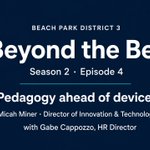
On Beach Park D3’s Beyond the Bell (Season 2, Ep. 4) with Gabe Cappozzo, HR Director, we talked about what “Director of Innovation & Technology” actually means in a district: instructional leadership, not gadget theater. Pedagogy has to stay ahead of devices. Screen time is the wrong primary question when Chromebook charging carts still create daily friction and a meaningful share of middle-school use is still passive. On AI, I’m a power user who stays skeptical. Tools like Magic School can help, but only with human oversight, and students still have to do the thinking. A lot of the work that keeps roughly 2,500–2,800 devices usable never shows up in the highlight reel. Thanks to Gabe and BPD3 communications for the conversation. Listen: open.spotify.com/episode/3tx…
🤖 Made with AI
32
I filed my comment in the FCC's E-rate review. Here is why, and what I am asking of superintendents, tech directors, librarians, board members, teachers, families, and researchers before comments close Tuesday, Oct 13. micahminer.com/why-i-filed-o…
25
The FCC is asking whether E-rate should be "limited or sunset." Comments close October 13. Before a single student logs on, a school network has already routed the buses, brought the ventilation online, unlocked the doors and screened visitors, turned breakfast into a federal meal claim, and sent attendance to the state. Stacy Hawthorne's piece for CoSN walks through that morning hour by hour. It is the clearest short account I have read of what E-rate actually pays for. I write critically about screens in classrooms, and the screen-time concern behind this review is real. Families are right to ask why screen time keeps rising at school. But E-rate does not buy devices, software, or curriculum. It pays a discounted share of the connection into the building and the network inside it, including the lines that carry 911 calls and lockdown systems. Screen time is a pedagogical question. It belongs with teachers, families, and local boards. Sunsetting E-rate would not answer it. It would move the cost of running a building onto local budgets, and the highest-need districts, which receive the deepest discounts, would likely absorb the most. Have one minute? CoSN's Tell Congress page takes four fields and sends a letter to your members of Congress. cosn.quorum.us/campaign/1650… Have twenty? File in FCC Docket 26-133. The tracker has the FCC's questions by paragraph and a worksheet for drafting your comment. minerclass.github.io/erate-t… Why a technoskeptic ends up defending E-rate: micahminer.com/a-technoskept…
2
47
Looking forward to speaking at the Imagine Learning "Turning Vision into Classroom Practice" summit on Oct 6 at The Morton Arboretum in Lisle, IL. Session: "Future Ready, Not Just AI Ready." Moving past tool adoption toward critical thinking and durable learning. Register: qrco.de/future-ready-student… Sessions: rebrand.ly/IL-Oct-6-Speakers…
28
The Pouch and the Bypass: What this fall’s screen debate is actually about, and what it leaves untouched. See micahminer.com, minerclass.github.io for more. View article
1
90
Great article in @EdSurge by my @CoSN colleague and fellow @ISTEcommunity leader Pattie Morales, CETL. She details how to build an AI-ready school culture through deliberate collaboration and community frameworks rather than reactionary policies. Thank you to Pattie for referencing my work on "unproductive success" and "Beyond Secondary Orality." As students increasingly use AI for cognitive offloading, we must critically evaluate our pedagogical approaches and recognize when technical success masks a lack of learning. Highly recommend reading her insights on navigating this complex landscape. How My School Used Common Sense and Collaboration to Confront AI edsurge.com/news/how-my-scho… digitalcommons.nl.edu/ie/vol… #EdTech #AIinEdu #TechnoSkepticism #EdLeaders
39
Counting screen time hours is the wrong metric. The real question for EdTech leaders is what habits of mind students are practicing behind the screen. Generative AI can create "unproductive success" if we do not protect cognitive struggle. Read my new piece for CoSN: Screen Time Is the Wrong Question #EdTech #AIinEdu
9
Generative AI can remove difficulty from academic work. But schools need to ask: what kind of difficulty? Productive friction builds capacity: retrieval, revision, explanation, argument, synthesis. Exclusionary friction blocks access: inaccessible formats, irrelevant language barriers, one-size-fits-all "rigor." The AI question isn't only "Did the student use it?" It's "What did the tool bypass?" Week 2 of my Summer Research Series → micahminer.com/summer-resear…
🤖 Made with AI
1
39
1/ More than half of U.S. teens now say they have used AI chatbots for help with schoolwork. That does not automatically mean they are cheating. It does mean schools have a new assessment problem. 2/ For years, a polished essay or project gave teachers at least partial evidence that a student had wrestled with the material. The final product was never perfect evidence of learning, but it usually carried traces of reading, drafting, revising, and deciding. 3/ Generative AI changes that relationship. A student can now submit work that looks complete while the human learning process behind it remains unclear. That is what I call the illusion of completion. 4/ My dissertation proposal examines this through the idea of pedagogical friction: the productive forms of struggle schools may need to preserve, redesign, or remove in the age of generative AI. 5/ The goal is not to make school harder. The goal is to make learning more visible. That means process evidence: draft history, oral explanation, source defense, reflection, peer critique, and authorship statements. 6/ The question is no longer simply: “Did the student use AI?” The better question is: “What human work did the student still have to do?” This summer I’ll be writing through that question in my Designing with Friction series. micahminer.com/summer-resear… #PedagogicalFriction #AIinEd #K12
🤖 Made with AI
25
My dissertation proposal asks: What happens when student work looks polished, but the thinking behind it is unclear? I’m studying how K–12 educators and leaders make sense of GenAI, pedagogical friction, productive struggle, access, authorship, and learning. #AIinEducation #EdTech
16