

26+ years building software. AI-native engineer. Building production systems with coding agents. Shipping open source. Sharing what works and what breaks.
🟩🟧⬜⬜⬜⬜⬜⬜⬜⬜ - $100k MRR
Joined January 2023
- Tweets1.6K
- Following213
- Followers104
- Likes1.2K





A small specialist just took over the memory harness.
Hy-Memory-30B-A3B is trained to decide what to remember, how to write it, and when to update existing memories. It replaces the general LLM in systems like Mem0 and MemOS.
On fixed benchmarks, it reportedly beats Claude Opus and DeepSeek Flash at memory writing.
The interesting part is what moved inside the model. Logic we treated as permanent harness code became a specialized model task.
As models absorb more of that work, the harness will need to focus on what still requires hard guarantees: budgets, permissions, verification, and recovery.
The boundary between model and harness keeps moving.
huggingface.co/tencent/Hy-Me…

The best voice agent isn't the one that speaks fastest. It's the one that never leaves you wondering if it's still there.
Google's ADK guide tackles a real UX problem: silence breaks trust.
The tradeoff is latency vs. natural conversation. Keeping users informed matters as much as getting the answer right.
Great engineering, @GoogleAI.
developers.googleblog.com/st…

The fix for agents drowning in context wasn't a bigger model. It was a thinner orchestrator.
One central agent had every schema, pipeline rule, and data source. It worked in demos, then cross-contaminated decisions in production.
Meta split the work across 14 specialists. Each sees only its own domain. The orchestrator routes requests and checks results.
Config prep fell from days to under an hour. Two-thirds of changes need almost no human edits.
The lesson is simple. Give each agent only the context it needs, and make the router responsible for coordination, not execution.
engineering.fb.com/2026/10/1…
@Meta

YC takes 7% for $125K.
Dubai is offering $150K grants with zero equity. The catch? Build an AI agent.
No age or location restrictions. No trade licence needed to apply. Ideas are enough to get started, and non-technical founders are welcome. Go solo or bring a team of up to six.
You get workshops, a Digital Academy, and mentorship while you build. Winners set up a Dubai company to receive the funding.
Registration closes in December. Submissions are due in January. The live final takes place in Dubai in the first week of May 2027.
The previous edition attracted 15,564 applications from 153 countries.
If you're building AI agents, this is worth a serious look. Zero equity means you keep ownership of what you build.
Apply here:
dubaichamberdigital.com/en/c…
Google open-sourcing Harness² changes how I think about agents.
The model stays frozen. The system around it evolves.
Prompts, guardrails, memory, tools, skills, scripts, subagents, and plugins.
The agent proposes small changes, tests them on the same task, keeps what performs better, and carries those lessons forward. No answer key needed.
A weaker model with a better harness can outperform a stronger model running the original setup.
Maybe more of the gains we're chasing are in the harness, not the weights.
Would you let an agent rewrite its own setup, or is that still too risky?
Papaer: arxiv.org/abs/2610.14224
Github: github.com/google-research/h…

DeepSeek-V4.1-Flash-1017 is getting all the attention.
Shorter outputs, same price, better agent scores. That's real progress.
But it doesn't fix the loop. Long agent runs reuse most of the same prefix. When the cache misses, you pay for prefill again, regardless of how short the next answer is.
Upgrade the harness alongside the model. Exact caching. Hard tool budgets. Stop when the budget runs out.
The SVG will look fine either way. The session bill won't.
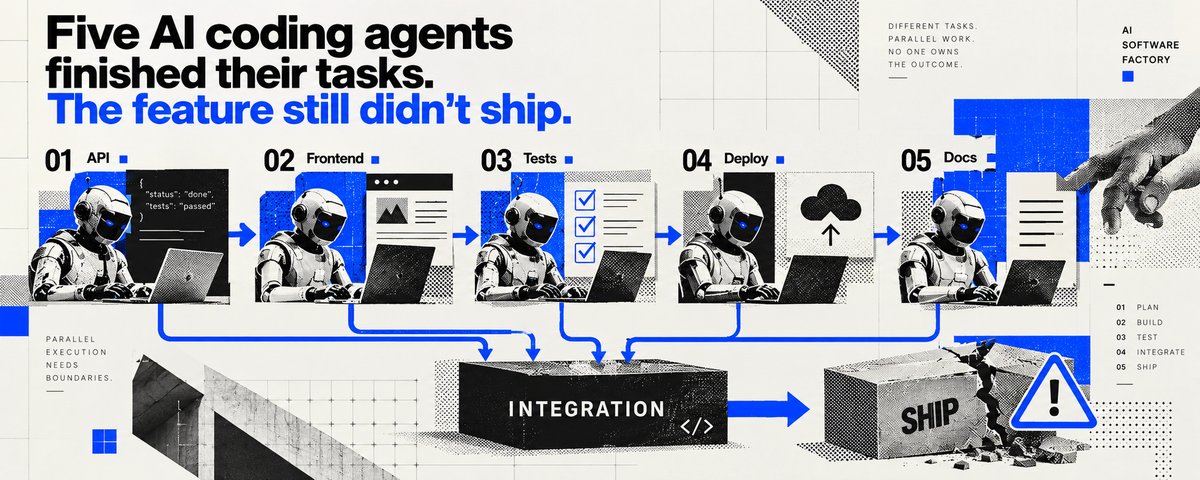
Five AI agents. Five tasks done. One feature unshipped.
The bottleneck: integration, ownership, verification.
I'm building a software factory for reliable AI collaboration.
How do you make agents ship?
The interesting part isn't that the agent ran for 11 hours. It's that maintainers rejected four of the six changes. Letting agents investigate real bottlenecks is useful, but keeping humans in charge of what ships is what makes it practical. Have you seen similar gains on smaller codebases, or does this approach really pay off at scale?


Uzu is a high-performance on-device inference engine for running AI models locally, with no network latency, better data privacy, and no per-token API costs.
It provides a unified API for Rust, Python, Swift, and TypeScript. It handles model downloads, uses unified memory on Apple devices, and supports quantized models. The same engine powers the Mirai Mac app and CLI.
Useful when you need local inference without managing a separate runtime or handling GPU memory yourself.
github.com/trymirai/uzu

Tov is a language built for coding agents. It reads like TypeScript so your agent can already write it, and when the agent gets something wrong the compiler returns the exact edit that fixes it (with a code and whether the fix is safe to apply).
What comes out is a single native binary. Their benchmarks show a web server doing 242k req/s on one core in 1.6 MB, ahead of Rust’s axum and well ahead of Bun on memory. Compile times are also lower. Bun and Node APIs work, including npm packages, and there’s no `any`, no `null`, checked errors, and integer overflow traps.
Early (0.0.1), macOS and Linux only for now. You can point an agent at tov.sh/llms.txt to get started.
github.com/richiemcilroy/Tov
REA lets coding agents drive reverse engineering through a local MCP server.
It connects to Ghidra, Hopper, or IDA for native binaries and supports Electron apps, JavaScript, Android packages, firmware, and more. Describe the behavior you want to understand, and it returns observed evidence and limitations instead of claiming to recover the original source.
Setup is one command: `npx rea-agents setup`.
Useful when you need to understand software without source access and rebuild compatible behavior in your own stack.
github.com/morluto/rea

Keep an explicit unknown route. If the input doesn't fit the closed set, don't force a label. Escalate to a general model or a human, log the case, then expand the taxonomy when the pattern repeats.
Fast routing only works if uncertainty has a path.

Introducing Microsoft-Decision-1
Our model for fast decision-making that delivers top performance in latency and quality on structured decision tasks to outperform both LLMs and other decision models.
commandline.microsoft.com/mi…

An agent with no spend cap is a bill you read later.
The loop is the cap, not the model.
Exact cache only. Never “close enough” on a tool call.
If it spends, sends, or deletes, a person still says yes.
Build is cheap. The judge is the product.
Ship the seam. Post the number.
A chatbot in the inbox gets used twice.
The loop that gets bookmarked is smaller:
1. Quote comes in by email, PDF, or photo of a list.
2. Compare it with the rate sheet. Never invent a price.
3. Draft the reply. Owner still approves.
4. If it spends, sends, or deletes: allow, ask, or never.
Build is cheap. The judge is the product.
If a person can't check it in a minute, don't ship it.

LLMs are great at talking. They’re bad at deciding.
Cloudflare just open-sourced Clef: a model built for structured decisions, with probabilities, in tens of milliseconds.
Urgent? Which team? How bad?
No essay. No tool-call soup. Just the answer your agent was waiting for.
It beats Jev on most decision benchmarks, adds vision, and supports fine-tuning. Apache 2.0, so you can run it locally.
The agent loop finally gets a fast “yes / no / route here” step.
That’s the piece that was missing.
blog.cloudflare.com/clef-dec…

Day 5 of building KIVO in public.
Today I defined the initial data schema.
The stack:
Drizzle for the database.
Valibot for validation.
drizzle-valibot to connect them.
Nothing flashy.
Just getting the foundation right before I build more of the product.
Next: build on top of the schema.
Christoph Nakazawa just shipped Vite+ 1.0.
One `vp` command for runtime, install, dev, test, and build.
Nine commands. One `vite.config.ts`. Rust tools underneath.
Oxlint is 50–100x faster than ESLint.
Oxfmt is up to 30x faster than Prettier.
Almost 2M weekly downloads. 2,600 public repos already using it.
> Instead of maintaining a tool stack, you often just want to ship features.
`curl` install → `vp create` or `vp migrate` → same commands in every repo.
The stack was the work.
Now the work is the product.

Vite+ 1.0 is out:
* Fast tools
* No config
* Less time and fewer tokens wasted
Almost 2m downloads per week too, what are you waiting for?
voidzero.dev/posts/announcin…

Milon retweeted

Hono v4.13.10 is out, and the runtime adapters are now separate packages like `@.hono/bun` and `@.hono/cloudflare-workers`.
hono/<adapter> is deprecated and will be removed in v5. Just change the import path.
github.com/honojs/hono/relea…

Day 4 of building KIVO in public.
I'm starting to shape KIVO around AI coding agent teams.
Not one agent doing everything.
Multiple agents.
Different roles.
Structured handoffs.
Human-gated decisions.
The bigger idea is a software agent factory.
Agents do the development work.
Humans stay in control of the important decisions.
I'm designing the workspace for both DX and AX.
Developer Experience + Agent Experience.
Now I need to make this workflow actually work.