

Trying to make the machine that makes medicines. Working on AI for science @LilaSciences
San Francisco
Joined October 2019
- Tweets45
- Following590
- Followers183
- Likes7.3K




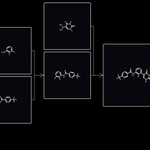


Exciting step towards finding medicines for a debilitating rare disease. Winning submission was resynthesized batch from DEL screen.

Major win for the chordoma community today: as part of our TBXT Challenge, @XChemInc discovered a compound that binds to brachyury—chordoma's key vulnerability—with much greater affinity than any previously published. In doing so, they've overcome a longstanding scientific hurdle, and the achievement could open the door to developing several types of promising drugs aimed at this target.
More: chordomafoundation.org/lates…
Very grateful to all of our supporters, incl. @biohub and @TheMarkFdn, for making this possible. Excited to see what comes next, including more discoveries from our ongoing Challenge!


Me strolling through Kyoto, Uji, and Nara during a post-ICML deco stop, translating signs and accepting any coffee stop suggestion.


Heading to Seoul for ICML. Looking forward to seeing old friends and meeting new ones! We're also hiring ML scientists and research engineers @Terray_Tx - reach out to grab coffee👋
Come say hi at our Tuesday happy hour: luma.com/2g1rr4v6


Miles retweeted

Last week we shared some of our recent work on TerraSynth, a generative synthesis planner that addresses the synthesis bottleneck in small-molecule drug discovery.
While generative models are good at proposing molecules with desirable properties, they often propose molecules that are difficult to synthesize in practice, slowing down DMTA cycles.
TerraSynth makes synthesis planning a native part of the design loop rather than a problem to solve afterward. Integrating TerraSynth into our EMMI platform has helped us focus on the molecules that are worth making to advance our programs.
Thanks to Zack and @mileswhen for their incredible work on this.
Got asked how the TerraSynth title animation was made. Short answer is coarse co-fold of BTK and designed ligands, rendered by Claude using blender w/ geometry nodes.
More details in thread.
Since it's coarse co-fold we only have the backbone structure without sidechains. I wanted to go for a "fluorescent optical fibre" rendering. Trick to getting this right (after a few iterations) was
1) transparent backbone "cartoon" tube
2) principled BSDF shader to get the self-emission glow
3) kill some competing light by bumping up surface roughness


Highly recommended reading. An earlier draft of PAI was my bible while studying: arxiv.org/abs/2502.05244
Was unfairly skeptical of this one, while never actually trying it on large chemical datasets. Finally tried it. Kicks ass, and seems better calibrated than other bayesian last-layer approaches (e.g. VBLL) for large pre-trained models.
