

The future dominance of AI over the world is obvious... it’s pointless to deny it
Joined July 2026
- Tweets216
- Following80
- Followers72
- Likes477


Mila | money & power in tech retweeted
This guy took full control of his TV and PS5 in one night using Claude Code.
His TV stopped calling home. Developer mode is on, 37 tracking domains are blocked, ads and bloatware are gone. It now boots into his own launcher instead of the slow stock one.
His PS5 goes straight into games — 9 seconds instead of 41. He hid 14 preinstalled apps, freed 190 GB for GTA 6, and pushed the store out of the way.
He also built a custom screensaver for both screens that shows his calendar, the weather, a ping every time Stripe sends money, and a live GTA 6 countdown.
The whole thing took one night. Claude Code + the right sequence of prompts.
He’s going to drop exactly what he asked Claude Code in a few days.
Mila | money & power in tech retweeted
THIS IS F*CKING WILD: 54 GROK BOTS FROM SPACEXAI'S OWN TEAM, ALL FREE TO INSTALL
shub gaur, lauren tan, matt palmer and the rest of the grok bot team made the whole set. each bot has one job, explained in one line.
open the marketplace, pick one and hit add. no config files, no prompt writing, no weekend setup.
how to use the video:
1. watch the run through all 54
2. pause on the job you would happily never do again
3. install that one first
save this and check the marketplace below ↓
every fortune has a receipt. this one is $0.
Official marketplace: x.ai/bot/marketplace
Original format and research: @unicodef1wn

Mila | money & power in tech retweeted
this is getting f*cking dangerous...
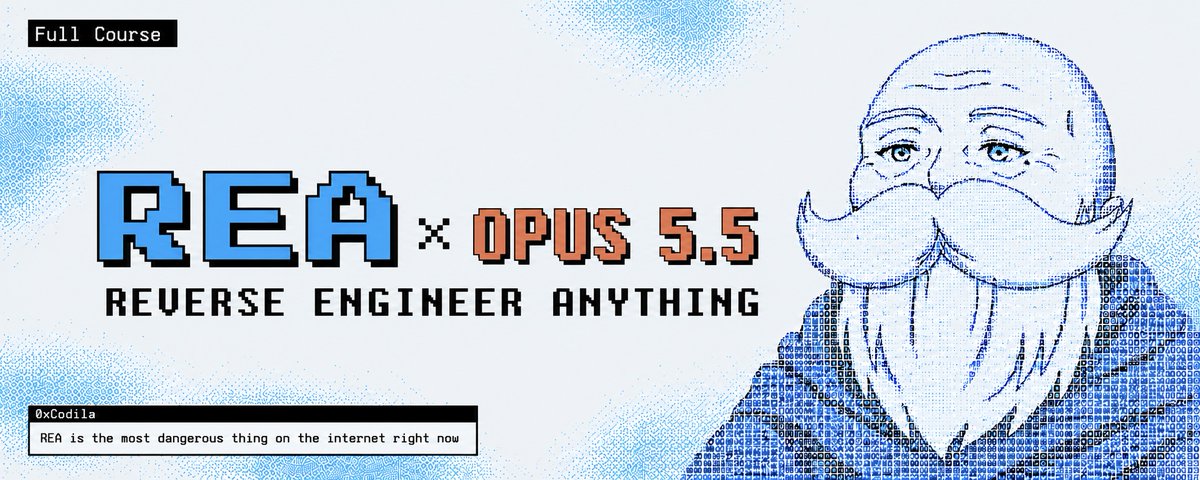
the REA creator (@morluto) just dropped 20 GitHub repos to build a f*cking reverse engineering studio:
[01] analysis core
[02] mobile & apps
[03] binary & low-level
[04] network & runtime
[05] rebuild & verify
how it runs: binary -> REA -> SPEC.md -> rebuild -> oracle -> retry
point it at any app and watch it explain itself.

this is getting f*cking dangerous...
the REA creator (@morluto) just dropped 20 GitHub repos to build a f*cking reverse engineering studio:
[01] analysis core
[02] mobile & apps
[03] binary & low-level
[04] network & runtime
[05] rebuild & verify
how it runs: binary -> REA -> SPEC.md -> rebuild -> oracle -> retry
point it at any app and watch it explain itself.
[01] analysis core > REA: a single MCP that plugs into everything github.com/morluto/rea> Ghidra: decompiler, free github.com/NationalSecurityA…> GhidraMCP: lets your agent drive Ghidra github.com/LaurieWired/Ghidr…> ida-pro-mcp: hooks your agent into IDA Pro github.com/mrexodia/ida-pro-… [02] mobile & apps > jadx: turns Android APKs back into Java github.com/skylot/jadx> Apktool: take APKs apart and put them back together github.com/iBotPeaches/Apkto…> Frida: hook into apps while they run github.com/frida/frida> ILSpy: decompiles .NET github.com/icsharpcode/ILSpy [03] binary & low-level > radare2: RE framework that lives in your terminal github.com/radareorg/radare2> x64dbg: debugger for Windows github.com/x64dbg/x64dbg> ImHex: hex editor with its own pattern language github.com/WerWolv/ImHex> angr: symbolic execution engine github.com/angr/angr [04] network & runtime > mitmproxy: sits in the middle and reads the traffic github.com/mitmproxy/mitmpro…> dnSpy: debug and edit .NET apps github.com/dnSpyEx/dnSpy> rizin: the radare2 fork github.com/rizinorg/rizin> raddebugger: the debugger from Epic Games github.com/EpicGames/raddebu… [05] rebuild & verify > awesome-ai-reverse-engineering: 122 repos, every one graded github.com/zhuyansen/awesome…> awesome-reverse-engineering: curated by the guy who made REA github.com/morluto/awesome-r…> REA workflows: ready-made investigation prompts, ship with REA > clean-room loop: SPEC.md, oracles and checks until it matches

DeepSeek just built its own search engine. Not a wrapper around Google or Bing: its own index of hundreds of billions of pages, already handling hundreds of millions of searches a day. Today it opened it to everyone for $0.75 per 1,000 calls.
The line that matters is buried in the docs. It filters "SEO spam, GEO manipulation, and low-quality AIGC". GEO is the new spam: pages written not for Google's rankings, but to trick the answers AI gives you.
Every chatbot that searches the web reads that junk before it answers you. DeepSeek's fix is to clean the internet its model reads from, before the model ever sees it.
And it's free until October 31 if you run DeepSeek inside Claude Code or Codex. A Chinese lab is giving its search away inside its American rivals' tools.
Google spent two decades fighting spam written for search engines. AI labs now have to fight spam written for them.
Would you trust an AI more if it searched with its own engine, or does that just mean trusting one company with everything?


Source: DeepSeek API docs, Oct 17 release notes: api-docs.deepseek.com/news/n…

In 2012, Google, Baidu, Microsoft and DeepMind bid against each other from a casino hotel at Lake Tahoe. The prize was a company of three people. At $44 million, the man selling it stopped the auction himself.
His name is Geoffrey Hinton. The other two were his students, Alex Krizhevsky and Ilya Sutskever, who later co-founded OpenAI. Hinton chose Google and stayed for ten years.
In May 2023 he walked out, so he could talk about the dangers of AI without thinking about how it would land on Google.
In December 2024 he won the Nobel Prize in Physics for the work behind neural networks. In the video below, he uses his banquet speech to say: "We have no idea whether we can stay in control."
Then one more line, about who is building it: "If they are created by companies motivated by short-term profits, our safety will not be the top priority." He had sold his own work to one of those companies.
He gave his share of the prize money away. Half went to a charity that trains people in Indigenous communities to run safe drinking water, half to a prize for young researchers.
In 2012 he named his price. In 2024 he used the Nobel stage to warn about what it bought.
Was selling to Google the mistake, or was there never a buyer that wasn't chasing profit?
Mila | money & power in tech retweeted
A qigong master fixed his friend's willpower with one sound. Six months later, the guy had paid off his debts.
The sound has nothing to do with it.
In the video below, Song Park explains the deal: do this every morning for six months, and never ask why. That second rule is the real method.
Most habits die the same way. You start negotiating with yourself: is it worth it today, should I find a better version first. "Never ask why" deletes the negotiation before it starts.
Park says even he finds it strange that it works. I don't. You don't need more willpower. You need one promise you never debate.
Would you do something every morning for 6 months without knowing why?
In 2009, Facebook turned down a 37-year-old engineer for a job. He answered in one line on Twitter. Five years later, Facebook paid $19 billion for the company he built instead.
His name is Brian Acton. In the video below, he says what he turned into after that deal: "I am the David going against the Goliath that I created."
The line, from August 2009: "Facebook turned me down. It was a great opportunity to connect with some fantastic people. Looking forward to life's next adventure." Twitter had already said no in May.
He had spent more than a decade at Yahoo and Apple. That November he joined his old Yahoo colleague Jan Koum at a tiny app with no ads and almost no revenue. It was called WhatsApp.
On February 19, 2014, Facebook announced it would buy WhatsApp for $19 billion. Rising Facebook shares pushed the final price to about $22 billion. Acton's cut came to more than $3 billion.
Inside Facebook, he fought over how WhatsApp should make money. He pitched charging a tiny fee after a big batch of free messages, instead of selling ads off the data. Sheryl Sandberg shot it down.
In 2017 he quit, about a year before his last stock grants vested. That was $850 million he never collected. "I sold my users' privacy to a larger benefit," he told Forbes. "I made a choice and a compromise. And I live with that every day."
In March 2018 he posted one more tweet: "It is time. #deletefacebook." No explanation followed.
The company that wouldn't hire him paid him billions. Then he left $850 million of it on the table.
Would you have stayed one more year for $850 million, or walked out like he did?
sources:
BBC, Feb 20 2014 (both 2009 tweets): bbc.com/news/business-262719…
Facebook deal, $19B announced Feb 19 2014; ~$22B at close, Acton $3B+: forbes.com/profile/brian-act…
$850M, Sandberg, "I sold my users' privacy": Forbes, Sep 26 2018, forbes.com/sites/parmyolson/…
#deletefacebook: CNBC, Mar 20 2018, cnbc.com/2018/03/20/whatsapp…
video: Forbes India interview, youtube.com/watch?v=2ftSZp3V…

Mila | money & power in tech retweeted
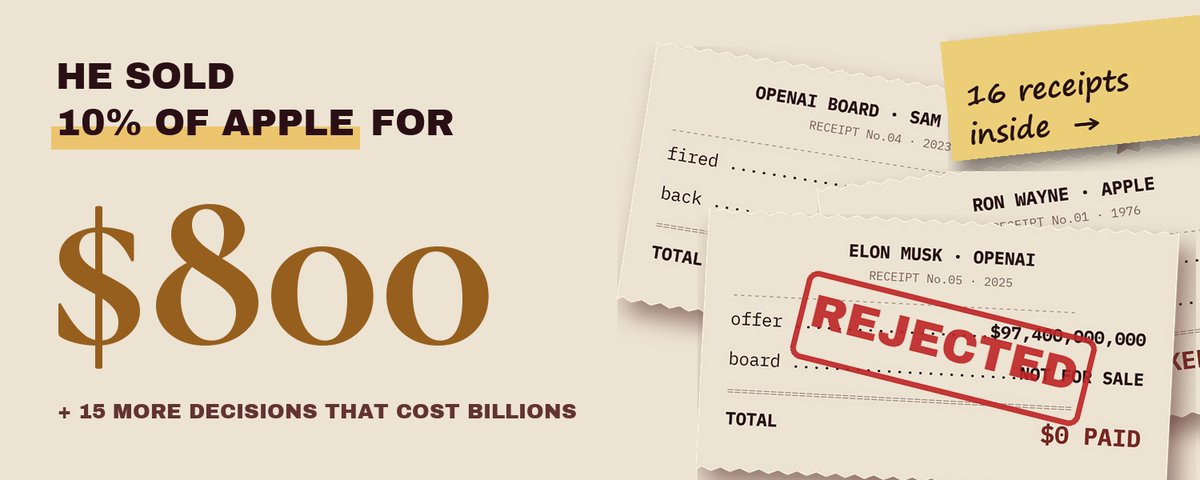
In 1976, Ron Wayne owned 10% of Apple. 11 days later, he sold it for $800.
At today's Apple valuation, that 10% is worth about $500 billion. In the video below, at 76, he's living on a Social Security check outside Las Vegas.
April 1, 1976.
Steve Jobs was 21.
Steve Wozniak was 25.
Ron Wayne was 41.
All three signed the same contract.
Jobs and Wozniak got 45% each.
Wayne got 10%, so he could break a tie.
He drew Apple's first logo.
He wrote its first manual.
Then he watched how his partners worked.
"They were going to bulldoze their way through anything to make this company succeed."
If it failed, he could be on the hook for its debts.
"If I wasn't careful, I was going to wind up the richest man in the cemetery."
11 days after signing, he walked away.
He took $800 for his 10%.
Later he took another $1,500 to give up any claim.
In 1994 he sold the founding papers to a collector.
In 2011, that contract sold at Sotheby's for $1.59 million.
Asked how many Apple products he'd bought over the years, he said:
"I've never owned an Apple product."
$800 for 10% of Apple.
$1.59 million for the paper it was written on.
Was Wayne the founder who threw away $500 billion, or the only one who read what he was signing?
Sources: Reuters on the $800 sale, the $1,500 release and the $1.59M Sotheby's auction: reuters.com/article/technolo… · interview clip: ABC News · Apple market cap ~$5.06T (Oct 13, 2026)

Mila | money & power in tech retweeted
In 2015, Elon Musk promised OpenAI up to $1 billion.
He ended up giving about $45 million. Ten years later he offered $97.4 billion to take it over.
In the video below, Sam Altman says what he thinks Elon is really doing, and why.
2015: Musk co-founds OpenAI as a nonprofit
2018: he leaves the board
2024: he sues OpenAI and Altman
Feb 10, 2025: his group bids $97.4 billion for the nonprofit that controls OpenAI
Same day, Altman replies on X: "no thank you but we will buy twitter for $9.74 billion if you want"
Apr 27, 2026: the trial opens in Oakland
May 18, 2026: the jury throws out every one of Musk's claims. It takes them under 2 hours
He put in $45 million. He offered $97.4 billion. He walked out of court with nothing.
Was Musk right about what OpenAI became, or did he just lose a company he wanted to run?