I never liked being put in a box so I spent the last 30 years as an entrepreneur, i-banker, professor, speaker, investor & fundraiser for various charities.
Worldwide
Joined April 2009
- Tweets2.6K
- Following379
- Followers3K
- Likes1.8K



Mike Costache retweeted

Elon Musk just proved that ownership in America is a legal fiction.
Musk: “You get taxed on what you earn, you get taxed on what you buy, and you get taxed on what you own.”
Think about what property tax actually means.
You worked for decades. Paid it off in full. The deed is in your name.
Stop paying the government its annual fee. Watch them take it and sell it to someone who will.
You never owned that house. You were leasing it from an entity you never signed a contract with.
Income tax tells the same truth in softer packaging.
The government does not take a portion of your earnings. They decide how much of your own labor you are permitted to keep.
That is not semantics. It is a confession of who the system believes your time belongs to first.
Sales tax buries itself in the receipt. Two people exchange value voluntarily. A third party who contributed nothing takes a cut simply for allowing it to happen.
Now stack all three.
Taxed when you create. Taxed when you spend. Taxed when you hold. Taxed again when you die and try to pass it to your children.
At no point in that cycle does the system recognize your output as yours.
Because money is not an abstraction. It is crystallized human lifespan.
Every dollar taxed is an hour you already lived, already bled for, already gone.
The state is not managing an economy. It is claiming dominion over time you will never get back.
And spending it on systems you never asked for and actively oppose.
The institution extracting all of it faces zero obligation to perform. A contractor who delivers nothing gets fired. A bureaucracy that burns through trillions gets a budget increase the next fiscal year.
SpaceX pays taxes to the agencies that obstruct its launches. Tesla funds the regulators drafting rules to shield its competitors.
The builders are not subsidizing government. They are financing their own friction.
The tax code is 74,000 pages long. Not because the economy demands it. Because the extraction had to be buried in enough complexity that you would stop asking who it was designed to protect.
The past belonged to the people who taxed the world.
The future belongs to the people who build it.
Mike Costache retweeted

Polymarket trader just printed over $70 BILLION in profit
No, that's not a typo. Not $70 million. $70 BILLION
His name is "CorellianCoder" and nobody seems to know how he pulled it off
Profile: polymarket.com/@corelliancod…
🤝 Paid partnership
Mike Costache retweeted

In 2018, Warren Buffett called Elon Musk's strategy a mistake:
"You need a moat. Pace of innovation isn't enough."
Eight years later, Musk just became the world's first trillionaire.
And it came from ONE play Buffett would never have touched:
December 24, 2008. 6 PM.
Elon Musk had one hour left to save Tesla.
The financing round was scheduled to close at the end of the business day.
If it didn't, payroll would bounce two days later.
Three months earlier, SpaceX had finally launched Falcon 1 into orbit on its fourth try after three straight failures.
Days before Christmas, NASA had awarded SpaceX a $1.6 billion cargo contract.
SpaceX had survived. Tesla had not.
Musk was getting divorced.
The Great Recession was tearing through the economy.
Tesla wasn't profitable and was burning cash faster than it could raise.
He took the last of his cash from the PayPal sale and put all of it into Tesla.
Every dollar of his liquid net worth.
Into a pre-revenue car company in the middle of the worst financial crisis since 1929.
He didn't own a house.
He was borrowing money from friends to pay rent.
This is the bet Warren Buffett's entire framework is designed to prevent you from making.
Diversify. Margin of safety. Never bet the farm. Wait for the fat pitch.
Buffett's playbook has produced one of the great fortunes in history.
19.8% compound annual returns from 1965 to 2023.
A track record nobody else in modern investing can touch.
But Buffett's playbook would have told Musk to fold Tesla that night.
Take the loss. Live to fight another day.
Musk did the opposite of every Buffett principle in one transaction.
The Tesla round closed at 6 PM.
Tesla survived. The compounding started.
17 years later, Musk rang the bell at the Nasdaq for the largest IPO in history.
SpaceX closed up 19% on Friday at a $2 trillion market cap.
His personal net worth crossed $1 trillion.
For context, Berkshire Hathaway took 60 years to reach a $1.05 trillion market cap.
Musk did $1 trillion in 17 years.
By ignoring almost every rule Buffett wrote.
Buffett wasn't wrong. His framework is one of the great achievements in investing history.
What Musk proved is something different.
Conviction in a single asymmetric bet, sized to the limit of survival, can outperform 60 years of perfect diversification.
Musk has openly said he gave SpaceX less than a 10% chance of working when he founded it in 2002.
He put $100 million of his PayPal money in anyway.
Six years later, on Christmas Eve 2008, he doubled down by putting the rest into Tesla.
A 90/10 bet, twice, with 100% of his liquid net worth on the table.
While his marriage was ending and the world was burning.
The world's first trillionaire was made by a man who broke every rule of investing in one December afternoon.
For the rest of us, the system is the edge...
Mike Costache retweeted

SpaceX valuation: $2.5 TRILLION
Amazon valuation: $2.560 TRILLION
SpaceX revenue: $18 BILLION
Amazon revenue: $742.78 BILLION

BREAKING: SpaceX, $SPCX, is now worth $2.5 trillion and the 6th largest public company in the world.
SpaceX is now just 5% away from surpassing Amazon as the 5th largest public company in the world.

Mike Costache retweeted

Elon just created 4,400 millionaires in a single day.
400 of them are now worth over $100 million.
These aren't VCs. They're SpaceX employees, and the list includes welders, technicians, and cafeteria staff, because for two decades the company paid every level of the workforce in stock instead of higher salaries.
Juan Hernandez immigrated from Mexico and took a $28 an hour contractor welding job in 2015. He says he didn't even know what SpaceX was. The company gave him a $10,000 equity grant and let him buy more shares through payroll deductions. That stake is now worth $880,000.
Trevor Hise's parents wanted him to take a stable job at General Electric. He picked SpaceX instead, stayed 12 years, and accumulated over 100,000 shares. At the $135 listing price that's $13.5 million. He's 37 and semiretired. His words: "The magnitude of this has been ridiculous."
The most telling detail came before the listing. Over 100 employees quietly banded together and negotiated a group wealth management deal covering up to $5 billion, because none of them had ever needed a wealth manager before.
Software IPOs have minted millionaires for 30 years. This is the first one where the money went to the factory floor.
Mike Costache retweeted

Benzinga asked me about quantum computing and Bitcoin.
The answer… Bitcoin is more secure than the dollars sitting in your bank account.
Quantum will crack the banks long before it touches the blockchain.
Everyone's panicking about quantum breaking Bitcoin's encryption while banks are running on legacy infrastructure that makes Bitcoin look like Fort Knox.
Even if something happened to the blockchain, the full node operators can roll back to the last secure block. The network survives.
The dollar and banks don't have that option.
At some point, Bitcoin eclipses the dollar entirely as retailers begin to accept bitcoin, and then they decide they only want to accept bitcoin.
Read the full Benzinga interview to see what else we covered.
benzinga.com/crypto/cryptocu…

Mike Costache retweeted
If Donald J Trump does a full audit of Fort Knox, I will contribute $1,000,000 to the charity of his choice.


Mike Costache retweeted

🧑💻 This week alone, I personally made over 300 commits on GitHub.
The migration to our new AI-driven codebase is progressing well, and we’re now moving at a speed that simply wasn’t possible before.
In the past, 30 developers would produce around 300 commits in a month. Today, we can achieve that same level of output in a fraction of the time.
We’ve always focused on innovation, and while I know our delivery speed has not always been where it needed to be, that is now changing. At this pace, we expect to implement the full whitepaper roadmap within the next 2–3 months, with additional surprises beyond that.
Expect major updates to our architecture as we continue building this new AI framework.

Mike Costache retweeted
🤖 This week marks 4 years since the first line of code for Ice Open Network was written.
It’s been a journey full of ups and downs, but one thing never changed: we kept building. We stayed focused, ignored the noise, and kept moving forward.
We started using AI heavily in 2024. Over the last few months, we pushed it much further and began using it to write code. It was not easy. Building complex systems with AI is still difficult, and the output is not always reliable.
But after a lot of work, we built a flow that changes everything for us.
@Bao_Rush went from zero to live in 10 days, built by just 2 developers, one frontend and one backend, fully with AI using prompts only, with no human-written code across the entire stack.
From on-chain to backend to frontend, the entire product was built with AI.
That’s right. 10 days. One frontend dev. One backend dev. Live product.
As builders, we saw the shift early. And we understood that if we want to lead, we need to be among the first teams using AI as close to 100% as possible in the product development process.
At the same time, we also learned the limits of current AI models. They are still not great when working inside large existing codebases. Accuracy drops, complexity rises, and instead of speeding things up, they often introduce bugs and friction.
That is exactly why we made the decision to rebuild the entire ION Framework from the ground up with an AI-first approach.
This will allow us to ship features, updates, and utilities every week instead of every few months.
Since last Friday, the team has fully shifted to building this new framework. Our goal is to make it open source in the next 2–3 weeks, when we expect to be close to launch.
Tokenized Communities are also being rewritten from the ground up to be fully compatible with this new stack.
Some may ask why we did not launch Tokenized Communities first and only then make this move.
The answer is simple: if we stayed on the old path, we would still be weeks away, with the whole team blocked on a stack that would slow down everything that comes next. With this new AI-first approach, we can build faster and, more importantly, keep launching new tools and utilities for the coin one after another without waiting months in between.
Realistically, if Bao Rush had been built the traditional way by just one frontend developer and one backend developer, it probably would have taken at least 6 months.
I’m very confident that we are entering a new phase, one where we can build and launch at a speed that simply was not possible before.
While others are waiting for AI to fit into their old codebases, we are rebuilding the stack to be AI-native, scalable, and ready for the future.
The future is bright.
Mike Costache retweeted

📢 World Premiere Listing: @ice_blockchain $ION Is Coming to #KuCoin!
Ice Open Network (ION) is a Web3 ecosystem enabling tokenized communities and on-chain social interaction. It allows users to create and trade tokens linked to profiles and content, bridging social activity with blockchain participation.
📅 Trading starts: 10:00 on March 24, 2026 (UTC)
💰 Deposits open now (BSC-BEP20)
🔁 Pair: ION/USDT
Details: kucoin.com/announcement/en-i…
#KuListing #ION

Mike Costache retweeted

It appears that a Polymarket account called "Magamyman" made $515,000 in a single day betting on last night's U.S. strike on Iran, with the first trade placed 71 minutes before the news broke publicly.
When this person bought in, the market had this at a 17% probability. They turned roughly $87,000 into over half a million dollars overnight.
Reminder that Donald Trump Jr. sits on Polymarket's advisory board and his firm invested double-digit millions into the platform last year. The DOJ and CFTC both had active investigations into Polymarket that were dropped after Trump took office.
Prediction markets cannot be a vehicle for profiting off advance knowledge of military action.
We need answers, transparency, and oversight.

Mike Costache retweeted

✨ The wait is over.
$ION listing goes live Tuesday, March 3.
This is the final step before we roll out Tokenized Communities on #OnlinePlus together with @pumpit_now.
🚀 Let’s build the new online. #ION x #BNBChain
Mike Costache retweeted
💚 Lately there’s been a wave of noise targeting @cz_binance and @binance. To anyone who’s been in this industry long enough, it’s obvious when narratives are coordinated.
I’ve been building for 24 years. Cycles change, headlines change, critics change. Builders don’t.
Through every storm, Binance has focused on one thing: creating an ecosystem where users have more opportunities — to learn, to earn, to build. Real platforms compete by empowering users, not by extracting from them.
February, we’ll show exactly why serious utility-driven projects like ours choose BNB Chain.
Our beta testers have already started sharing previews of what’s coming — and this is just the beginning.
BNB Chain doesn’t need noise.
It needs strong builders shipping real products.
That’s exactly what we’re here to do.
@BNBCHAIN

Mike Costache retweeted
🎙️ Just wrapped up a great AMA with Gareth from @Cointelegraph.
We covered Online+, Tokenized Communities, the $ICE → $ION migration, and our vision for a user-owned Internet.
Thanks to everyone who joined.
xitter.cf/i/broadcasts/1lDxLBrYQ…

Mike Costache retweeted

This video was sent to me, I’m not even sure who made it, but the claim is that Trump’s new Strategic Bitcoin Reserve order is basically the modern version of the 1933 gold play, setting up a future revaluation of Bitcoin and gold while the dollar weakens. I’m not totally convinced, but it’s an interesting angle.
What do you all think?
Mike Costache retweeted

Yes.
But who owns BlackRock?
Mainly institutions, high-net-worth individuals, sovereign wealth funds, the BlackRock board/executives, and index funds.
But agreed, today BlackRock is the most powerful.
If a foreign sovereign wealth fund wants to own the West, then they need to own BlackRock shares and secure a board position.
This is something Gulf countries have achieved using Chinese money.
It’s the modern equivalent of the Dutch/British East India Company, but now foreign-owned as well.
It’s not nationalistic.
Also, BlackRock’s data, AI, and technology are used by the Federal Reserve, the U.S. Treasury, central banks, and most major asset managers, which means they can influence the underlying data behind monetary policy, fiscal policy, and global capital flows.
Let’s not forget they also hold board seats across their portfolio companies.
The West created a master more powerful than all Western governments combined.
It’s portfolio companies lobby the Senate and Congress, and through its exposure to the military-industrial complex, it has access to deep-state intelligence and covert operations—enabling bribery, the funding of militia groups such as ISIS/Al-Qaeda to secure resources, the launching of covert warfare, and the shaping of public narratives through its media-portfolio companies.
And most people still think Democrats and Republicans are responsible for politics.
Democracy is a lie.
Their job is to print money and funnel it upward into BlackRock portfolio companies so stock prices rise—and any company that does not comply finds itself on the wrong side of JPMorgan, starved of the debt that high-net-worth investors depend on when they borrow against their stock.
They can wipe out or regime change governments, public companies like Nvidia, and leveraged high-net-worth executives like Elon Musk whenever they choose.
If you comply you get to leverage your stock, borrow against it and buy an app like this with Gulf countries as long as you build their social credit score for when BlackRock tokenizes everything.
That’s how the world really works.
The west is owned by the financial industrial complex and foreign sovereign wealth funds dressed up as a democracy, pretending to be capitalism with an “independent” media.

Mike Costache retweeted
The Dow Jones first hit $1,000 in 1966. It’s now approaching $50,000. That 50x gain is being heralded as proof of a spectacular economic boom. But in 1966 gold was $35. Today it’s over $4,200. That's a 120x gain. In real terms, the Dow is 60% lower today than it was 60 years ago.
Mike Costache retweeted

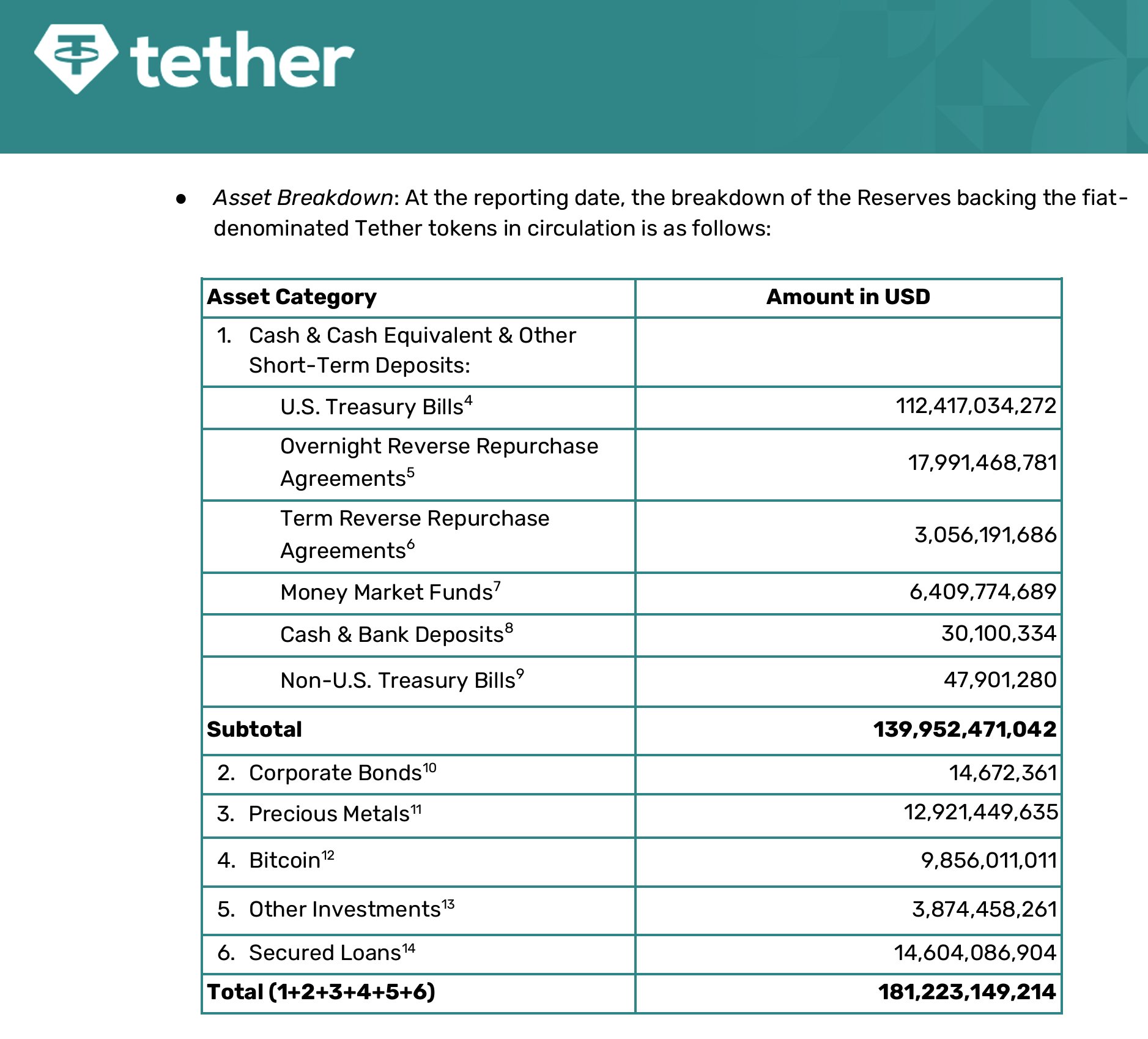
The Tether folks are in the early innings of running a massive interest rate trade. How I read this audit is they think the Fed will cut rates which crushes their interest income. In response, they are buying gold and $BTC that should in theory moon as the price of money falls.
A roughly 30% decline in the gold + $BTC position would wipe out their equity, and then USDT would be in theory insolvent. I'm sure some large holders and exchanges will demand a real-time view of their B/S so they can assess the solvency risk of Tether. Get out your popcorn, I expect the MSM to run wild with this, especially all the editors with TDS who want to shit on Lutnick and Cantor for backing this stablecoin.