

Resident Ophthalmologist | Tech Enthusiast | Adventure Junkie
Toronto, Ontario
Joined July 2021
- Tweets141
- Following278
- Followers289
- Likes413





Pinned Tweet
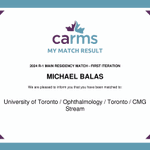
Kicking off my #PGY1 specialization into #Ophthalmology today at #UofT!
Ready to "see" my dreams come into focus and help patients look towards a brighter future.
Grateful for this opportunity and excited for the challenges ahead.
#Toronto #Residency #EyeCanDoIt #eye #surgeon

ALT Dr. Peter Kertes (left) presenting Dr. Michael Balas (right) the Dr. Louis Kagan Memorial Prize and the Dr. Kelly Gollish 5T7 Memorial Award.
We measure IOP sitting up. Patients spend a third of their lives lying down.
Our new #Ophthalmology #Glaucoma meta-analysis found a ~3 mmHg rise in supine IOP among glaucoma-spectrum eyes.
Whether this increases translaminar stress or drives progression remains unknown for now.
doi.org/10.1016/j.ogla.2026.…
An IOP of 16 on iCare isn't necessarily 16 on Goldmann.
Our new meta-analysis of 5,593 eyes found a small average difference between devices, but substantial variability in agreement.
A useful reminder when interpreting IOP in clinic.
doi.org/10.1097/IJG.00000000…
@JOGJournal

First Wnt-pathway biologic to clear noninferiority in DME (+9.1 and +8.7 vs +11.8 letters at year 1), but no secondary endpoint beat ranibizumab and PDR AEs were 6.7%/6.1% vs 0.9%. If it repairs the barrier rather than suppressing neovascularization, it may end up as a combo, not a swap

Today at #AAO2026, we’re presenting data from our Phase 2b/3 trial of an investigational drug in patients with diabetic macular edema (DME).
Learn more: go.merck.com/~4ba

If a cure really works, the mechanism may be irrelevant to the patient. But “really works” is what Tao is interrogating. An AI might learn to satisfy our trials rather than cure the disease. We needn’t understand every mechanism; we do need to trust how efficacy is established.


Michael Balas retweeted

📣 Temerty Centre Speaker Series: Evaluating Clinical #AI in Practice
🗣️ Dr. Tania Tajirian & Marissa Binstock
📆 Oct. 20 (Tue.)
🕘 12pm to 1pm ET
📍 Virtual
🔗 ow.ly/copZ50ZOTkk

With growing concerns around GLP-1 medications and vision loss, could optic nerve anatomy offer some answers?
Proud to share our new 16-centre study in Ophthalmology: crowded discs were common in NAION, regardless of GLP-1 exposure. A cup-to-disc ratio (CDR) ≤0.20 carried 46x greater odds!
authors.elsevier.com/a/1noE3…
Michael Balas retweeted

Ophthopedia Update: Cup-to-disc ratio in GLP-1 RA Associated Non-Arteritic Anterior Ischemic Optic Neuropathy dlvr.it/TTt3Xr #Ophthalmology #ophthotwitter #eyecare

Michael Balas retweeted

Standardized Classification System for Dysphotopsia Reporting
ow.ly/kJzU50ZeeVi
@RSTHuang @michaelbalas @PopovicMM @DrZebardast@irfankherani @mattschlenker
#ophthalmology #glaucoma

Can LLMs reliably assess Risk of Bias in RCTs? Not quite - but they may still deserve a seat at the table.
Our new @PLOSONE study found that ChatGPT was more conservative than human reviewers, supporting its use as an adjunct rather than a replacement
doi.org/10.1371/journal.pone…
New in CJO - meta-analysis of RCTs (n=9,718) examining intravitreal anti-VEGF and respiratory adverse events.
No increased risk of COPD vs sham. Differences in lower respiratory events were observed across agents, largely driven by bronchitis, with substantial heterogeneity in adverse event reporting.
Findings highlight the need for standardized safety reporting in future trials.
sciencedirect.com/science/ar…
#Ophthalmology #Retina #MedTwitter #EvidenceBasedMedicine
Comprehensive review of trabecular meshwork–based MIGS highlights consistent IOP reduction, favorable safety profiles, and expanding surgical options for glaucoma management, while underscoring the need for long-term comparative outcomes.
@JCM_MDPI
mdpi.com/2077-0383/15/4/1490

We tested 4 LLMs on retinal management across 14,400 simulated patients and found treatment recommendations shifted with demographic changes.
These models can be useful, but they need to be evaluated beyond average accuracy before they’re ready for deployment
Published in @ajo_int
doi.org/10.1016/j.ajoint.202…
Michael Balas retweeted

#mdpijcm
#Editor’s Choice Article🔥 Citations 7
Periocular Aging Across Populations and Esthetic Considerations: A Narrative Review
📌mdpi.com/2077-0383/14/2/535
@JCM_MDPI
#oculoplasticsurgery #oculofacialsurgery
New in AJO International: we mapped what patients actually ask Google about ocular cancers (uveal melanoma, retinoblastoma, ocular surface tumours). Commercial pages dominate; government sites are most transparent… and still too hard to read.
doi.org/10.1016/j.ajoint.202…
@ajo_int
Ectropion can be stubborn. We reviewed the standard toolkit - and added a practical adjunct: superotemporal skin transposition (STS) for tarsal/recurrent ectropion. Quick add-on, strong vector, nice early outcomes.
mdpi.com/2077-0383/14/3/827
@JCM_MDPI
#Oculoplastics #EyeSurgery
@brendantao @EdselIng