





브라더 retweeted

The First Green Star Ever Found: A Dead Sun That Ate Its Planets and Now Glows Chartreuse
For decades astronomers had a confident rule: green stars don’t exist. Even when a star’s light peaks in the green part of the spectrum, the surrounding red and blue wavelengths usually wash it out into white or pale yellow. The human eye simply refuses to see a pure green star. Then the white dwarf WD J1330+6435 broke the rule.
Located about 280 light-years away in the constellation Draco, this object is no longer a living star. It is the dense, cooling core left behind after a Sun-like star died — roughly the mass of the Sun packed into a body the size of Earth. Such remnants are extremely faint, so no one will ever see its color with the naked eye. Astronomers have to trust spectra and models of human vision. Those models are unambiguous: if you could get close enough, the star would appear a pale yellowish-green — a ghostly chartreuse.
How a Dead Star Turned Green
The culprit is sodium. At some point WD J1330+6435 swallowed rocky debris from its own planetary system — pieces of planets or asteroids that wandered too close and were torn apart. The material polluted the star’s atmosphere with sodium, calcium, and lithium.
Under normal conditions sodium absorbs only a narrow slice of orange light (the same orange that makes sodium street lamps glow). In the ultra-dense helium atmosphere of a white dwarf, however, sodium atoms are constantly battered by helium atoms. This broadens the absorption dramatically: sodium removes a wide band of yellow, orange, and some red wavelengths. Calcium additionally blocks violet light. The remaining light peaks around 500 nanometers — the blue-green region — producing that pale chartreuse glow.
It is the cosmic equivalent of tossing copper wire or copper chloride into a campfire: the flame instantly turns green. Here the “fire” is a dead star, and the “copper” is the wreckage of its own planets.
A Whole Rainbow of White Dwarfs
Researchers at the University of Warwick examined 151 white dwarfs within about 65 light-years of Earth. Roughly one in thirty turned out not to be white at all. Some would look pink or salmon-colored (thanks to carbon dredged up from their interiors), others yellow, cyan, or purple. WD J1330+6435 is the first that vision models clearly paint green. Its surface temperature is only about 4,000 °C — cool for a star.
The color itself is less important than what it reveals. A polluted white dwarf acts like a perfect laboratory. It shreds and mixes the material of destroyed planets, then displays a clean spectrum. From the metal lines astronomers can reconstruct the chemistry of those lost worlds — essentially doing forensic science on planetary systems that no longer exist.
We will never see this green star with our own eyes; it is far too faint. But the spectra are reliable, and upcoming surveys should find more color anomalies. The universe has once again proved stranger than science fiction: even after death, a star can keep a very unusual “makeup” made from the remains of its own planets.
Sources: University of Warwick, CNN, Reuters, and the original 3DNews report.

브라더 retweeted

Every second breath you draw comes from the ocean.
While forests are frequently hailed as the “lungs of the Earth,” they are not the main source of our planet’s oxygen. That distinction belongs to the ocean—specifically to the countless trillions of microscopic marine organisms drifting in its sunlit upper layers.
Phytoplankton, along with cyanobacteria and other tiny algae, perform photosynthesis just like land plants: they harness sunlight to turn carbon dioxide and water into energy, releasing oxygen as a byproduct.
Though individually invisible to the naked eye, these organisms are extraordinarily productive. Together, they generate an estimated 50–80% of the oxygen present in Earth’s atmosphere.
This massive oxygen factory operates across the world’s oceans, largely out of sight. From space, satellite imagery reveals their seasonal blooms as swirling, paint-like patches of color—vivid evidence of the hidden engine that keeps our air breathable. These blooms respond sensitively to shifts in sea temperature, sunlight, nutrient availability, and ocean currents; scientists continue to study how climate change and other pressures may reshape these patterns in the coming decades.
This does not lessen the vital importance of forests. Trees lock away carbon, support immense biodiversity, regulate local climates, and provide countless other benefits. But when it comes to producing the oxygen we breathe, the ocean—not the rainforest—is the dominant contributor.

브라더 retweeted

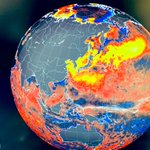
OCEAN SHIFT 🌊: NASA satellites are capturing a striking change in the Pacific Ocean as a powerful El Niño develops, with once-green waters turning bluer. The reason? Phytoplankton are declining as nutrient-rich waters become harder to reach, offering scientists a fascinating look on how a Super El Niño impacts the ocean’s color.
#ocean #nasa #color #ElNiño


브라더 retweeted

This might be the pinnacle moment of the strongest El Niño in history.
Pacific Super Typhoon Champi is unbelievable by every metric. A buoy just measured a ~909 MBAR pressure at the edge of her 40+ mile-wide eye, which has now reached a blistering dryness of -10.94 C. Her eyewall is a 180+ MPH (290+ kph) buzzsaw of cyclonic violence, and her CDO is a perfect Saturnian ring of icy, -110 F (-80 C) convective thunderstorms.
And she is still. Getting. Stronger.
브라더 retweeted

나도 이번에 한국에 PHP 서버가 이리 많은지 처음 알았다. 공공기관에서 하두 자바 프레임워크 이야기를 한지라..
"문제는 옛 버전이다. PHP 개발진은 지난 21일 8.2~8.5 버전용 보안 업데이트를 내놨지만 지원 기간이 끝난 8.1 이하 버전에는 업데이트를 내지 않는다."
[단독]'해킹 구멍' PHP…국내 서버 10대 중 9대, '업데이트 불가' share.google/280pdXcetHm7QNp…


브라더 retweeted
🚨 STRONGEST STORM ON THE PLANET: Satellite views of Super Typhoon Champi continue to impress as the storm churns in the Pacific. The category 5-equivalent storm peaked in strength with maximum sustained winds of 185 mph, tying Super Typhoon Sinlaku as the strongest storm on Earth in 2026 by wind speed.
브라더 retweeted
CO pollutants from the widespread wildfires in Indonesia are being pulled into the circulation of Typhoon Champi.


브라더 retweeted

.@Hearts2Hearts “ICONIC HEART (Korean Ver.)” MV (Hakyuhya Ver).
So cutee😍˚ ♡
브라더 retweeted

Astronomers say they've discovered the first star that would appear green to human eyes.
The presence of calcium, sodium, and lithium in the star's composition is the source of its unusual color, astrophysicist Mark Hollands says.
(cnn.com/2026/10/16/science/g…)

브라더 retweeted

Where is the color white?
Readers added context they thought people might want to know
The video magnifies RGB subpixels on a digital screen. White is perceived from their additive mixing at full intensity.
en.wikipedia.org/wiki/Additive_…
en.wikipedia.org/wiki/Color_mix…
commons.wikimedia.org/wiki/File:Cell…


