

Serial risk-taker, hands-on operator, free thinker. 18 years a founder, now in AI. Back to pro football at 33.
Norway
Joined December 2009
- Tweets387
- Following289
- Followers134
- Likes38




Pinned Tweet
Last time I posted here, this was still called Twitter. 14 years later, the full story, from the top:
2002 -- checked out of school, immersed in computer games
2004 -- decided to build my own game with no idea how
2005 -- almost raised $400K to do it
2008 -- barely finished school, decided to quit football, lost myself.
2009 -- joined college, sold my first game for $2,000, dropped out of college.
2010 -- sold my game company for $250K; i'm top of the world!
2011 -- launched new co, lost all my money.
2012 -- launched new co, it works!
2014 -- sold my co for 7 figures, i'm top of the world!
2015 -- launched new co, it works!
2017 -- merged with one of the biggest player in the market
2019 -- IPO, although i'm in the most miserable place I've ever been.
2020 -- launched new co, but lost myself
2021 -- health issues, questioning life choices, launched another new co
2023 -- IPO, on the way to remission, launched my own charity
2024 -- one of the co's failed, decided to play football again
2025 -- another co is growing! moved to Cyprus, joined 5th Div team.
2026 (so far) -- moved to Norway, joined 2nd Div team, launched new co.
What we can learn from it:
• S̶u̶c̶c̶e̶s̶s̶ t̶a̶k̶e̶s̶ t̶i̶m̶e̶
• I̶t̶ i̶s̶ a̶l̶w̶a̶y̶s̶ d̶a̶r̶k̶e̶s̶t̶ b̶e̶f̶o̶r̶e̶ t̶h̶e̶ d̶a̶w̶n̶
• It doesn't matter if you feel good or bad, just go and start a new co 🙂
Because there was never a better time than now, really
The best thing that ever happened to my football career started with somebody not showing up for training.
I was a midfielder back then and perfectly happy there, and then one day our keeper did not turn up, the coach told me to go and stand in the goal, and i caught the first ball that came at me. I still remember that feeling, i could help the team with something completely different from what i thought i was good at, and nobody had asked me whether i wanted to.
That is how most things in my life happened afterwards. I never planned the companies either, adtech and big data and gaming were never a strategy drawn on a whiteboard, somebody put a thing in front of me and i said yes and threw myself at it hard enough to find out whether it clicked, and most of the time it did not click at all, and sometimes it did and quietly became the next ten years.
We are taught to find our path first and commit to it afterwards, and my own experience keeps saying the opposite, that you commit to whatever is in front of you and the path shows up later, hiding inside the thing that refused to let you go.
Was your real path a plan, or an accident you took seriously?


Time stops being your advantage the moment you can afford to buy it, and after that the only thing left to compete on is what goes into your head.
When you are young you outwork everyone and that is the whole playbook, then you get money and a team and hours become something you simply purchase, so the quality of your decisions is what separates you now, and decisions are made out of whatever you have been reading.
Which is why seven of my ten working hours are still reading, and the trick i use for it i noticed back when the Facebook feed had only just started learning, long before everybody began complaining about it. I liked everything about entrepreneurship for two weeks, the feed rebuilt itself around that, and i understood the machine works both ways, it can eat your attention or it can be pointed somewhere.
So now, every time i enter a new field, i open the feeds, type the keywords and like everything on the subject for a few days, and a week later every second reel is about the thing i need. Last month it was bread, sourdough starters, how bacteria produce enzymes, and my Instagram turned into a bakery in about seven days.
One rule though, because if a topic genuinely interests you then you want every point of view on it, not the one the feed decided you like, so i always balance the two sides on purpose and keep liking the control posts from the other camp. In medicine my feed is split exactly in half, people who trash peptides and people who say peptides are everything, and what i actually read there is the mechanism, how the thing works, not whose opinion sounds louder. I have fallen into that one-sided trap before, so i know you cannot go there.
The same feed everybody blames for eating their attention is the cheapest research assistant you will ever get, imo, as long as you decided what goes into it and not the other way round.
Is your feed something you built, or something that happened to you?
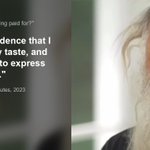
There is one interview with Rick Rubin, the 60 Minutes one, where he gets asked whether he plays instruments, barely, and whether he knows how to work a soundboard, no, no technical ability at all. So what is he being paid for then? His answer was that the confidence he has in his taste and his ability to express what he feels has proven helpful for artists. And this is the guy behind Red Hot Chili Peppers and Linkin Park.
With AI it is the same story, imo, because the tooling and the prompt library and the speed at which you ship are buyable within a week by anybody now, and the only real lever left is your confidence in your own broad, developed judgment, in your taste.
Where did your own taste come from, and would you be able to teach it to somebody?

imo half of "I embraced AI" is just autocomplete with swagger. shift begins where you stop approving every line.

The longer you postpone learning a new technology, the more complicated it looks to you, which is exactly backwards, because most technologies get simpler over time while your fear of them keeps growing.
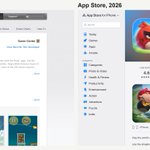
I keep watching people around me hit this wall with AI, and it reminds me of the App Store around 2011, which was much harder than it is today, because you could not buy traffic inside the store, you could not test two versions of your page against each other, and analytics meant bolting on somebody else's SDK and hoping for the best, so you shipped an app and it either flew or it did not while you had almost no control over which of those happened. Apple only opened search ads in 2016 and only let you run a real A B test on your product page in 2021, so the founders who arrived later actually had the easier ride, not the harder one.
That is roughly where AI sits right now, because people can see there is something sweet in there and the tooling has already appeared, and yet they keep standing in the doorway thinking, well, now i have to sit down and press buttons and figure things out, and honestly that thought is the only real barrier left.
What i take from this is that adoption will be slower than the tooling suggests, because the barrier was never technical and people do not change how they work on a schedule. Which also means service companies are not going away here, somebody has to sit in that chair and press the buttons for those who will not do it themselves, and that job is going to exist for years.
What did you postpone this year that turned out to be easier than you expected?

Everyone keeps saying the hard part of AI adoption is the technology, and i spent a couple of thousand dollars on an experiment to check whether that is true.
A founder i have known for years runs the accounting firm, and he came to me wanting an AI transformation and asked me to recommend an AI engineer, so i told him there is a tool where you write what you need and it does the rest, and he answered that they need somebody who will do the writing, because they do not understand any of this themselves. Fine, i thought, if you will not type into the machine yourself then we will do it the other way around.
I hired a junior analyst for a couple of thousand dollars and told him he is the one pressing the buttons now, and i made the setup as unfavourable as i could on purpose, because i wanted to see where the thing breaks, so he had a very shallow idea of what AI even is.
About a month later he shipped them a product they are testing right now, and nobody in that whole chain had to become technical.
What this experiment actually says is that the problem with AI right now is not in the tools at all, it is the mental impossibility, for most people, of spending the time to work it out even a little, and that impossibility grows out of two things, a big fear first, and the idea that it is terribly complicated second. There is a gap hiding underneath that, because the longer you postpone sitting down with a new technology, the more complicated it feels, you assume the distance keeps growing while you wait, when in reality most technologies only get simpler with time, since founders keep turning the raw thing into something user-friendly. So the tools were never the expensive part, the fear was, and it costs far more than any tool ever will.
So what do you think happens first, mass adoption finally picking up speed, or service companies living long and happily on everybody who will not press the buttons themselves?
A journalist asked me last week why people are so disillusioned with corporate careers, and she clearly expected me to blame AI for taking the jobs, while the honest answer starts decades earlier. The deal made complete sense in the sixties, when the world moved slowly, so you stayed loyal, you worked long, you brought value, and in return you got a decent pay-off and a pension and a union that protected you and the reasonable certainty that nobody fires you out of nowhere.
The problem is that this whole period turned out to be an anomaly, because predictability never really existed before it and it does not exist after it, two years ago most of what is happening in the world right now was not there at all.
Joining one of the big AI labs today is a semi-entrepreneurial move rather than a corporate one, because you take real risk in exchange for real upside, and everything sitting in the middle stopped making any sense, since the middle pays you an average salary and offers predictability in return while having none of it left to give.
The outliers who took the risk and won are also the ones accelerating the whole economy, that unpredictability pushes inflation and money printing, and the printed money lands disproportionately with those same outliers, so life keeps getting more expensive for the people who stayed in the middle while their income sits exactly where it was.
So the next time somebody turns down your offer because they need something stable, it is worth working out together what their current job actually still guarantees them.
Predictability was always the anomaly.
It did not exist before the sixties and it does not exist now, and the corporate deal was always that anomaly sold back to you for money.
An AI lab looks corporate from the outside, but you are paid in a bet there, real risk for real upside, while an ordinary job still charges you a premium for safety it ran out of.

interesting, at what percent the word leads stops meaning "the person approves" and starts meaning "the person finds out post factum"

Claude is now helping build its own successor!
Anthropic says Claude already leads 26% of its model R&D, up from just 1% in March, and participates in more than 90% of its research work. Around 30,000 AI agents are simultaneously active on its internal platform.
It isn't fully autonomous yet, but the feedback loop has clearly begun.
This is how recursive self-improvement starts.
the gatekeeper here is not new, just before the publisher rejected the manuscript once a year, and the algorithm rejects your post every day, and this daily dose of rejection hooks faster than any publisher.

Seat-based pricing was never fair to anybody, and agents doing the actual work are about to make that impossible to keep hiding.
Take any product tool with two users sitting inside it, a product manager who gets a hundred percent of the value out of it and a developer who gets maybe twenty, and you bill both of them exactly the same. That gap is where the margin of classic SaaS actually comes from, it has been quietly financing this industry for years, and everybody in it knows this.
Some verticals started moving to usage-based pricing back in 2018 and 2019, slowly and without much noise, and AI made that shift far faster, so the conversation has already moved past usage and landed on outcomes. HR tech is the clearest pioneer here, where you pay neither per seat nor per resume processed but for a hired person, and that number is defensible in a way that seats never were.
IMO, this will spread across the whole industry, and not because founders suddenly became principled, but because the gap becomes impossible to defend the moment your competitor starts charging for the result.
Companies used to billing per seat will suffer first, which will push them to deliver more value and charge more for it, and that is good for everybody, while the ones who cannot work out where their value actually sits will die, since billing for seats and billing for value are two completely different disciplines.
If you run a SaaS, could you charge for the outcome tomorrow, and if not, what does that tell you about the product?
We spent a full week trying to get our own texts past the AI detectors, and by the end of it i was fairly certain the entire category is theatre.
It began as a routine check and turned into a small obsession, because the numbers made no sense from the first day. A text written by a person from scratch, no machine involved at any point, came back as fully generated, while something thrown together in five minutes sailed through as human. We changed the rhythm, we broke up the sentences, we left mistakes in on purpose, and the score kept jumping around like a coin toss, so at some point i stopped trying to pass the test and went to look at what the test actually measures.
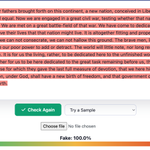
Somebody ran the Gettysburg Address through one of these tools and got 97% machine written, and the same detectors happily flag the US Constitution and parts of the Bible, which stops being funny once you understand why it happens. A language model predicts the next token and it learned to do exactly that from human writing, so what you are trying to catch is a machine imitating the statistics of people, and the closer your own writing sits to clean correct English, the more artificial it looks to the detector. Lincoln writes too well, so Lincoln gets marked as a robot.
The labs promised to solve this from the other end, one of them announced watermarking everything their model produces, and people had already worked out how to strip those marks with anchors before the announcement finished circulating.
What is left is a filter that punishes good writing and misses actual generation, and companies are making hiring and grading decisions on the number it spits out, which is the part that bothers me, because detectors detect an algorithm and people do not read with an algorithm.
Google settled this same argument years ago for search, where they stopped caring who wrote the text and started caring whether it was worth your time, and we will land in exactly the same place, though the probability that we waste another two years on detector theatre before we get there is not small, imo.
If you are still checking texts with these tools, what do you actually do with the number?

People keep telling me they feel insane about the pace of AI releases, and i think the releases have very little to do with it.
I noticed the same pattern in conversation after conversation over the last months, and it works like a Chinese room, because until you understand the mechanism underneath, every update looks like one more thing you failed to catch up with, when most of them are technical patches that change nothing about how you actually work.
The place where people stop is always the same, because they ask a model to design something, the result is mediocre, they read a bit, they find a skill or a prompt pack, the output gets better and that is exactly where they park. They never take the next few steps to understand why token prediction cannot design well on its own and what you have to hand it instead, so they keep collecting skills and second brains and prompt libraries, and every new one raises the anxiety instead of lowering it, because a collection like that quietly becomes a substitute for understanding.
That is the point where the noise starts feeling like the whole vector is running away from you and you have no grip on any of it, and the grip never comes from more tools, it comes from understanding the mechanism once, which takes days rather than years.
If this sounds like your last three months, what stopped you from going deeper?