

- Full stack Developer - Not Perfect but Honest. https://xitter.cf/t.co/8uRfDcgOiy
Joined January 2024
- Tweets1.5K
- Following405
- Followers637
- Likes2.7K






Pinned Tweet
🚀 Just shipped the upgraded version of my Movie Ticket Booking App 🎬
🔗Live - stellar.mehtabhussain.tech/
This isn’t the same project I built earlier. I went back, rebuilt major parts, and pushed it closer to a real-world application.
✨ What I upgraded:
• Robust authentication & authorization
• Multiple movies instead of a single movie
• Real seat selection & booking
• Better API/error handling
• Improved backend architecture
• Deployed & fully working
Users can browse movies, select available seats, and book their tickets through the app.
#BuildInPublic @Hiteshdotcom @ChaiCodeHQ


Around April, I participated in a hackathon where we were asked to build a BookMyShow-style application.
At the time, I only managed to build the backend—and honestly, it wasn't in a state I was happy with.
Now, I picked the project back up and rebuilt it
Introducing Stellar IMAX 🎬
A BookMyShow-inspired seat booking application with:
• JWT Authentication (Access + Refresh Tokens)
• HTTP-only Cookie Authentication
• Automatic Access Token Refresh
• PostgreSQL Transactions
• Row-level locking to prevent double booking
• Clean API & Error Handling
It was a great opportunity to learn about authentication, transactions, and handling concurrent requests.
🌐 Live Demo: [steller-max-book-my-ticket.o…]
📂 GitHub: [github.com/Mehtab-786/stelle…]
#NodeJS #ExpressJS #BuildInPublic @ChaiCodeHQ @nirudhuuu @Hiteshdotcom @janardhan_v_

Mehtab retweeted

Today we are in a security nightmare:
- Railway may have exposed customer environment variables and API keys
- SBI confirmed that customer records ended up on the dark web
- eMudhra's certificate keys were extremely weak (one was literally just the number 4)
- LiteLLM shipped a compromised version that steals credentials and includes a backdoor
- PHP released two critical remote code execution vulnerabilities (PHP2Shell)
- Node.js issued urgent security patches for a Brotli decoder remote code execution flaw, plus TLS and DNS issues and blocked the compromised eMudhra certificates
- Rajasthan gov systems were allegedly linked to the exposure of a large set of identity records
- OpenCode confirmed a breach that exposed AI provider API keys (OpenAI, Anthropic, Google) for a portion of Console users
- Plex Media Server vulnerabilities (Plex2Shell) are being actively exploited in the wild to install malware on unpatched servers
- GitLab fixed a critical CVSS 10.0 unauthenticated remote code execution flaw in its CI/CD regex compiler
These bugs and vulnerabilities are coming out of nowhere like they were hidden gems lost somewhere 🥲

12-Year-Old GitLab Vulnerability Allows Remote Code Execution on Self-Managed Server
Details: cybersecuritynews.com/12-yea…
GitLab has released urgent security updates for a critical vulnerability that could let attackers run code on self-managed servers without logging in. Tracked as CVE-2026-110264, the flaw carries the maximum CVSS score of 10.0 and affects both GitLab Community Edition and Enterprise Edition.
The company published the fixes on October 21, 2026. The affected code reaches back to GitLab 7.0, released in 2014, giving the vulnerability a roughly 12-year history. That does not mean attackers have been using it for 12 years. GitLab’s advisory describes the risk but does not report confirmed attacks or provide a public exploit.
#cybersecuritynews


Art of wasting time :
I somehow wanted antigravity IDE alone not new agent based app, so i install the version 1 for linux, then I saw i downloaded the ancient version 😮💨 where nothing is working again deleted it then got the v2 IDE finally .
Mehtab retweeted

“if you’re not making ₹1L/month, living in India, at 21, sorry, you’re not good enough.”
this is the kind of tweet i see on X very often.
six months ago, i was making ₹7K/month through freelancing. my realistic goal back then was to reach ₹50K/month by the end of my final year.
now, go back three years. i was packing my bags with my dad and taking a sleeper train to college as a fresher.
i come from a lower middle-class family, and i remember my dad saying that even a ₹4 LPA package, roughly ₹30K/month, would be a big achievement for us.
today, my goals are very different. but that doesn’t make those goals any less meaningful.
someone might be chasing their first ₹20K/month internship.
someone else might spend their 20s studying to become a scientist.
both can be huge wins.
so don’t look at tweets like these and feel insecure about your own life.
your timeline doesn’t have to look like anyone else’s.
just focus on becoming a little better every day. you’ll be surprised how far that takes you.

Okay guys, I'm officially in linux environment .
Starting with ubuntu, planning to explore arch, mint, fedora in upcoming months


Guys try these, If you want an title-less essay😅
looks like "Super Intelligence" is here

1.) Go to America.gov
2.) type “hello”
3.) type “play Minecraft”
4.) watch the agent’s reality implode
5.) ????
6.) PROFIT!


Mehtab retweeted

Attended the 2nd #ChaiCode Wednesday Webinar, led by @surajtwt_ sir.
Learnt about:
✅ Harness
✅ LangChain
✅ LangGraph
✅ StateGraph
✅ Built a CLI Chat Agent with LangChain
...and much more!
Enroll for next session (they're free) 👇
inapp.app/chaicodesocials/cl…

TCP — the backbone of reliable internet communication.
Layer 4 (Transport Layer) protocol, just like UDP.
Uses port numbers to identify application running on host machine, such as a React app, Express/Node.js server, or PostgreSQL database.
It's a connection-oriented, which means it establishes connection before sending data. ( 3 way handshake )
TCP is also stateful, because hosts maintain information about the connection, such as sequence numbers, status, etc
To gracefully close a connection, TCP uses FIN and ACK messages
TCP divides the data stream into smaller chunks called TCP segments. These segments contain sequence number so that the receiver can put the data back into the correct order.
TCP provides reliable and ordered delivery. If a segment is lost, TCP can detect the loss and retransmit the missing packet.
The trade-off is higher overhead compared with UDP. TCP has to maintain connection state, sequence numbers, acknowledgements, retransmissions, etc which requires additional processing and network resources.
Some common use cases include :-
1. Database Connection ( MySQL, PostgreSQL )
2. Web APIs( HTTPs / REST )
3. Email ( FTP, IMAP )
4. SSH


For the first time, I made a video explaining fetch. And I wanted to share my experrience
Man it was not easy 40+ retakes , cuts etc. and let me tell you it was just 2.5 minutes in length
So, what I learned is making video is not easy && when you're making video of something , you really understand these topics first really well
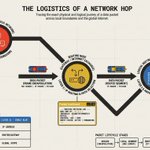
What Really Happens When You Make an HTTP Request ?
You know as a developer, many of us write the fetch request and we just wait for the response. But there's a lot going behind the scenes .
Let's say we have a Client (React Frontend) with IP 127.0.0.1 on port 3000 (assume public) and server (Node backend) in AWS EC2 with IP 10.0.0.1 on port 443 hosted on api.example.com
Machine doesn't understand human readable text, they understand binary, DNS resolves the domain name into IP .
You see browsers are really powerful software but they don't or they can't send the request we need OS for that purpose .
Okay, so browsers final job is to convert text request into bytes and hands over to OS which have TCP/IP stacks which is set of connection for OS's every OS have different ones.
HTTP relies on TCP because it's reliable, hence TCP connection is formed (you know the 3-way handshake thing). Then this stream of bytes are sliced into smaller chunks (called segments) by TCP layer inside OS, because can't rely of sending one large data.
Each TCP segment contains a TCP header (with source port, destination port, sequence number, etc.) and the payload. This TCP Segment is wrapped in a IP Packet. IPs are the virtual addresses. MAC (Media access control address) is like a specific desk inside a building .Sequence number to keep the data in order.
ARP (Address Resolution address), see your laptop doesn't know router's MAC address, it uses ARP, It throws request to every device in local network. Then only the device with requested IP replies with it's MAC address. The IP Packet is again wrapped with MAC source & destination address .
Then this bits is converted to physical signals. Now it's all set for the ride through radio signals, electric signals etc.
The incredible part? The journey is only 25% complete.
The signals have only just left the building.
We will talk about the return trip of the response next time, I'm pretty sure that the same path will be followed.
@ChaiCodeHQ @Hiteshdotcom #networking_series


Got a new perspective
Maintaining streaks is not real learning sometimes, it includes ups & downs
I mean wow, it's just an illusion for us , for companies it's good
@Hiteshdotcom @ChaiCodeHQ

Gamification gives you illusion of learning, it’s doesn’t measure your true outcome.
These are new research papers out in domain. Gamification gives impact to companies, not much useful for students.
Mostly research is around 1 language learning app but this video will give you a different perspective towards learning.
Video is up on Chaicode YT channel.

