

Jaded. Let me know when one of you figures out how the human body works.
Armchair
Joined May 2021
- Tweets2K
- Following87
- Followers3.8K
- Likes1K





Have seen this a couple of times recently:
If you are reporting the results of a kinase panel in a paper, please make sure to include not only the concentration of compound used, but also the concentrations of ATP used in said panel.
@KRHornberger has several useful past posts on the relevant kinetics here, if helpful.
Wonderful little paper here with many useful warnings inside:
pubs.acs.org/doi/10.1021/acs…
Practical notes:
-Do fresh resynthesis (orthogonal route a +)
-Test potentially interfering salts+compounds in assay
-Lots of things bind and give Xray structures at mM
More warnings below...

I've previously collected similar articles with useful warnings and tips about methods such as scavenger reagents.
See them by following the linked threaded tweets
xitter.cf/med_chemist/status/151…

Glad there is room for papers like this to be published. pubs.acs.org/doi/10.1021/acs…
I hope there will be some follow up on the original ACS Med. Chem. Lett. paper on the supposed probe.
Some other references on metal impurities linked below, if useful.

I'm extremely pleased people are working on novel antibiotics.
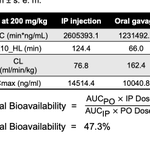
But it still makes me a bit sad that this is the PK characterization of the key compound in the world's purported premier science journal:


What if there was an antibiotic that doesn't disrupt the gut microbiome?
There is now.
A discovery published @Nature today
nature.com/articles/s41586-0… @PaulHergie and colleagues @UofIllinois @justsaysinmice

On the other hand, the efficacy data for antibiotics does mitigate the risk of mischaracterization a bit. Paws up / paws down is a pretty clear endpoint!
xitter.cf/med_chemist/status/154…
After good data: "May I die if I were to change places with the Persian king!"
After bad data: "You know, maybe leaving behind chemistry in exchange for my own kingdom would be a sensible choice if given the option."


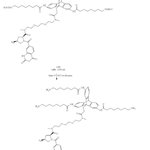
Forgot to provide the answer: US20220402883 - COMPOUNDS AND METHODS FOR MODULATING RNA FUNCTION
@dragon38073853: we miss you posting fun patent structures...
Can you all guess the target of these compounds?

Just a reminder to any of you mixing drinks tonight: grapefruit juice is good for masking the taste of alcohol, but beware of juice-drug interactions!

Estimated total $$$ spent making compounds based on misanalyzed SAR — chasing noise rather than true signal…
A Fermi estimate to absolutely no significant figures: WAY TOO MUCH

Good thread and responses.
And before initiating a study always ask:
"how will the med chem/discovery strategy change based on the results of this?"
Amazing how often people want to spend time+$$$ on studies that will not change anything besides satisfying intellectual curiosity
The Nobel Prize in Chemistry is awarded for the naming of "fancy-name."
Though no practical use cases have yet been discovered, the creation of "fancy-name" has led to hundreds of papers and reviews noting the promising potential applications of "fancy-name."
I pose the following solution:
- Make med chem (somewhat relevant to physicians) a required course for pre-medical students
- Make organic a prerequisite for med chem
- Organic chem courses are now highly relevant
Now all the students get to be even more angry at chemistry!
Now quite annoyed I didn't get at least 10 J. Med. Chem. papers from the last time I was working on a diastereomeric series:
doi.org/10.1021/acs.jmedchem…

5 easy steps to become a modern grumpy med chemist:
- Have a HTS return no useful hits
- Have a virtual screen return no useful hits
- Have a fragment screen return no useful hits
- Have a DEL screen return no useful hits
- Have a literature compound fail to reproduce
This Post is from an account that no longer exists. Learn more
Perhaps a certain journal and its editors could lead the way in changing this culture, to a world where particularly useful negative results are seen as essential to the main body of the paper. Hint. Hint. Wink. Wink.

As an author, it is hard to put lots of negative examples into a paper because of fear reviewers will not be positive. But what about putting tables of unsuccessful substrates in the SI? #OLAskTheEditor
Fun, COVID related fact:
When Kariko and Weissman first went to publish their paper showing the uridine -> pseudouridine switch suppressed the immunogenicity of mRNA. It was instantly rejected by Nature, Science, and Cell as "Incremental"
Kariko even had to look up the word!

This Post is from an account that no longer exists. Learn more
Sources:
doi.org/10.1016/j.cell.2021.…
doi.org/10.1073/pnas.2119757…
Their 2005 paper in Immunity is doi.org/10.1016/j.immuni.200…
