

Business architect and data geek with a passion for empowering life sciences companies to do more.
Philadelphia
Joined August 2009
- Tweets2.1K
- Following1K
- Followers643
- Likes561
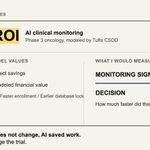



82x ROI from an AI clinical monitoring agent surprised me.
I would not measure it by hours saved. I would measure the time from a monitoring signal to a decision.
If that time does not change, AI saved work. It did not change the trial.
fiercebiotech.com/cro/ai-cli…

ALT Plain note-style graphic contrasting an 82x modeled ROI for AI clinical monitoring with the implementation measure Chris would use. The Tufts model estimates up to $5.6 million in direct savings and $21 million in modeled financial value from fewer site visits, faster enrollment, and earlier database lock. Chris's measure is the time from a monitoring signal to a decision. The graphic concludes: if that time does not change, AI saved work; it did not change the trial.
HHS Just Named the Clinical Trial Speed Problem linkedin.com/pulse/hhs-just-…


The FDA RFI window did not close on May 29.
It moved to June 29.
That extension is not administrative housekeeping. It is a diagnostic.
The extra month separates two kinds of organizations.
The ones that needed more time to write a substantive position.
And the ones that needed more time to realize they did not have one.
Anthropic buying a biotech AI startup is not just a discovery story.
It is a throughput story.
If model companies make biology move faster, the pressure moves downstream: protocol design, site activation, data quality.
Discovery got faster. Execution has to catch up.
A third of the procedures in your Phase III protocol don't support an endpoint.
That number is from Tufts and TransCelerate. It's not an execution problem.
Operations didn't write the protocol. They got handed it and asked why enrollment is slow.
You can't fix in execution what was overbuilt in design.
Check out my latest article: Three Questions the Agentic AI Wave Hasn't Answered Yet linkedin.com/pulse/three-que… via @LinkedIn

The UI was never the moat in clinical development.
The moat was the operating logic nobody documented well enough to move.
That is the part headless software conversations keep missing.
Open the APIs. Let agents read the data. Let them write back to the source of truth. Take humans out of the swivel-chair work.
But clinical development is not sticky because people love clicking through EDC, CTMS, eTMF, IRT, and safety systems. It is sticky because those systems have become containers for process and institutional memory.
And most of that memory is not actually in the system.
It lives in the study team member who knows which exception will become a finding. It lives in the data manager who knows the reconciliation rule the SOP does not quite explain.
That is what agents need before they can safely act. Not just access — context, boundaries, and the judgment to know when the happy path has ended.
That is not an IT cleanup exercise. It is operating model work. It is the work of writing down what your best people actually know and what your process actually does, not what the SOP says it does.
If your process knowledge lives in tribal memory and workaround culture, an agent will not modernize it. It will expose how much of the current operating model depends on humans quietly preventing the system from failing.
Maybe that is the useful part.
Agentic workflows force a level of honesty clinical organizations have avoided for years. They make you ask what the system actually knows, what only your best people know, and what nobody has been willing to write down.
Because writing it down would reveal how fragile the process is.
The next generation of clinical systems will not win because they hide the UI better. They will win because they make the operating logic visible enough that humans and agents can share the work without breaking it.



The AI governance conversation in life sciences right now: frameworks, guardrails, human-in-the-loop, audit trails.
Number of published case studies where one of these frameworks was actually tested by an inspector or a failure: zero.
The only stress test we have is the Purolea warning letter — and that's an example of what happens with no governance at all.
We're somewhere between "nothing" and "works under pressure" and calling it progress. It's documentation pretending to be governance.
CRA AI agents: "8 hours saved per CRA per week."
Two possible futures: Fewer sites per CRA → better monitoring More sites per CRA → cheaper monitoring
Every vendor promises the first. Every CFO sees the second. The CRA doesn't get to choose.
We've seen this movie before. EDC was supposed to free data managers for deeper review. It freed their headcount lines.
Check out my latest article: If You Want Better Clinical AI, Start With Better Data Architecture linkedin.com/pulse/you-want-… via @LinkedIn

We keep calling protocol amendments an operational problem. They're a design problem.
76% of trials require them. The amendment is the receipt for the protocol design meeting where nobody had the authority — or the incentive — to say no.
Chris McSpiritt retweeted

🚨 GIVEAWAY ALERT
We're giving away 2x ErgoChair Pro - Autonomous' most popular ergonomic chair
Easy entry:
1. Follow @workspacesxyz + @autonomous_labs
2. Like & RT
3. Tag 2 friends you'd love to share this with
4. Subscribe workspaces.xyz/giveaway
Ends Apr 15 - good luck!

Check out my latest article: Why Im Optimistic About the Future of Study Design linkedin.com/pulse/why-im-op… via @LinkedIn

You've spent millions on AI. Very little of it is reaching clinical operations. Not because the technology doesn't work. Because nobody wants to own AI governance in regulated environments.
Discovery gets to experiment. Clinical doesn't. Every tool needs validation. Every decision needs a human in the loop. And nobody's signed up for that conversation yet.
You don't scale AI in regulated environments by starting with the AI. You start with the governance model that lets it survive an audit. The organizations that figured that out are already pulling ahead. Everyone else is on their fourth pilot.
Hot take: The FDA is not the reason your clinical tech stack is stuck in 2004. Your legal team's interpretation of the FDA is.
The FDA de-emphasized rigid Part 11 enforcement in 2003. They moved to a risk-based framework. Most orgs never updated their internal guidance to reflect this.
Cloud-based EDC, e-signatures, and remote monitoring tools have all passed FDA inspection — repeatedly, at major sponsors. The technology is compliant. The fear is cultural.
Every year of delay has a cost: manual data entry errors, longer database lock times, higher CRA costs, and a growing gap between your capabilities and your competitors'.
If the FDA has been operating risk-based since 2003, why is your org still treating every tech decision like it's 1997? What would actually change if you updated the interpretation?