Joined June 2011
- Tweets46.9K
- Following5.7K
- Followers10.1K
- Likes33.1K




John C. Maxwell, III retweeted

Good morning.
Of note: French bond yields have been surging today (Bloomberg chart), pulling European peers higher and spilling over somewhat into the US.
As noted previously, this dynamic is worth monitoring: if it gains traction, and it's an IF, the resulting two-way feedback loop could easily become a headache for many countries.
#economy #markets #france #yields #bonds

John C. Maxwell, III retweeted

FRANCE'S DEBT CRISIS IS INTENSIFYING:
French 10-year government bond yields jumped +10 basis points to 4.89%, while 30-year yields rose to 5.44%, both near their highest levels in 22 years.
The spread between French and German 10-year yields widened by as much as +8 basis points to 146 basis points, its highest since the Eurozone Debt Crisis.
Furthermore, the Euro fell as much as -0.5% to $1.1183, while France’s CAC 40 plunged -1.2%, underperforming the broader European market.
The renewed selloff followed a weekend of violent unrest, with public buildings burned, hundreds of shops looted and nearly 2,400 people arrested, following weeks of demonstrations over the cost of living and deteriorating public services.
Meanwhile, France’s public debt stands at a massive 115.6% of GDP, while its budget deficit stands at 5.1%, leaving the government under pressure to rein in spending amid growing public unrest.
The government’s proposed 2027 budget includes €43 billion in deficit-reduction measures, but political divisions and an approaching presidential election threaten to derail the plans and increase borrowing needs.
Moody’s upcoming sovereign rating review adds another risk, with a downgrade seen as more likely given its negative outlook, further intensifying concerns over France’s fiscal position and political stability.
French markets and streets are in turmoil.




John C. Maxwell, III retweeted
Project 'North Star' is a $60 billion debt package where Anthropic is offering Blackstone double digit yields to fund its largest chip financing, a procurement of 1.5 gigawatts of tensor processing units.
Blackstone would invest $9 billion in the debt, backed by Anthropic's 5-year lease payments, accounting for about half of the $18 billion of junior loans. The total return is well over 10%+ and into the double digits, and the rise in borrowing costs highlights the challenges facing the AI boom.
Anthropic received a BB+ credit rating, one notch below 'investment grade' and the high borrowing costs may complicate the company's goal of achieving the coveted credit status.
Investment grade is a state of mind.




John C. Maxwell, III retweeted
Credit stress is SKYROCKETING among US AI companies:
CoreWeave, $CRWV, 5-year credit default swap (CDS) spread surged +135 basis points on Wednesday, to a record ~1,118 basis points, implying a 63% probability of default within 5 years.
At the same time, the company's 2032 bonds have fallen to ~78 cents on the dollar, yielding more than 15%, while its shares plunged as much as -17%, to near their lowest level since May 2025.
$CRWV CDS has now surged over 500 basis points since November 2025.
Meanwhile, Oracle, $ORCL, 5-year CDS widened to a record 288 basis points, up from 260 bps a week earlier.
Default insurance costs have also risen to record highs for Amazon, $AMZN, Alphabet, $GOOGL, Meta, $META, and Nvidia, $NVDA.
The pressure is intensifying as higher-than-expected US inflation raises the prospect of further Fed rate hikes.
Furthermore, record AI-related borrowing is colliding with surging concerns about whether massive data-center and chip investments will generate sufficient returns.
Investors are increasingly questioning the 'AI Boom'.


John C. Maxwell, III retweeted
From the @FT:
"Prices of bonds issued to fund prominent data centres where Meta, Nvidia, Oracle and others will become tenants — such as “Hyperion” and “Project Excalibur” — have fallen well below par in recent weeks.
Investors are also dumping debt issued by so-called neocloud companies — of which the best known is Nvidia-backed CoreWeave — which have been the most aggressive in how they finance their AI build-out."
#economy #markets #bonds #DataCentres

John C. Maxwell, III retweeted
Chart from Apollo showing 2027 AI capex forecasts getting revised higher despite the 10yr rising 125bps.
No surprise. The companies spending are playing a different game and the least sensitive to rates.

John C. Maxwell, III retweeted
It’s honestly crazy that 5 years ago, HY was yielding a measly ~3.9%.
That was the era when we joked the asset class should be renamed “medium yield.”
FWIW, yields have more than doubled to ~8%, but spreads are only ~300bps. Nearly all that extra yield is Treasuries.

John C. Maxwell, III retweeted
HY AI data center bonds ranked by YTW
Lots of upside in some of these if they get called once the assets are built and leased
Which ones do you like?

John C. Maxwell, III retweeted

The U.S. housing market is experiencing one of the worst homebuyer demand recessions in history.
Mortgage purchase applications have collapsed 60% from their pandemic peak.
Demand is now back near 1995 levels, and even lower than at any point during the 2008-2012 housing crash.
Think about that. There are fewer mortgage purchase applications today than during the worst years of the foreclosure crisis.
Homebuyers have effectively gone on strike.
And that's a big problem for sellers.
Because roughly 70% of home purchases are financed with a mortgage. And that's likely to put even more downward pressure on home prices.
The silver lining?
It's a great time to make low ball offers, and pick up houses at big discounts in late 2026.
To see where mortgages have dropped most, search your ZIP on Reventure: reventure.app/map/jYRFYxGKsw

John C. Maxwell, III retweeted
US market breadth is COLLAPSING:
Just 21% of S&P 500 stocks are trading above their 50-day moving averages, the lowest share since April 2025.
Meanwhile, 85% of index constituents are down at least -10% from their all-time highs, while 59% are down at least -20%.
The damage is broad-based, with 41% of stocks down at least -30%, 26% down at least -40% and 17% down at least -50%.
Meanwhile, only 2% of S&P 500 stocks are trading at record highs, while the average constituent is 20.1% below its peak.
The headline index is masking a severe deterioration in the underlying market, with the vast majority of stocks trading in a BEAR MARKET.
How is this a historically 'strong' market?

John C. Maxwell, III retweeted

US families are falling behind on debt payments.
The percentage of families reporting overdue loan payments surged to 19.6% in 2025, the highest since 2010, according to the Fed data.
This marks a sharp increase from 12.2% recorded in 2022.
This also reverses the gradual improvement between 2013 and 2019, when the percentage declined by -2.6 points.
Furthermore, more than 8.0% of families reported they were at least 2 months behind on payments, up from 5.0% in 2022.
This comes despite the typical family debt load remaining unchanged since 2022, suggesting that more households are struggling to keep up with existing financial obligations.
Americans are falling behind on loan payments at a concerning pace.


John C. Maxwell, III retweeted

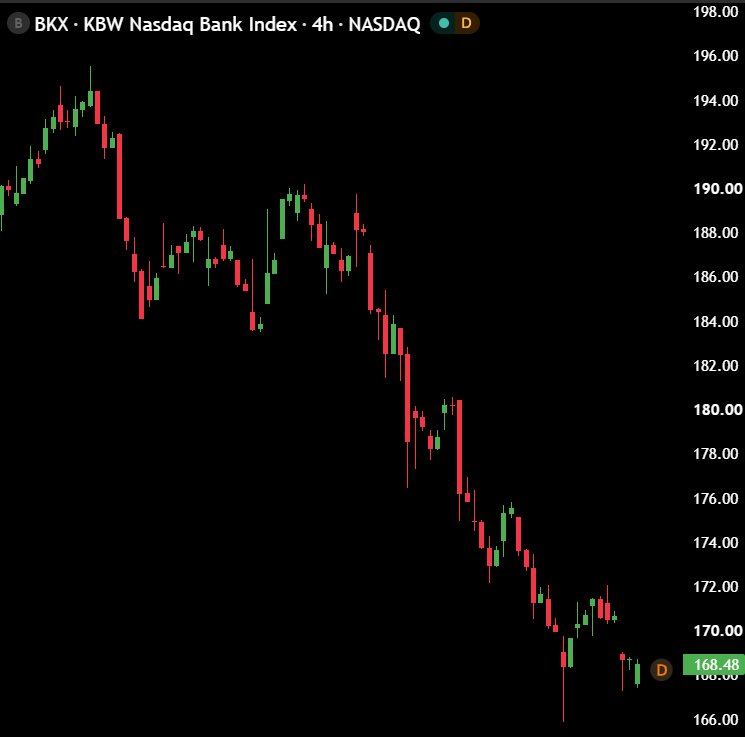
THE LARGEST BANKS IN THE US HAVE ENTERED THE CORRECTION TERRITORY.
JP Morgan: -11%
Bank of America: -19%
Citigroup: -15%
Wells Fargo: -18.5%
Goldman Sachs: -24%
Morgan Stanley: -19%
US Bancorp: -15%
Capital One: -25%
PNC Financial: -16%
BNY Mellon: -14%
Even the KBW Nasdaq Bank Index, which tracks the 24 publicly traded U.S. banking stocks, is now down 14% from its August peak.
What's even more interesting is that during the 2000, 2008, and 2020 market crashes, the KBW Nasdaq Bank Index peaked 4-8 months before the S&P 500 did.
This means if the Bank Index continues to drop even with the S&P 500 hitting new highs, it could be a major warning sign for the US stock market.