

President @IsomorphicLabs: solving disease with AI. Prev: Deepmind, Vision Factory (acq. Google), Oxford VGG.
London, England
Joined April 2009
- Tweets549
- Following1.3K
- Followers20.7K
- Likes2K





Pinned Tweet
Breakthroughs in frontier science rarely come from a sudden stroke of luck. Every major leap in AI drug design is the product of years of method development, rigorous engineering, and learning from what came before.
Witnessing the rapid advances in deep reinforcement learning and frontier AI capabilities led to a deep conviction: we could apply these same computational principles to other complex fields, like the engineering of new medicines.
That thinking led to the formation of Isomorphic Labs in 2021. Now, five years on, we have compelling evidence that our AI can unlock therapeutics to a wide range of disease classes. We are confident this technology will fundamentally impact how new medicines are created, from early discovery all the way through development.
In this article, I share the massive opportunity we have to transform human health with AI, and offer a look at the real, measurable progress we’re already making today.
isomorphiclabs.com/articles/…

Max Jaderberg retweeted

As we launch Gemini 4 Argon, we’re excited to share two standout results accelerating our quantum computing research at Google DeepMind, in collaboration with Google Quantum AI.
To unlock the full impact of AI on human health we need to build both the technology and the biological dataset it will run on. We’ve been developing our AI, our drug design engine (IsoDDE), for the last 5 years. Today, by joining the Virtual Biology Initiative as a founding member, we will be part of a large effort to generate the AI-ready data that will power predictive biology models.

Today, Isomorphic Labs joins the Virtual Biology Initiative (VBI) as a founding member.
We are helping build an open resource for the global research community to accelerate how we understand and treat disease.
Read more here: isomorphiclabs.com/articles/…

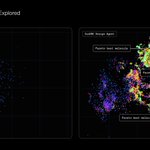
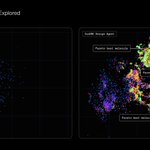
Here’s a visualisation I built of the generative design agent we use every day at Iso. IsoDDE takes the goals of our drug designers and works autonomously to produce a set of pareto best molecules. Throughout the core generative design and optimisation process you can see a visualisation of the agent’s attention (heatmap) as it balances exploration-exploitation across chemical space (here just umap visualised) to find the best molecules (greener = better)
I’ve pulled out only one pareto-best molecule to exemplify this process, but I’ll showcase in a later video how we do this at scale (1/5)
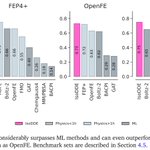
This is one example but we’ve seen this sort of success dozens of times at this point from our engine: unlocking exquisitely engineered molecule designs and proving out unique biological hypotheses in the lab. And pushing hard to show the translation into the clinic to benefit patients. (4/5)
The predictive capabilities from IsoDDE mean that not only can we create scientific hypotheses of new molecules, we can do a lot of predictive validation, so that when we do test in the real world, it has a much higher chance of success. More thoughts in the article here: isomorphiclabs.com/articles/… (5/5)

Looking forward to talking about how we move past the current AI hype and build systems that can improve human health. See you in November!

#BloombergTech London welcomes @maxjaderberg to the 2026 lineup of speakers.
Learn more here:
bloom.bg/4xqBD1u

Max Jaderberg retweeted

Excited to release AlphaGenome Atlas 🧬 We used AlphaGenome to predict the regulatory impact of all 9B possible SNVs in the human genome. We collaborated with amazing scientists to analyze and apply it, and developed a portal to browse the genome using this new lens 🔬
🌐 Portal: alphagenome.google/atlas
📖 Blog: goo.gle/4heuCvn
📄 Preprint: deepmind.google/blog/alphage…
🧵 1/6
Max Jaderberg retweeted

The prediction: 5 years for the industry to realise AI is essential in drug design and development – @maxjaderberg.
While this episode aired a year ago, we’ve been building for almost 5 years already, and have always held the conviction that our AI will redefine how new medicines are made.
Interesting to see a benchmark for discovery that seems to have a meaningful axis of difficulty (at least wrt frontier models). And given that humans can solve first try.

We find that
1) Opus 5 & Fable marked a real increase in ability on these games, but they still struggle with the hardest tiers of games (Tiers 6 and 7)
2) Agentic harnesses like Prime don’t offer any benefit over a basic (non coding!) harness
3) There’s a large gap between closed-source (Opus 5) and open-source models (Kimi K3) and another big gap to smaller open-source models (Qwen 3.6 27B)
Finally, rule discovery really is the bottleneck in these games: when we give the ground-truth rules in plain language, even the previously weakest models score near perfect.
(4/5)

There's never been a better time to lean into using frontier AI towards the most important problems in the world, and at a place that is so singularly focused on achieving that impact like Isomorphic

I’ve been working towards AGI my whole life, and as we enter this pivotal moment, I’m stepping into a new role as Chair of Google DeepMind & Chief Scientist of Alphabet. This will allow me to focus on long-term strategy, and accelerating scientific breakthroughs, including leaning into my work at Isomorphic to help cure disease.
I’m excited that @koraykv will be stepping up to lead GDM as SVP, alongside @joshwoodward and our exec team. I could not be more excited and confident about our amazing next chapter! 🚀
blog.google/company-news/ins…

Agreed @DeryaTR_ we have already reached the point where most experiments we do in the lab are used to verify what our models have already reasoned about

Exactly what I had been claiming for some time, 💯@demishassabis :
Drug discovery could shrink from 10 years to months, weeks, or even days.
Most experiments may happen in simulations before human validation.
Personalized medicines tailored to individuals could become possible.
Demis believes AI could bring all diseases within reach of treatment.

Building with Kuba is awesome!

Max Jaderberg retweeted

Cheers, chills, and a standing ovation when RASolute 302 showed unprecedented survival on daraxonrasib for patients with progressive pancreatic cancer
Seldom do you sense you’re witnessing a historic moment in cancer care but this feels like ras targeting has arrived
#ASCO26
AlphaFold models were a huge breakthrough in understanding biomolecular structure, but AI drug design isn’t just about predicting structures: the real challenge is engineering molecules that solve for potency and toxicity, whilst being actually able to make the molecules in the real world (synthesis). Rebecca and @m_schaarschmid break down our approach to solving this problem.
In the latest episode of @theneurondaily Podcast, @_rebecca_paul and @m_schaarschmidt discuss how we're bringing together machine learning and medicinal chemistry to tackle the messy world of drug discovery.
They discuss the excitement of seeing our Iso drug design engine (IsoDDE) accelerate our evolution from pioneering novel AI models to applying them at scale - delivering scientific breakthroughs with a precision previously thought impossible.
Head to the comments to listen ➡️

I’ll be at @sxswlndn with @averyklemmer to talk about our mission to solve disease with AI. Always nice to get out and share what the team has been building.

Should AI design the drugs put into your body? Max Jaderberg is the President of Ismorphic Labs – an Alphabet company, spun out from the world-leading AI lab DeepMind, with the sole mission of using AI to revolutionise drug discovery.
In a conversation at @sxswlndn, Jadergberg is joined by Avery Klemmer (Thrive Capital) and Michael de la Merced (New York Times) to discuss drug discovery at digital speed.
Join @sxswlndn in Shoreditch from 1–6 June 2026. sxswlondon.com/passes


