

kta fan and investor
Keeta
Joined August 2024
- Tweets16.1K
- Following820
- Followers798
- Likes25.8K







maxifan26 retweeted

Keeta.md gives an agent 15 skills for working on the Keeta network: creating and funding a wallet, receiving bank deposits, paying out to bank accounts and other chains, converting currencies, paying per request with x402, and following a spend policy.
Built so agents can act, and the people behind them stay in control.

keeta.md is now live! Built for AI agents, Keeta.md provides a simple way to discover and learn the skills needed to build on the Keeta Network. As agentic development continues to accelerate, we’re making it easier for agents to understand our infrastructure, integrate with our technology, and build directly on Keeta. We’ll continue to update and expand this skill library as we introduce new capabilities, integrations, and developer tools across the Keeta ecosystem.
Please note that this website is agent-first, so it may be a little harder for humans to navigate. :)
To get started, simply give your AI agent the following prompt:
“Visit keeta.md and explore the available skills and documentation. Learn how to build on the Keeta Network, including its architecture, SDKs, APIs, and integrations. Follow the relevant instructions to familiarize yourself with the ecosystem so you can assist me with developing applications on Keeta.”
maxifan26 retweeted

keeta.md is now live! Built for AI agents, Keeta.md provides a simple way to discover and learn the skills needed to build on the Keeta Network. As agentic development continues to accelerate, we’re making it easier for agents to understand our infrastructure, integrate with our technology, and build directly on Keeta. We’ll continue to update and expand this skill library as we introduce new capabilities, integrations, and developer tools across the Keeta ecosystem.
Please note that this website is agent-first, so it may be a little harder for humans to navigate. :)
To get started, simply give your AI agent the following prompt:
“Visit keeta.md and explore the available skills and documentation. Learn how to build on the Keeta Network, including its architecture, SDKs, APIs, and integrations. Follow the relevant instructions to familiarize yourself with the ecosystem so you can assist me with developing applications on Keeta.”

maxifan26 retweeted

VELOCITY Update | November 3, 2026
Trade KTA and VELO from 40+ chains in 20 to 30 seconds
You can now swap directly into $KTA and $VELO on @KeetaNetwork from Solana, Base, Arbitrum, BNB Chain, Robinhood Chain, and 40+ more chains
Rotating back out? Swap your KTA or VELO into $SOL, $ETH, or $USDC right from the same terminal.
What Makes This Different
Fast Cross-Chain Settlement: Once signed, buys land in your Keeta wallet in just 20 to 30 seconds.
Zero Copy-Paste: Velocity automatically binds your transaction to the official Keeta bridge address linked to your wallet.
One-Flow Execution: Go straight from SOL, ETH, or stablecoins into KTA and VELO without manual bridging.
How to Swap
1. Go to velocityonkeeta.com/evmsol/s…
2. Create or unlock your self-custodial Velocity wallet, then connect the wallet you are paying from (Phantom, MetaMask, Rabby, etc.).
3. Select your asset under Pay With, and choose KTA or VELO on Keeta under Receive.
4. Review the exact route and fees, confirm, and sign.
Swaps on this route carry a 0.3% Velocity fee, and 75% of that fee goes directly to buying back and burning VELO.
Watch the full cross-chain flow in action in the video below👇
Architecture & Routing Notes
We engineered this execution layer on top of Keeta’s official Base bridge. Our swap and bridge provider carries your funds across networks and holds them in transit until arrival, while Keeta’s bridge settles transfers between Base and Keeta.
Expanding soon to more Keeta ecosystem tokens, including $MURF $PACA and $PFP
Official Links
Website: velocityonkeeta.com
Discord: discord.gg/velocityonkeeta
Swap: velocityonkeeta.com/evmsol/s…
maxifan26 retweeted
(1/8) Keeta has partnered with @LayerZero_Core to bring tokenized commercial bank money to major blockchains.
Together, we’re the first to combine regulated, compliance-native infrastructure with omnichain interoperability, enabling financial institutions to move bank-grade money across any ecosystem.

maxifan26 retweeted

Everyday is Zeroday

BREAKING: Binance has been hacked with wallets across the Ethereum, Bitcoin, and TRON networks seeing outflows of -$5.7 billion.
The hack includes $1.45 billion worth of Bitcoin and $875 million worth of ETH.
If confirmed, this would mark the biggest hack in crypto history.
We expect more information shortly.
maxifan26 retweeted

KEETA NETWORK: THE INFRASTRUCTURE, THE TECHNOLOGY, AND WHERE TO RESEARCH IT.
As banks, clearinghouses, exchanges, and financial institutions continue investing in blockchain infrastructure, I think there’s a fundamental question that deserves more attention.
Why are we developing so many independent financial systems without an established common infrastructure through which they can all interact?
@DTCC, @JPMorgan, @SWIFT, and others are already building or integrating blockchain technology. Each has different requirements, operating environments, settlement processes, and existing financial relationships.
But the institutions using these systems will still need to transact with one another.
This is where I believe @KeetaNetwork deserves serious examination, particularly by the companies building this infrastructure!!
$KTA isn’t simply another blockchain designed to move tokens between wallets. Its architecture is designed to connect existing financial systems without requiring those systems to abandon their underlying infra
The three components I’d encourage anyone researching Keeta to understand are its Anchors, Resolver, and native account architecture.
Anchors allow external systems, including banking services, payment rails, liquidity providers, and other blockchains, to connect to Keeta. Providers can operate their own services, establish their own requirements, and determine their fee structures.
The Resolver provides a way for applications, institutions, and Ai agents to discover available financial services rather than individually hardcoding every provider relationship. Official Keeta products use the Globetrot Resolver, which has compliance requirements for participating providers.
The native account architecture includes permissions, multisignature functionality, tokenization, and certificate based identity capabilities that can support more complex financial operations.
Taken together, these components represent an attempt to create common financial connectivity between systems that were never designed to operate together.
And rather than asking anyone to accept that explanation at face value, I want to provide the actual resources.
OFFICIAL KEETA REFERENCES
Network architecture and technical documentation:
docs.keeta.com
How Anchors connect external systems:
docs.keeta.com/features/anch…
How institutions and developers can create Anchors:
docs.keeta.com/features/anch…
The Resolver and third-party provider ecosystem:
keeta.com/blog/keeta-opens-i…
Keeta SDK and developer instructions:
docs.keeta.com/introduction/…
Public source repositories and development:
github.com/KeetaNetwork
Official network explorer:
explorer.keeta.com
Independent network activity and analytics:
keetaview.com
FOR AI DEVELOPERS AND AUTONOMOUS AGENTS
Keeta has also published machine readable skills intended to help Ai agents understand and interact with the network.
Official agent skills:
github.com/KeetaNetwork/keet…
Agent instructions:
keeta-md.pages.dev/SKILL.md
These resources cover wallets, payments, anchor discovery, currency conversion, banking integrations, and other documented workflows.
I’d encourage anyone using ChatGPT, Claude, Gemini, or another capable Ai system to provide these resources and ask it to independently examine Keeta’s architecture
Ask how a bank could integrate an existing payment system. Ask how an international fintech could discover financial providers. Ask how Ai agents could access banking services, move currencies, or operate under defined financial permissions.
Ask what is technically documented, what is commercially available, what still requires development, and how Keeta compares with the alternatives.
You don’t need to agree with my assessment of Keeta. I’d much rather see people research the technology, challenge its limitations, and determine for themselves where it could be useful
Let’s get more engineers, institutions, and Ai developers actually examining what Keeta is building
🤙

maxifan26 retweeted

Was speaking with @Brown_Thunder76 , who’s since stepped back from the space but wanted to get some of this out properly. Sharing with his input.
I don’t think people fully realise what’s happening with LayerZero’s ATLAS launch on 30 November.
There are essentially two sides to ATLAS, Open ATLAS and Institutional ATLAS.
With DTCC’s recent tokenisation announcements, I’ve seen growing speculation that tokenised stocks and other traditional securities could begin trading on ATLAS from day one. While that’s certainly possible, I’m not convinced that’s what we’re going to see initially.
The 30 November launch seems to be focused on Open ATLAS, with GTE, Bullish, Defined and TrueNorth among the first announced partners. Looking at these platforms, their current focus seems to be cryptocurrency trading, perpetual futures and other digital asset services. None of their announcements, at least so far, confirm that tokenised traditional securities will be trading on ATLAS at launch.
But that’s only part of the bigger picture. LayerZero has also discussed an institutional side of ATLAS designed to accommodate regulated financial markets. LayerZero has previously disclosed involvement from major financial institutions, including ICE, DTCC and Citadel Securities, in its broader institutional infrastructure efforts. DTCC announcing progress on tokenisation doesn’t mean those assets will be available to trade on ATLAS on 30 November. For that to happen, you still need trading venues, supported assets, custody arrangements, settlement infrastructure and the necessary regulatory framework.
So when does Institutional ATLAS actually arrive? As far as we’re aware, there hasn’t been a confirmed production launch date for institutional securities trading on ATLAS. My speculation is that we could begin seeing initial institutional deployments during Q1 or Q2 of 2027, potentially with additional partners and integrations announced before then. That doesn’t rule out tokenised securities appearing sooner, it simply means we shouldn’t confuse the launch of the trading infrastructure with the launch of every market that may eventually use it.
I think the initial crypto native venues could demonstrate what ATLAS is capable of. But the institutional venues could ultimately represent a substantially larger opportunity. 30 November may be the starting line, not the finish line.
Worth tying this back to Keeta specifically. Keeta’s own commercial bank money product with LayerZero is live today, moving across Ethereum, Solana, Base and Keeta via the OFT standard. But that’s Open ATLAS adjacent infrastructure, not Institutional ATLAS. Any role for Keeta CMB inside institutional ATLAS, trading alongside DTCC linked securities or similar, would depend on institutional ATLAS actually launching, and based on the above that’s realistically a Q1 or Q2 2027 story, not a 30 November one. Good reason to keep expectations calibrated to the right timeline.
base:0xc0634090f2fe6c6d75e61be2b949464abb498973 @KeetaNetwork
maxifan26 retweeted
Quick thread on a pattern worth watching. On its own, every piece here is public and confirmed. Connected together, it’s speculation, clearly labelled as such. But the dots are sitting unusually close together right now.
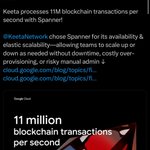
Start with what’s live today. Keeta already has bank issued stablecoins on mainnet, Bivo’s KBUSD and KBEUR went live 21 October. Keeta also already moves cross chain via LayerZero’s OFT standard, Keeta Stablecoins are usable on Ethereum, Solana and Base since that integration went live in July. Keeta’s infrastructure has been Google adjacent from early on too, the chain was benchmarked at 11.2 million TPS alongside Google’s own Spanner engineering team.
In June, ASK Group (UAE) and Keeta announced a joint venture to tokenise Gulf commodities, oil, gold, silver and copper, backed by on chain reserves, aiming for a public exchange by 2027, starting in the UAE then wider GCC. This is the project that needs real institutional custody and compliance infrastructure to actually work at bank scale.
Separately, LayerZero has spent 2026 building toward something bigger than payments messaging.
February: Zero, a new L1, backed by Citadel Securities, DTCC, ARK Invest and ICE.
August: ATLAS, a headless exchange and settlement engine built on Zero, with commodities explicitly listed as a supported market type alongside equities, bonds and spot tokens.
Zero mainnet plus Open ATLAS is now dated for 30 November.
Now the new piece. 28 October, Google Cloud ran its first ever Digital Assets Symposium in New York, invite only, under confidentiality. Keeta was there (@schenkty , @yourpal , Riley, Josh). So, by all indications, was Zero Hash, the compliance and orchestration layer banks use to actually plug into crypto rails.
What Google announced there: Google Multi Party Compute, a custody product that splits a private key across multiple independent parties, your own hardware, Google Cloud, another cloud, with threshold signing and a policy engine for transfer limits and approvals. Private preview now, general availability targeted early 2027. Currently supports Ethereum and Solana signing. Rich Widmann, Google Cloud’s digital assets strategy lead, framed it as neutral infrastructure: institutions “need scalable, proven infrastructure to secure their clients’ assets.” Google is explicitly positioning itself as custody that works regardless of which chain an institution settles on, not a push toward its own chain, Universal Ledger. That neutrality matters here. Google doesn’t need to choose Keeta over its own chain for this to be relevant, it just needs institutions tokenising and moving assets, on any rail. A bank already live on Keeta is exactly the kind of customer this product is built for.
Here’s the speculative stack, building from plausible to a genuine reach.
Plausible: Google MPC becomes the custody layer sitting under bank issued assets on Keeta, Keeta already has the live stablecoins, Google already has the infra relationship, and Google is explicitly selling chain agnostic custody to exactly this kind of institution right now.
More speculative: Zero Hash, if it was in that room for the reason its business model suggests, becomes the compliance and bank onboarding layer connecting Google custody to Keeta settlement, custody, compliance, settlement, three logos, one stack, nothing confirmed.
The reach, clearly labelled as such: LayerZero’s OFT standard already lets Keeta Stablecoins move across Ethereum, Solana and Base. If that same framework extends to Zero once it’s live, and institutional ATLAS, which explicitly supports commodities as a market type, needs a settlement asset for exactly the kind of Gulf commodity tokens ASK Group and Keeta are building toward 2027, you get a full pipeline. Physical commodity, tokenised and settled on Keeta, custodied via Google MPC, moved cross chain via OFT, cleared through a Citadel Securities and DTCC backed institutional exchange. A full stack from Gulf vault to institutional trading desk, built from pieces that each independently exist today, with zero confirmed connective tissue between them.
To be clear on what isn’t confirmed: no company has named Keeta on Zero or on ATLAS. No company has confirmed a Keeta, Google MPC or Zero Hash partnership. ASK Group hasn’t disclosed its full tech stack. This is pattern recognition across public announcements, not reporting, treat it accordingly, not financial advice.
What would actually confirm or kill this: Keeta named as a market creator or settlement asset on ATLAS, Google or Zero Hash naming Keeta as a design partner, or ASK Group disclosing LayerZero or Google MPC in its stack. Watching for all three.
base:0xc0634090f2fe6c6d75e61be2b949464abb498973 @KeetaNetwork @LayerZero_Core @zerohashx @googlecloud @GoogleCloudTech @askgroupae

maxifan26 retweeted
The biggest moves in finance aren’t always announced!!
Sometimes, you just have to pay attention to who’s being invited into the room👀
🤙
$KTA @KeetaNetwork

maxifan26 retweeted

Ty Schenk just shared the official badge from Google Cloud's closed door MPC symposium in New York, confirming that he brought Keeta's core engineering bench directly into Google's Manhattan campus: Chief Architect Roy Keene, Riley, and Josh.
They spent the day in closed door sessions with Google Cloud Digital Assets leadership, discussing Google's new Multi Party Computation product and the convergence of AI, payments, and cryptography.
Multi Party Computation is the threshold cryptography that lets autonomous AI agents and enterprise institutions sign transactions without exposing private keys.
Now, before connecting this to what is hitting the stage tomorrow, let me be clear: Nothing here has been confirmed by the team, and this is purely my own personal observation as an independent sleuth looking at public conference agendas.
Remember PR #355, where Lucas Rosa and Ty integrated ISO 20022 corporate identity directly into Keeta's cryptographic certificates?
Cloud providers like AWS are on stage tomorrow explaining why global finance needs to convert banking messages into signed cryptographic settlement for AI agents: Keeta already deployed that exact mechanism to mainnet.
And remember: Roy Keene himself was a Senior Cloud Application Architect at AWS specializing in high security architecture and cryptography.
AWS is on stage explaining the exact infrastructure their former architect already built into Keeta.
It is practically impossible for that to just be a coincidence.
Then ten minutes right after AWS finishes, Zero Hash Chief Executive Officer Edward Woodford takes the Main Stage directly alongside Bill Capuzzi, the Chief Executive Officer of Apex Fintech Solutions.
Apex Fintech Solutions is the custody and clearing engine powering millions of modern trading accounts, and Zero Hash is the regulated settlement bridge connecting fiat into digital assets.
Today it was closed door sessions with Google Cloud, and tomorrow it is AWS and Wall Street clearing giants on the public stage validating the exact architecture Keeta already built.
$KTA @KeetaNetwork #Keeta #Fintech #Crypto

maxifan26 retweeted
First, let me be 100% clear before we begin: This is purely my own personal research as an independent sleuth, and not an official statement from Keeta or any entity mentioned.
I want to ensure everyone understands that none of this is officially confirmed as of yet, but when you look at how the infrastructure is connecting, the mechanics speak for themselves.
Also prepare yourselves for a long read. 😉
Remember my post yesterday breaking down the institutional connection between ICE, tZERO, and Zero Hash?
I highlighted how David Goone, who spent two decades as Chief Strategy Officer at Intercontinental Exchange, became the CEO of tZERO and partnered directly with Zero Hash to power brokerage funding rails.
If you thought that was an isolated move, look at what Zero Hash just announced today, October 27, 2026.
They dropped not one, but two massive institutional announcements back to back.
First, Zero Hash launched AUTH by Zero Hash and appointed Ryan Beaudry as General Manager.
Ryan Beaudry was the Executive Vice President of Global Open Finance at Mastercard, where he scaled account based financial infrastructure across nearly one hundred million connected accounts.
Why did Zero Hash build AUTH, and what does this actually mean for Keeta?
AUTH was engineered to solve the single largest barrier preventing institutional open finance: Eliminating raw forty character hexadecimal wallet addresses and replacing them with human readable account tags, WebAuthn hardware passkeys, and centralized Certificate Authority verification.
If that architecture sounds familiar, it is because that is the exact blueprint built directly into Keeta's core ledger with Keeta Tags, native P-256 passkey signing, and MANAGE CERTIFICATE operations.
On legacy blockchains, trying to force account based identity requires fragile smart contract abstractions, bundlers, and third party paymasters.
The fact that Mastercard's former Open Finance head is building an identity layer designed around accounts, passkeys, and CAs proves that Keeta's foundational design is the exact standard global finance demands.
Second, Zero Hash officially brought Open USD, known as OUSD, live across its entire global network.
This is the stablecoin introduced by the Open Standard consortium, backed by Visa, Mastercard, Stripe, and Coinbase, with underlying reserves custodied at BlackRock and BNY Mellon.
In their official release today, Zero Hash explicitly named Marqeta and Visa Direct as the live enterprise rails powered by this integration across Base.
What does this actually mean?
Marqeta powers the modern card issuing infrastructure for the largest fintechs on earth, while Visa Direct connects over eight billion endpoints for real time global push payments.
This is not a crypto experiment for decentralized finance, it is the actual plumbing that pays corporate salaries, funds commercial cards, and settles multi million dollar business transfers.
By deploying OUSD across Base for Visa Direct and Marqeta, the world's largest payment networks are turning Base into their primary digital dollar staging ground.
And where has Keeta been building its live cross chain bridge?
Directly on Base, where Keeta's EVM anchor is already live, creating the exact highway that connects those institutional corporate payouts into Keeta's native block lattice.
So why is this happening right now?
Why would the former Chief Strategy Officer of the parent company of the NYSE, the former head of Open Finance at Mastercard, and the largest payment networks on earth all converge on Zero Hash within 24 hours?
Because the entire architecture of global capital is being forced into 24/7 continuous settlement.
We even got a tease today from the CEO himself about 24/7.
Wall Street brokerages cannot run 24/7 equities trading if settlement takes two business days for wire transfers to clear.
Global payment networks cannot scale cross border payouts if institutions are forced to copy paste forty character hexadecimal wallet addresses and gamble with mempool gas spikes.
Regulated institutions cannot custody anonymous crypto assets or unverified stablecoins on their balance sheets without triggering catastrophic compliance violations.
This is why this entire stack is falling into place:
ICE and tZERO provide the regulated exchange infrastructure.
DriveWealth provides the fractional brokerage access.
Zero Hash provides the B2B funding conversion and account based passkey authentication.
OUSD, backed by Visa, Mastercard, and BlackRock, provides the compliant commercial bank dollar with shared reserve yields.
Why can other prominent networks like Ripple, Chainlink, or Sui not fill these shoes?
Ripple cannot solve this because volatile tokens like XRP cannot legally clear or fund stock trades, and private stablecoins like RLUSD are restricted to an isolated single currency sandbox without direct commercial bank deposits.
Chainlink is an oracle and cross chain messaging pipe, not a settlement ledger, and moving a data message across chains is completely different from settling real money on an institutional balance sheet.
Sui claims massive speed through off chain tunnels, but remains a speculative crypto sandbox with zero chartered bank reserves and zero protocol level corporate identity.
And where do Keeta and Bivo fit into this picture?
Every single institutional trade that matches in milliseconds requires an immediate cash leg to settle the transaction with absolute mathematical certainty.
This is where the architecture of Keeta and Bivo becomes completely unique.
While Zero Hash has to build AUTH as an external wrapper to make legacy chains look like bank accounts, Keeta was engineered as a native account lattice from the ground up.
Bivo operates as the regulated banking anchor holding direct 1:1 chartered bank deposits, issuing legal claims rather than anonymous pooled tokens.
Keeta provides the neutral, sub 400ms block lattice where those commercial bank funds settle without shared mempools, MEV frontrunning, or gas spikes.
Through native MANAGE CERTIFICATE operations, Bivo attaches cryptographic KYB identity attestations directly to user and corporate account chains.
Before any funds move, the consensus nodes themselves verify that both sender and receiver hold valid compliance credentials.
The ledger refuses on its own account, giving institutional risk officers a mathematical guarantee that counterparty rules are enforced by code.
Bivo brings the licensed banking reserves, and Keeta provides the uncompromised consensus engine to settle them.
Zero Hash launching OUSD on Base at the exact time Keeta's Base bridge anchor reaches production height is not a coincidence, it is the convergence of the entire institutional settlement highway.
None of this is financial advice.
xitter.cf/zerohashx/status/21150…
$KTA @KeetaNetwork #Keeta #Fintech #Crypto

First, let me be 100% clear before we start: This is purely my own personal research as an independent sleuth, and not an official statement from Keeta or any entity mentioned.
When you want to see where financial markets are actually heading, you have to follow the ownership structure of the clearing firms.
Intercontinental Exchange, the parent company of the New York Stock Exchange, is the primary strategic equity backer of tZERO.
David Goone, who spent two decades as ICE's Chief Strategy Officer, currently serves as the Chief Executive Officer of tZERO.
Here comes something I was not expecting.
Then in late 2025, tZERO partnered directly with Zero Hash to enable crypto and stablecoin funding rails for brokerage accounts.
Why would a broker dealer backed by the owner of the NYSE partner with an embedded digital asset infrastructure firm?
Because licensed brokerages cannot custody anonymous crypto assets or unregulated bearer stablecoins on their balance sheets without triggering federal compliance violations.
Zero Hash provides the regulated B2B conversion layer, ensuring that digital asset funding enters the brokerage account as compliant cash.
Now consider how this connects to what LayerZero and Keeta have been building.
LayerZero confirmed that Zero and Institutional ATLAS go live on November 30, with institutional consortia currently testing markets that clear over one trillion dollars a day.
LayerZero engineered Institutional ATLAS specifically to give major exchange operators the infrastructure they need to run 24/7 global markets.
Every single trade that clears on an institutional venue needs an immediate cash leg to settle the transaction.
Matching an equity trade takes milliseconds, but settlement requires real money.
You cannot settle institutional trades in volatile tokens that fluctuate by double digits, and regulated brokerages cannot settle in stablecoins where the source of funds is unverifiable.
Institutional settlement requires asset backed commercial bank money that moves in sub second timeframes while carrying verified cryptographic identity.
That is precisely what Keeta and Bivo built with their nine sovereign stablecoins, LayerZero OFT rails, and automated corporate identity schemas.
ICE provides the exchange infrastructure, tZERO and DriveWealth provide the brokerage access, Zero Hash handles the funding conversion, and Keeta provides the sub second ledger that settles the cash leg.
The pieces are not developing in isolation, they are converging on the exact same institutional clearing highway.
If trading venues transition to 24/7 operations, global clearing houses will no longer wait two days for bank wires to settle trades.
Every single transaction will require instantaneous, compliant commercial bank cash moving atomically alongside the asset.
That turns the network from a speculative experiment into the actual settlement backbone for institutional capital.
Remember, all of this is purely my own speculation as an independent sleuth, but imagine what this could actually mean.
None of this is financial advice.
$KTA @KeetaNetwork #Keeta #Fintech #Crypto

maxifan26 retweeted

JUST IN: 🇺🇸 US officially finalizes new crypto stablecoin regulations under the GENIUS Act.


maxifan26 retweeted

@LayerZero_Core + Atlas hints have me looking back at their announcement with @KeetaNetwork regarding commercial bank money.
ATLAS brings trading, clearing & settlement infrastructure. Keeta brings tokenized bank money and multi-chain connectivity.
If these pieces come together, this could be about more than interoperability. It could be about how real money settles across global markets.
Nothing confirmed yet, but the Layer Zero is leaving bread crumbs. I don't think this announcement should be ignored. 👀 $KTA $ZRO 👇
xitter.cf/LayerZero_Core/status/…

The world's largest institutions need a cash management system that works across fiat currencies and public blockchains.
@KeetaNetwork is solving that problem by introducing tokenized commercial bank money, built on LayerZero's OFT standard.

maxifan26 retweeted

Good news! Looks like Keeta’s commercial bank money stablecoins have been getting quite a bit of testing today by Lucas!
No doubt in my mind these go live before November 30.
Come on ATLAS cash settlement leg!
41 more days or less until we find out. 🤞
@KeetaNetwork $KTA

maxifan26 retweeted

⚡ @KeetaNetwork processed 647,180 transactions on Sunday.
That is nearly 8 transactions each second through the whole day, and its busiest day of the past week.
The most advanced way to move money, and Sunday put it to work.
📊 chainspect.app/chain/keeta-m…

maxifan26 retweeted
Imagine being a vendor for $ETH $SOL & @base, with @LayerZero_Core as an anchor.
One wallet for everything, 9 major fiat currencies, 11B+ TPS, compliance, and direct connections to your personal bank account.
Keeta Business adds enterprise-grade management, multi-entity treasury controls & developer integrations.
This chain does a LOT.
And @askgroupae’s commodities exchange is coming to a theater near you. $KTA 👀


maxifan26 retweeted

$KTA Looks like it's almost 'go time'. I will have no sympathy for the fudders and naysayers when the rocket launches.