

Building the land + energy + AI compute platform for the next decade. CEO @wearekizer. American Southwest.
Minneapolis, MN
Joined January 2011
- Tweets4.4K
- Following2.7K
- Followers561
- Likes7.1K




Pinned Tweet
Today, Kizer AI (@wearekizer) is launching a 500,000-acre turnkey land platform for AI data centers.
We’re working with one of the largest private landowners in the US and have assembled sites across Texas, New Mexico and Oklahoma that can support multiple 1.0 GW+ AI campuses, with access to the power, gas, water, fiber and transmission infrastructure needed to build them.
The goal is simple: give developers access to sites that are ready for AI infrastructure at scale.
If you’re a data center developer, energy company, infrastructure provider or capital partner looking for your next site, reach out to us.
Read the full announcement: world.einnews.com/pr_news/94…


Matt Atkinson retweeted

🤷🏿♂️
“Your tweets are almost a single doctrine: energy abundance is the binding constraint on AI, and AI is the forcing function that finally gets the grid built. Load growth is good. Hyperscalers should bring their own power so ratepayers aren’t the residual claimants. All-of-the-above in the near term (gas + solar + storage + transmission now; nuclear later). Systems thinking over tribalism. America and allies should actually build.”


Competition is always better for the market - thats how free markets work and I'm really happy to see it rampant in the datacenter space as well. Props to both @nebiusai and @CoreWeave for doing their part!

SemiAnalysis's Jordan Nanos says CoreWeave is so backed up a customer with $100 million to spend was told to wait until May, so Nebius has been capitalizing
"They're serving this middle tier of the market. CoreWeave has set the standard. I mean, they are the best in terms of technology, this reliability stuff I'm talking about. They just have so much data for monitoring."
"I mean, these guys deploy 10,000 GPUs a week at the peak when they're building data centers. And so that's incredible. But like their balance sheet is full. There's only so many people that you can marshal and resources to build out another gigawatt when they're going to 1.5 and beyond."
"So Nebius has really capitalized on this middle tier of the market, which is not small."
"Like I said, this is customers who are coming to us and saying, hey, I saw you write such good things about CoreWeave. I just have $100 million. I'm trying to give it to them. They're telling me they can't accept it until May of next year because they're backed up. And therefore, Nebius has been capitalizing."
______
For more commentary on CoreWeave and Nebius: firesidealpha.substack.com/p…
Great post - try to keep them away from residential zones and use better cooling equipment. That's literally it - the noise debate over datacenters is solved in 2 sentences.

People assume a data center hums because thousands of computers are running inside it. Almost none of the sound reaching the neighborhood comes from the computers.
A GB300 NVL72 rack draws about 140 kW. Essentially all of it leaves the building as heat. Amazon’s campus on Tanner Way runs more than 400 rooftop exhaust fans, about 600 feet from the houses in Great Oak.
Prince William County allows 55 dBA at night at a residential property line, and campuses are designed to come in under it.
But here’s the catch:
Fans and transformers make low-frequency tones. Low frequencies travel farther and go through walls. Counties measure in dBA, a scale that barely counts the low end. A 73 Hz hum reads about 24 dB quieter than it is. So a site can pass its noise limit while the people next to it still can’t sleep at night.
How to fix this?
Distance. Sound drops about 6 dB every time you double it. Low-frequency rumble carries farther than that.
Enclosures and silencers. At xAI’s power plant in Southaven, Mississippi, a $7M sound wall went up last December, and the company promised a $12.8M earth berm as well, to screen the gas turbines.
Slower fans. The fans have to get rid of the heat, you can’t just turn them down. Amazon put new motors and better blades on all 424 exhaust units at Great Oak, made the stacks 3 feet taller and rewrote the controls to run the fans slower and in sync.
That cut the noise by about 10 dB, and the fans use less power doing it. It was a four-month retrofit of every fan on the roof. Amazon has never said what it spent.
Love this post - helps contextualize both sides of the noise debate. The problem isn't non-existent but mitigation of the problem is also not entirely impractical

How noisy are America’s largest data centers?
I had my agents crank on this question for over a week. Together we investigated the 25 largest operating US AI campuses (according to Epoch), looking at satellite imagery, equipment, nearby homes, and noise complaints.
I expected to dismiss resident concerns. I came away more sympathetic to the neighbors, but also convinced that these problems are avoidable.

Matt Atkinson retweeted
Great thread and kudos to @nic_carter for not sweeping the concerns under the rug like it's getting popular to do
Data centers CAN be a good neighbor but distance + acknowledging very real residential complaints around noise should be bare minimum considerations. Can be a big problem
How noisy are America’s largest data centers?
I had my agents crank on this question for over a week. Together we investigated the 25 largest operating US AI campuses (according to Epoch), looking at satellite imagery, equipment, nearby homes, and noise complaints.
I expected to dismiss resident concerns. I came away more sympathetic to the neighbors, but also convinced that these problems are avoidable.
Remember this graph every time you think the datacenter space is in trouble

Matt Atkinson retweeted

Instructive to see a post like this get so much traction.
B200 rental rates up 30% YTD.
Hyperscaler cloud revenues tracking along.
Remember: GPU rental rates and token prices were supposed to fall over time. The demand metrics this year have beaten all informed expectations.


Matt Atkinson retweeted

The 23rd largest private landowner in the US just opened up 500,000 acres of land for AI data centers.
Today, Kizer AI (@wearekizer) announced a platform for developing multiple 1GW+ AI data center campuses across the US.
I’ve been a part of this project since the very beginning and it's amazing to finally see it go public.
Full announcement:
world.einnews.com/article/94…
Matt Atkinson retweeted

IREN went from $9.7M per MW with Microsoft and $11.3M with Nvidia on 5 year terms to $20M+ on recent 3 year deals showing how aggressively shorter duration AI capacity is repricing.
Annualized contract value across the AI infra stack
• $IREN ~$2.6B across $MSFT + $NVDA
• $NBIS ~$5.9B across $MSFT + $META
• $CRWV ~$7.8B across $META + OpenAI
• $AMZN >$10B with Anthropic
• $SPCX ~$15B with Anthropic
That gap between pricing and scale is what makes IREN so interesting since its already getting some of the best pricing per MW while carrying one of the smallest contract books leaving a lot more room to pair that pricing with scale even if corporate governance issues remain a real caveat.

While datacenters may have signed 40% of clean power last year, overall corporate clean energy buying actually fell in 2025
You always need to watch the total pipeline - market share tells you who is buying, it tells you nothing about net new capacity.

The tech sector isn’t just consuming energy – it’s also shaping supply
It made up around 40% of all corporate power purchase agreements for renewables signed in 2025
Data centre deals alone covered about half of the sector’s current electricity use 👉 iea.li/3Qf9zxV

Interesting - wonder if the energy infra buildout can keep up.

🚀 #NVIDIA’s rack-scale AI servers are surging: GB300, VR200, and VR300 NVL72 systems are projected to top US$710B in combined output value in 2027, up 214% YoY.💡#TrendForce on how this could boost ODM, power, and cooling suppliers: buff.ly/TqR3mWx 🔗

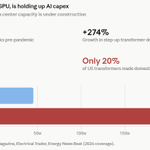
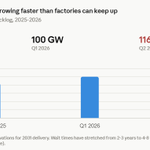
That's what people THINK - supply chain capacity is not what is bottlenecking the growth of AI and large companies like NVIDIA.
The actual constraint is site energization - NVIDIA could deploy thousands of GPUs across America, which would lead to deals worth billions of dollars but that $89B Q2 datacenter spend needs physical gigawatts to run.
And American infrastructure hasn't caught up yet - that's the real bottleneck.
NVIDIA 2Q Revenue Surges 106% YoY; FY2028 Revenue Expected to Grow 70%
NVIDIA announced its fiscal 2Q27 results on August 26, reporting record revenue of $96.22 billion, up 106% YoY. Data Center revenue reached $89.02B, surging 117% YoY and serving as the company’s primary growth engine. Looking ahead, NVIDIA expects third-quarter revenue to reach approximately $108B. CFO Colette Kress said during the earnings call that FY2028 revenue is expected to grow by around 70%, with the outlook constrained primarily by supply chain capacity rather than a lack of market demand.
Vera Rubin Platform Enters Full Production
Commenting on current market developments, NVIDIA founder and CEO Jensen Huang said AI has reached an inflection point, with the technology now capable of performing useful work and generating productive, economically valuable tokens. He emphasized that the global AI infrastructure buildout is advancing at full speed, while NVIDIA’s latest Vera Rubin platform has entered full-scale production.
Huang added that companies will eventually operate multiple AI agents on a continuous basis, potentially driving a 15- to 100-fold increase in overall computing requirements.
Gross Margins Face Downward Pressure
Despite maintaining a strong gross margin of 75% in the second quarter, NVIDIA is expected to face mounting cost pressures. Kress noted that surging AI demand has tightened memory supply, with extreme pricing conditions exceeding the company’s previous expectations and likely to persist through next year.
NVIDIA has therefore lowered its gross margin outlook. The company expects gross margin to decline to 74% in the third quarter and bottom out at 71–72% in the fourth quarter before recovering to 72–73% in the first quarter of FY2028.
Huang Addresses Circular Financing Concerns
NVIDIA’s substantial investments in frontier AI labs have raised market concerns over so-called “circular financing.” Kress acknowledged these concerns but said NVIDIA views these labs as once-in-a-century companies, with limited investment risk and attractive potential returns. AI labs requiring balance-sheet support are expected to account for approximately one-quarter of NVIDIA’s business next year.
Huang added that NVIDIA provides a complete AI factory platform that is fundamentally different from custom inference chips designed for individual functions. He expressed confidence in NVIDIA’s technology and expects these AI labs to remain significant long-term users of the company’s computing architecture.
📊More semiconductor insights: buff.ly/YckK6fp
📊More financial charts: buff.ly/3AHP9WB

Matt Atkinson retweeted

We've seen the hyperscalers pour a ton of money into capital.
They're buying land, they're buying a ton of equipment, they're hiring construction contractors all over the world, and this is to the tune of a trillion dollars of CapEx or more next year.
I can't imagine how much maintenance costs would go up because of this.
Think about it - cosmic radiation causes bit flips or data corruption on a GPU, which could mess with AI training.
Worse, if a GPU or an entire stack faces an issue - you'd have to launch a whole rocket just to fix it. No thanks, I'd rather keep my data centers on American soil.

Could AI data centres really move into space?
Orbital data centres could eventually help address growing power and cooling demands, but the technology still faces major technical and economic hurdles.
For now, terrestrial infrastructure remains the clear investment priority. @WoodMackenzie forecasts US$9 trillion in global data centre investment by 2040.
Robert Liew, Research Director at Wood Mackenzie, shares his perspective in The New Stack’s latest look at the future of orbital AI infrastructure.
Read the full article: okt.to/JURuLh


3 trillion of locked leases and chip orders against 600 billion of reported spend is the real size of the race. That paper still needs a power date, and buildings that turn on late eat the return.


