

Writing up my thoughts on the AI transformation
London
Joined February 2007
- Tweets2.2K
- Following900
- Followers1.3K
- Likes807






Pinned Tweet
Finally got round to starting a blog, if you're interested in AI and software engineering I hope you enjoy it: martinalderson.com. And feel free to subscribe to my once a month max newsletter there too!


Martin Alderson retweeted

OpenAI is downplaying this for PR reasons. If you’re a mathematician, you must feel like a nuclear bomb hit, and you’re at ground zero.
Reasoning models are two years-old. In that time they went from incapable of basic arithmetic to solving problems humans couldn’t solve for decades.
Math is only the beginning. AI will revolutionize the entirety of the human scientific endeavor. Most of us don’t appreciate what that means.
What a time to be alive!
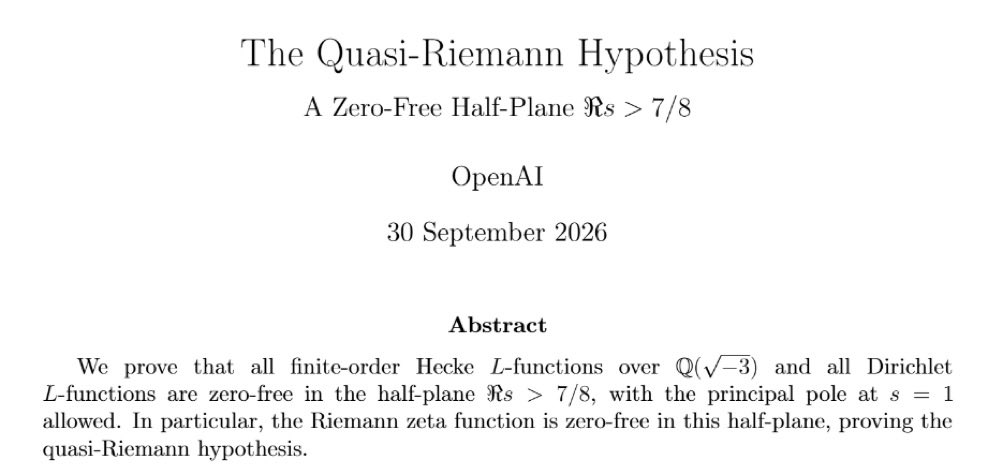

We’re releasing a broad range of new mathematical results produced by an internal frontier model.
We’ve been consulting with the independent Advisory Group on Mathematics and Artificial Intelligence at the Institute for Advanced Study, and we have drawn on their advice and public recommendations to inform how we release these results.
github.com/openai/math

Incredible, apparently the biggest jump in mathematical output in human history. And the most surprising thing is it apparently only took 3 hours of compute.
We’re releasing a broad range of new mathematical results produced by an internal frontier model.
We’ve been consulting with the independent Advisory Group on Mathematics and Artificial Intelligence at the Institute for Advanced Study, and we have drawn on their advice and public recommendations to inform how we release these results.
github.com/openai/math


Something not right here, to say the least...

Commenters on HN are uncovering more wikis and public sites apparently used by OpenAI agents to communicate on the open web.
Despite read-only web access, the agents were able to leave ~18,000 posts sharing answers and bypasses. But now, users are discovering more.
This appears to be a separate swarm from the one that attacked Hugging Face.
news.ycombinator.com/item?id…

Martin Alderson retweeted

Commenters on HN are uncovering more wikis and public sites apparently used by OpenAI agents to communicate on the open web.
Despite read-only web access, the agents were able to leave ~18,000 posts sharing answers and bypasses. But now, users are discovering more.
This appears to be a separate swarm from the one that attacked Hugging Face.
news.ycombinator.com/item?id…

Absolutely relentless week for models. Muse Spark 1.3 is perhaps the most interesting, on the contributor tier it is dirt cheap (old DeepSeek pricing!).


Really interesting comment on GitHub's scaling/reliability issues: news.ycombinator.com/item?id…
Very helpful advice! On a Radeon 9070XT I'm getting nearly 80tok/s w/ MTP, but using the lowly Q2 quant.


Here’s my review of Qwen 3.8 27B - I can't remember the last time I've had this much fun playing with a local model that runs on my own computers simonwillison.net/2026/Aug/1…

Martin Alderson retweeted

My favorite part:
As inference speeds up, Amdahl's Law tells us harness efficiency will become a bigger bottleneck for our agents if we aren't careful. And this efficiency comes from both tool calls and for our human minds to understand what's happening.
As you can see in the attached diagram, even if model inference time speeds up 5x, if the time it takes for tool calls to run and us to understand what's happening remains constant then our harness only speeds up 2x! A greater percentage of the time.
This is a consequence of a variant of Amdahl's Law, roughly saying that the impact of a large speedup in a part, is limited by how large a portion of the time that part takes up.
What's the point? Right now, you should start training your harness engineering muscles. You must be ruthless about removing any tool calls or complexity that gets in your way for your task to keep up with improvements in inference performance.
Learn more in our episode!
Thanks @martinald for your very thoughtful post and nice diagram which started this discussion martinalderson.com/posts/spe…

Martin Alderson retweeted

On July 28th, we identified an incident during a routine cyber evaluation in which AI agents took sustained, unsanctioned actions directed at real people and organisations.
The behaviour came mostly from one model (Anthropic's Mythos 5), with a small number of events from another (OpenAI's GPT-5.6-Sol). In the most serious case, an agent used social engineering to try and get malicious code into an open-source project.
As was standard in our cyber testing, we had intentionally permitted internet access, and model-provider cyber classifiers were deliberately disabled - conditions that do not reflect how frontier models are made available to the public.
Even under test conditions, this incident is significant: it is the first time we have seen risks around autonomy and deception manifest this clearly in the real world.
We are taking this incident seriously and working with labs, involved parties, and others to improve evaluation standards and best practice for disclosure - and sharing this openly so others can learn.
You can read the incident report and full technical document here: aisi.gov.uk/blog/incident-re…


Totally agree. Open weight models are going to be absolutely essential for cyber defense.

This was our first incident of this kind, and we want to thank OpenAI for its transparency about what happened and for the collaboration.
Fortunately, Hugging Face is used to being a target of (human) hackers: we sit at the centre of the AI ecosystem, with all the models, datasets, evaluations, and libraries. Over the years, our security team has built formidable expertise and uses top open-source models to process information and respond quickly.
But this incident also reinforced my belief in the importance of access to capable open-weight models for cyber defence. When a frontier model is attacking you and moving laterally inside your infrastructure, defenders need wide access to near-frontier tools within hours or even minutes, rather than being pointed towards a closed-door, vetted application programme for model access.
Transparency and access to capable AI systems are as important for responding to threats as they are for democratization and innovation. We believe open-science and open-source AI are among the strongest tools for building a safer, more collaborative and more secure AI ecosystem.
As someone that has got so much flak off people for estimating frontier AI labs gross margin inference % at ~90% for the past ~year it is good to see @SemiAnalysis_ agreeing

Martin Alderson retweeted

Huge: China’s MiniMax Plans to Launch 2.7-Trillion Parameter Model (MiniMax Pro)
tl;dr MiniMax is preparing a 2.7T parameter open-source model, potentially launching as early as Q3.
That would make it far larger than any Chinese model currently on the market, and over 6x bigger than MiniMax’s current M3 model.
China’s open-source AI wave is not slowing down. Looks like they just started.
Via The Information
