

United States
Joined November 2008
- Tweets1K
- Following1.5K
- Followers1.2K
- Likes1.9K









Mark Stuart retweeted

Power your browser agents with Stagehand v4 in OpenAI's official SDKs:
docs.stagehand.dev/v4/integr…


Mark Stuart retweeted

Use @OpenAI's computer-use and browser-use helpers with E2B to give your agent a private desktop in the cloud that you can watch live while the model clicks and types.
Use it to help you complete tedious tasks in an application or test user flows: docs.e2b.dev/agents/openai-c…

Mark Stuart retweeted

Browser and computer use got waaaay easier in the latest @OpenAIDevs Python and Node.js SDKs 🧵

Mark Stuart retweeted

Let your app choose the right model, tool, or action in near real-time with Decisions API, now available to all developers in public beta.
The Decisions API makes decisions up to 10x faster than GPT-6 Luna through the Responses API.
Mark Stuart retweeted

super excited to announce plugin extensions today 🎉
you can now use the exact same platform we use to build ChatGPT features like meetings, health, finance, and many others 🤯
all based on the same MCP & MCP Apps you’re already used to: github.com/openai/mcp-extens…

Mark Stuart retweeted

Please welcome GPT-6 Sol and GPT-6 Luna to the GPT-6 universe.
GPT-6 Sol and Luna build on the advances behind GPT-6 Astra, bringing much of its strengths into faster and more affordable models to support work at scale.
We’ve also made caching and inference more efficient, and we’re passing the savings directly to you: 50% lower API prices for Sol and Luna compared with GPT‑5.6 promotional pricing.
Mark Stuart retweeted
GPT-6 Sol and Luna just landed in Astra’s orbit.
Both launch today with API prices 50% lower than GPT-5.6.
Build with Sol. Scale with Luna. To production and beyond.


Mark Stuart retweeted

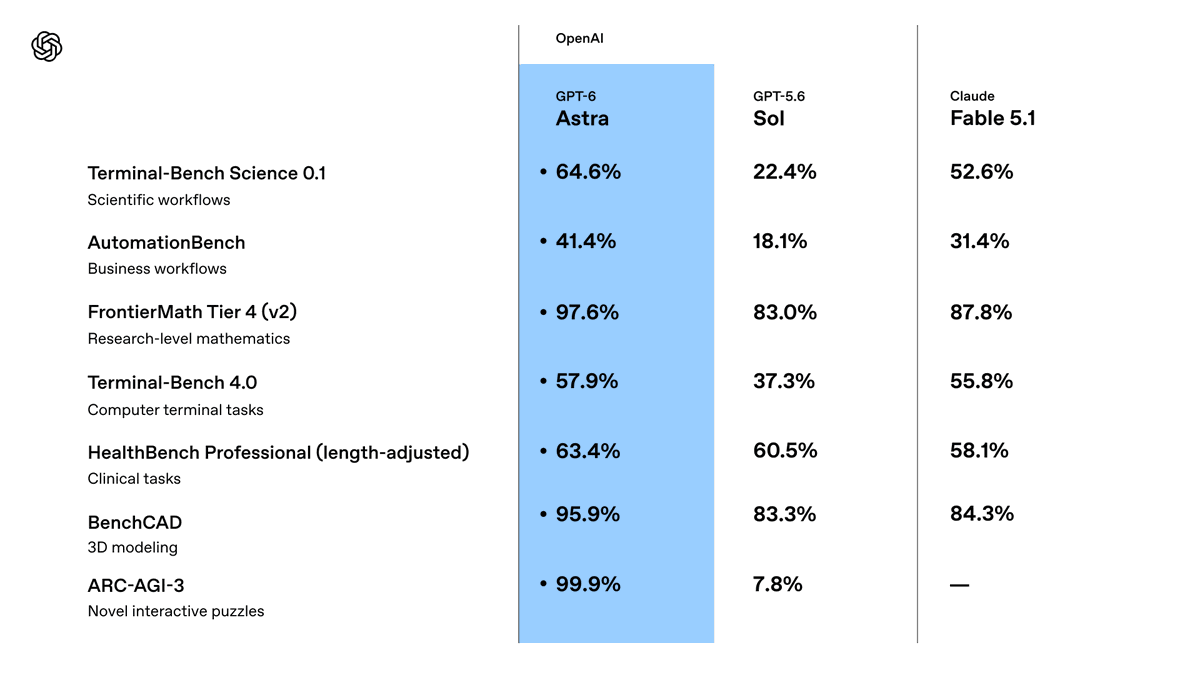
GPT-6 Astra is here.
We hope it will begin to enable a new generation of entrepreneurship, scientific discovery, and building.
We believe it is the best model in the world for computer use, professional work, science, coding, cybersecurity, and more.
It took us some extra time to ensure that we could meet the safety and alignment standards required for this capability level, but we think you’ll find it worth the wait.
It scores 98% on FrontierMath Tier 4, 99.9% on ARC-AGI 3, and 100% on ExploitBench.
Mark Stuart retweeted

Everyone is waking up to the fact that code-review is the bottleneck of 2026
I'm bullish on ramping review agents - but the vibes coming from
- 0github.com
- asi.review
- pierre.co
start to hit closer to home on where we need to go
Mark Stuart retweeted

Trying to visualize that Server-Side Rendering (SSR) isn't just about SEO, it actually makes the site faster. And why PPR is the goat.
Main cost =
🟥 JS load & Hydration
🟡⇆🔵 Region Latency

ALT A diagram comparing four web content rendering methods: Client-Side Rendering (CSR), Dependent Data CSR, Server-Side Rendering (SSR), and Streaming SSR, showing the data flow between the server, APIs, and the client during webpage generation.

ALT A visualization of three web content delivery strategies: CSR with Cached HTML, where the client fetches data from two APIs; CSR with Cached HTML and GraphQL, where the client fetches data from a single GraphQL API; and Partial Pre-Rendering with Streaming SSR, where pre-rendered HTML is streamed to the client and additional data is fetched from two APIs. Each strategy includes an 'Edge' server that serves cached HTML shell to the client.
Mark Stuart retweeted

I love node.js so much, overnight it multiplied my earning power, made me full stack where it counts, introduced to me to life long friends and collaborators, literally took me across the world many many times, and now I’m building a company on top of it. Unbelievable software.
Mark Stuart retweeted

Introducing the fastest way to build a Marko app! @marko/run offers zero configuration, live-reloading, directory-based routing, and great TypeScript support 🚀
Built with❤️and @vite_js.
Beta release today! 👇
github.com/marko-js/run

Mark Stuart retweeted

New post: Building Reliable Distributed Systems in Node
This introduces the concept of durable execution, which is used by @Stripe, @Netflix, @Coinbase, @Snapchat, and many others to solve a wide range of problems in distributed systems.
temporal.io/blog/building-re…
Mark Stuart retweeted

Live editing a react app with plain English featuring
@OpenAI Edit GPT, @nextjs and precedent template from @steventey (speed 1.5x)
Mark Stuart retweeted

The View Transitions API now supports MPAs (Multi-page applications) and it's truly mind-blowing.
This is a server-side rendered @astrodotbuild website where every interaction is a full-page load. There is _zero_ JavaScript on this site ✨


Mark Stuart retweeted

My talk from #ng-conf on WebApps at Scale looks into how we got here and what kind of challenges lie ahead.
docs.google.com/presentation…
