

Mock hypocrisy. Insult petty tyrants.
Midwest & Los Angeles
Joined August 2011
- Tweets221K
- Following5.6K
- Followers3.4K
- Likes171K




Pinned Tweet
Author of *Win Every Argument* shuts off the replies.
xitter.cf/mehdirhasan/status/207…


Mark Ashworth retweeted

"France’s youth unemployment stands around 20 percent, nearly three times the rate in Germany. Yet statutory social costs for employers are higher in France — about 45 percent of gross salary — than anywhere else in Europe, discouraging hiring"
nytimes.com/2026/10/20/opini…

Mark Ashworth retweeted

«J'ai mis 9 ans à construire ce magasin, petit à petit, je dois tout recommencer à zéro.» Sohal Hoque, co-gérant de «75Multimedia» à Paris Boulevard de Magenta, est effondré. Des casseurs ont saccagé et pillé sa boutique. Il estime le coût des travaux à plus de 150.000 euros.
Mark Ashworth retweeted

⚠️"Il faut que tout le monde voie ces images".
Guillaume Guérin, maire de Limoges, nous fait une visite de son Hôtel de Ville sous les décombres.
Je me refuse désormais à nommer ces gens-là d'émeutiers ou de casseurs.
Ce sont des terroristes.
Mark Ashworth retweeted

So this is the fool that has been arrested for this horrific arson: “French police have arrested Hodei Ciarra Docampo, a 34-year-old far-left militant, in connection with the arson attack that destroyed the historic 19th-century Limoges Town Hall during nationwide riots.”


We’ve raised an idiot generation.
Second generation of the Department of “Education.”
xitter.cf/goofywise/status/21125…


Multi-First World
xitter.cf/zingmiester/status/211…


Mark Ashworth retweeted

at no point in history were the irish ever slaves in the 17th or 18th century.
you are fucking delusional.

My Irish ancestors were slaves bought and sold by Jewish people. And you expect me to care about antisemitism?
Readers added context they thought people might want to know
Irish people sent to the Americas were primarily indentured servants under temporary contracts, not chattel slaves. No historical evidence supports claims they were bought and sold by Jewish people; this relies on the debunked Irish slaves myth.
en.wikipedia.org/wiki/Irish_sla…
snopes.com/fact-check/iri…
apnews.com/article/920e1c…
Mark Ashworth retweeted

In 2021, the head of the UN World Food Programme said $6 billion from Elon Musk could solve world hunger.
Elon replied: publish the plan, right here, publicly, and I'll sell Tesla stock on the spot.
The plan came out. And when you read it, it wasn't a plan to solve hunger. It was one year of food for 42 million people. A twelve-month subscription. And the year after? Start over.
A few months later, Elon summed up his view: if you care about the reality of goodness rather than the perception of it, philanthropy is extremely difficult.
"Reality of goodness over perception of goodness."
That line stuck with me for weeks. Does philanthropy actually work?
Gates-style philanthropy is first and foremost institutional capture. Foundations funding NGOs, funding governments, funding programs, producing reports, producing photos. Everyone's happy, and the aid machine keeps itself alive. Sixty years and hundreds of billions later, much of Africa is still dependent on aid. Zambian economist Dambisa Moyo laid it out in Dead Aid: aid breeds dependency, feeds corruption, and short-circuits the only mechanism that has ever lifted a country out of poverty.
So what actually works?
It's been tested. In Kenya, Berkeley researchers working with GiveDirectly randomly selected villages and gave every poor household about $1,000 in cash. No program. No training. No conditions. Just cash.
The result: people bought metal roofs, livestock, started small businesses. Barely any inflation. And every dollar injected generated around $2.50 of economic activity locally, including for neighbors who received nothing.
Why? Because you didn't give them charity. You gave them capital. You primed the pump.
And that's where everything hinges: ownership. Hernando de Soto showed that the world's poor hold trillions of dollars in assets, but without recognized property titles, it's dead capital. You can't borrow against it, pass it on, or grow it. Where property rights are respected, the system starts running. Where they aren't, no amount of aid will ever be enough.
Now reread Elon's post.
"Next year, I will give one of my SpaceX shares to every kid in America. This will be the first of many."
That's not a meal. That's not a handout. That's a property title. A piece of the company building the infrastructure of a multiplanetary civilization, owned directly by millions of kids.
A kid who gets a handout depends on the state. A kid who owns a share of SpaceX owns a piece of the future. He learns what an asset is, he has a stake in the economy working, and one day he'll vote as an owner, not as a client of the state.
Gates buys perception. Musk distributes ownership.
The reality of goodness versus its perception. And it's absolutely brilliant.

Mark Ashworth retweeted

NYC bagel shop forced to remove cartoon mascot after influencer calls it 'blackface' trib.al/beZO71F

Mark Ashworth retweeted

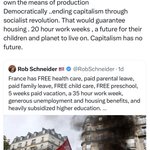
France has FREE health care, paid parental leave, paid family leave, FREE child care, FREE preschool, 5 weeks paid vacation, a 35 hour work week, generous unemployment and housing benefits, and heavily subsidized higher education.
Everything the left says they want AND THEY'RE STILL PROTESTING AND BURNING SHIT DOWN.

Mark Ashworth retweeted

Ma'am, western civilization built this more than a THOUSAND YEARS before the first European colony was ever established in Africa.

Mark Ashworth retweeted
"You reduce crime by eliminating poverty."
This is one of the greatest intellectual confusions of our century. It sounds compassionate. It feels obvious. And the moment you actually test it, it falls apart.
Let's look at the data.
First, the correlation is real. Nobody serious denies that poorer areas have more crime. In Sweden, kids from the poorest 20% of families are about 7 times more likely to be convicted of a violent crime than kids from the richest 20%.
But correlation is not causation. So Swedish researchers did something brilliant: they compared siblings. Same parents, same home, same upbringing, but different family income at different points in their childhood, because parents' income moves over time.
Result, on more than 500,000 children (Sariaslan et al., British Journal of Psychiatry, 2014): once you account for what's shared inside the family, the effect of income on violent crime goes from 7x to nothing. The hazard ratio drops to 0.95. No effect.
Finland ran the same test on 650,000 people. Same result: the income-crime link disappears when you compare siblings.
What predicts crime isn't the bank balance. It's what travels inside families.
Second test: what happens when poverty spikes for everyone at once? 2008. US unemployment doubled from 5% to nearly 10%. 15% of Americans officially poor. If poverty creates crime, crime should have exploded. Instead it fell. Year after year. Robbery, the most "economic" crime of all, dropped 10% in 2010 alone. Criminologists literally said they were stumped. Same story in the Great Depression: 25% unemployment, and crime went down in many cities.
Third test: take families out of poverty and see. The US government ran a randomized lottery called Moving to Opportunity. Thousands of families in public housing got vouchers to move to low-poverty neighborhoods. For boys, violent arrests dropped at first, property crime arrests went up, and over time the effects faded. New zip code. Same behavior.
Fourth: the claim that police don't matter. This one is just false. Chalfin et al. (American Economic Review: Insights, 2022): each additional police officer prevents about 0.1 homicides. And per capita, the lives saved are twice as many among Black victims as among white victims. The people who suffer most from "police don't matter" are the poorest neighborhoods.
So what does predict crime? The Dunedin study followed 1,000 children from birth to age 32. Self-control measured between ages 3 and 11 predicted adult criminal convictions, even after controlling for social class and IQ (Moffitt et al., PNAS, 2011). Cognitive ability matters too: across 700,000 Swedish men, lower cognitive scores at 18 track with violent convictions, and the link barely moves when you control for childhood socioeconomic status (Frisell et al., 2012).
And here's the part nobody quotes: in Dunedin, kids whose self-control improved over time did better than predicted. Behavior can change. Which means responsibility is real.
Why does this matter? Because "poverty creates crime" isn't just wrong. It's toxic.
It turns criminals into victims. The man who robbed you becomes a symptom of "the system," and you, the real victim, become a footnote in someone else's narrative.
It merges two completely different things. "You're poor, we'll help you" is one policy. "You're poor and you committed a crime, so we'll excuse you" is another. Fusing them insults the millions of poor people who work, raise their kids, and never hurt anyone. The vast majority of poor people are not criminals. That alone kills the theory.
It removes responsibility. Build a political system on "your circumstances made you do it" and you destroy the one thing that actually changes behavior: the certainty that you own your choices. Every excuse the state manufactures is an incentive.
And it feeds the state forever. If every crime is a social failure, every crime justifies a new program, a new budget, a new agency. Crime becomes the business model of bureaucracy.
The alternative is simple and old.
A lighter state that protects instead of explains. The same rules for everyone, from the projects or from a gated community. Certain, swift punishment for anyone who commits a crime. And never, ever telling someone their crime was written in their social condition.
Treating someone as responsible is respecting them. Excusing someone because they're poor is the most condescending thing you can do to them.

This quoted post is unavailable.
Mark Ashworth retweeted

Témoignage déchirant d’Audelia Sitbon, pharmacienne à Paris, qui découvre, en larmes, l’état de sa pharmacie complètement détruite. 💔
Rarement je n’avais ressenti une telle haine envers ces salauds de casseurs…
De tout cœur avec elle. ❤️
Mark Ashworth retweeted

A little French miracle. Every single shop on this street is graffitied, damaged or looted. Except the kebab shop. Resilient.


Mark Ashworth retweeted

DOUCE FRANCE… CHER PAYS DE MON ENFANCE… 🇫🇷🥐
broissant.co 🙏🏽


Mark Ashworth retweeted

اكثر الفيديوهات المتداولة لعمليات السرقة والنهب في فرنسا
امرأة عربية تقود دراجة نارية لنقل الغنائم ومساعدة ابنها في السطو على محل
والثانية متحجبه تسرق 3 كراتين من الاحذية
Mark Ashworth retweeted

Voici François-Louis Artois d’Hauteville, 15 ans, un jeune Français issu d’une ancienne lignée normande.
Il manifeste contre le manque de professeurs de philosophie dans son établissement — sa matière de prédilection. L’an dernier, un remplaçant a dû condenser en un seul semestre, à marche forcée, l’ensemble du programme consacré à Hegel et à Kant.
François a été le seul de sa classe à tenir le rythme : il avait déjà lu La Phénoménologie de l’esprit. Ses camarades, eux, peinaient à suivre, découvrant à peine cette œuvre en parallèle de la Critique de la raison pure.
Il a bien tenté de les aider après les cours, mais ces séances empiétaient sur ses engagements bénévoles dans une maison de retraite et sur ses leçons de violoncelle.
Voilà pourquoi, sur cette photo, il consulte sur son téléphone un cours consacré à la lecture des partitions et aux fondements de la musique classique.😇🇫🇷
